
ID

Unique brain injury treatment program returns to UW-Eau Claire
Story Categories
Authored on
Unique brain injury treatment program returns to UW-Eau Claire
Published on:
Intro text
When Reginald Jones of Milwaukee suffered a head injury on board a freight vessel in June 2025, he says he did not really understand the extent of his injuries.
“I walked around concussed for months before a physician explained to me that the block of steel that knocked me down had caused serious issues, including speech and vision problems, and I’ve since been working to heal my brain. That’s why I’m here — to gain tools to handle the lingering effects of a significant concussion.”
Sections

Mindfulness and movement breaks are part of the daily schedule at the Brain In-Com program, and Reginald Jones says the recumbent bikes have been a fun and useful exercise for him to explore lower campus with groups of other attendees.

Dr. Jerry Hoepner, professor of speech, language, and hearing sciences

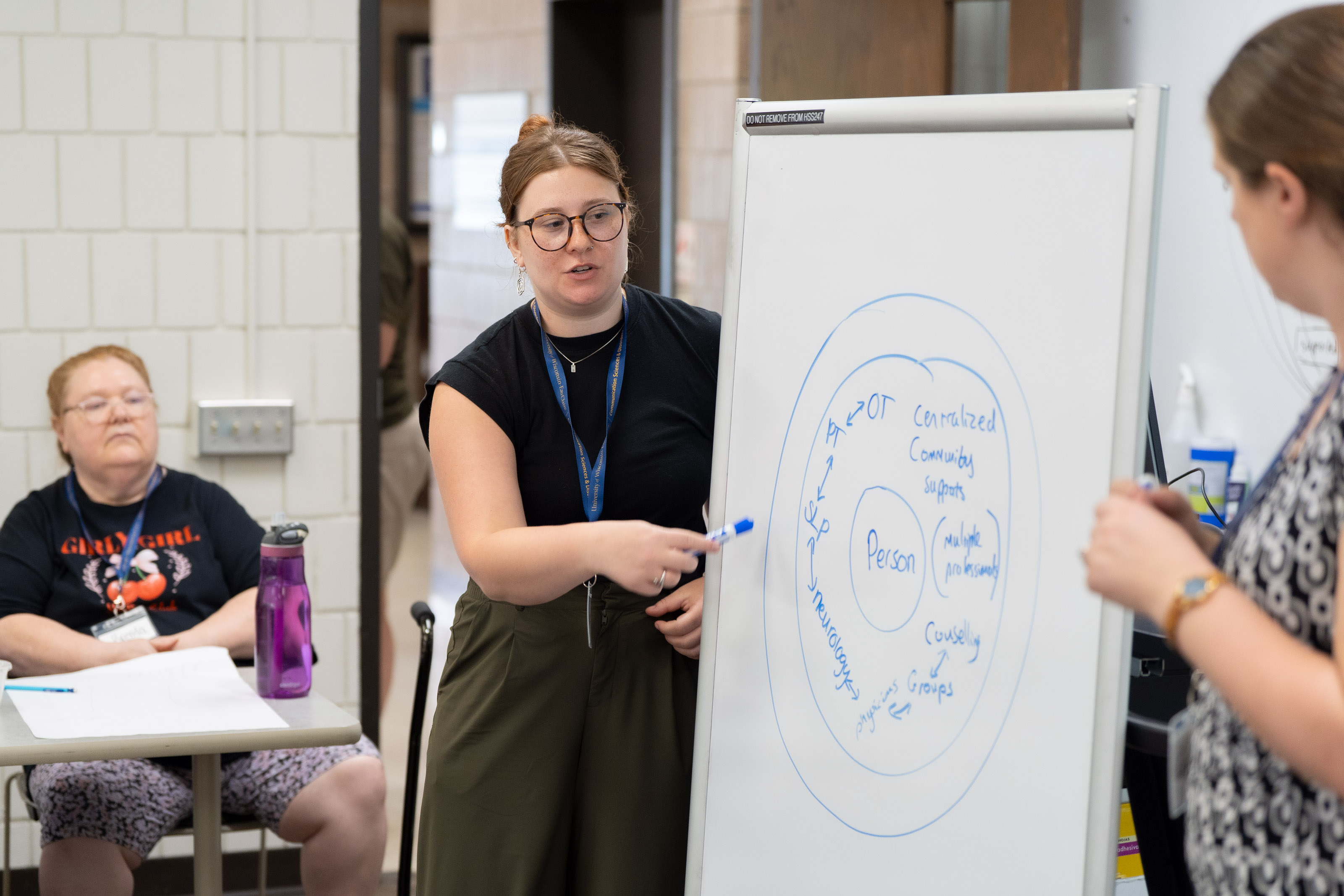
Senior Haylie Schmidt, left, says that while she was a little nervous to work with this demographic for the first time, she has already learned a great deal about helping individuals with brain injury express their stories and build community.

Graduate student Angel Woodford plans to apply her master's degree in a career working with children in the field of communication sciences, but is grateful for the opportunity to strengthen clinical and interpersonal skills that apply throughout speech-language pathology.
For the media
For the media
Image download
You may also like
“The Small and the Mighty: Chippewa Valley” exhibit is on display through Oct. 30 and ties together local and U.S. history through archival research of four area women who attended or taught at UW-Eau Claire.

The ribbon cutting of the new Grace Lau and Charles Tsui Finance Lab took place Oct. 2, officially opening the incredible new resource for students in UW-Eau Claire's College of Business.
The 395 members of the Blugold Marching Band got a big surprise after today’s rehearsal. The band has been invited to march in the 2027 Macy’s Thanksgiving Day Parade in New York City.