ID
Authored on
New donor-supported microscope raises accessibility for UW-Eau Claire science students
Published on:
Intro text

This month marks the 36th anniversary of the Americans with Disabilities Act, and faculty, staff and students at the University of Wisconsin-Eau Claire look forward to honoring this important occasion.

Sections

Katie Bublitz, director of UW-Eau Claire’s Services for Students with Disabilities, says that July 26 is a ”wonderful time to pause to acknowledge the work that has already been done to support Blugolds and campus visitors with disabilities, and to renew our commitment to the ongoing work yet to come.”

“The ADA is a landmark commitment to dignity, access and inclusion for millions of people with disabilities,” Bublitz says. “Since its passage in 1990, the ADA has removed physical and societal barriers, reshaped attitudes, affirming what many believe, that disability is an essential part of human diversity. It’s imperative we pause to honor the advocates, leaders and communities who have carried this movement forward.”

One of the key disability advocates at UW-Eau Claire has long been Dr. Katherine Schneider, senior psychologist emerita in Counseling Services. Blind since birth, Schneider oversaw decades of campus accommodation and adaptations for improved accessibility. She is a published author, a community organizer and a fierce advocate for people with disabilities of all types. Last January, Schneider established a new fund through the UW-Eau Claire Foundation, and the first major accessible equipment purchase was made during the spring semester.

The Katherine Schneider Disability Issues Fund supports initiatives that make UW-Eau Claire a more accessible, inclusive and welcoming campus for all students. It was established to provide resources for campus projects that enhance disability awareness, such as public events, classroom innovations and purchases of assistive technologies.

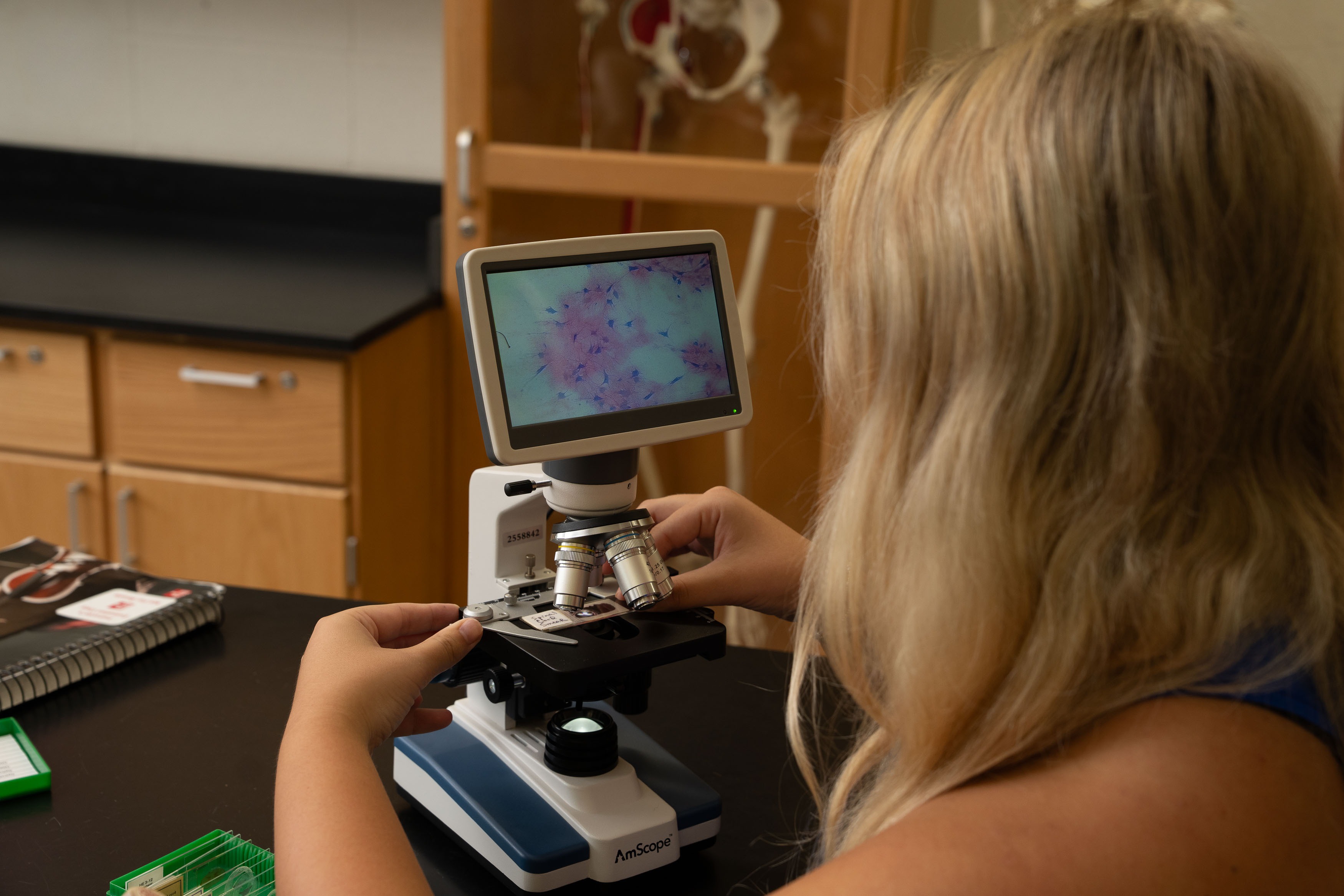
new microscope in use in biology lab
Dr. Denton Kary instructs summer biology research student Dylan Bruhn on the use of the newest lab instrument. Bruhn is a sophomore biochemistry/molecular biology major from Nekoosa who has been conducting summer research with Dr. Derek Gingerich.

Better lab experience, thanks to donor-funded purchase

Thanks to Schneider’s fund and several sponsoring offices, the biology department now boasts a microscope equipped with a digital screen display, replacing the traditional eyepiece for viewing slides.

Dr. Denton Kary, a lecturer in the biology department, applied to the Schneider Fund for the purchase of a digital screen microscope for one of his courses, Biology 214: Human Anatomy and Physiology I Lab. He says he has been surprised by the impact this one instrument has already had, and not only for students with visual or other disabilities.

“Beyond the immediate benefit for students needing visual accommodations, this purchase can have widespread impact,” Kary says. “This instrument can easily be used by students in the subsequent anatomy and physiology course in the series and other courses as well. Another bonus is the photo/video capture capabilities, which offer some exciting possibilities for how to administer unit tests in the lab or record slides for use in future instruction. The screen can also be transferred to a large monitor so the whole class can have the same view during a discussion. It has many advantages for all students.”

One student’s vastly improved lab experience

Kira Schoff is a sophomore nursing major from Ripon who was the first student with visual impairments given the opportunity to use the new microscope in Kary’s class.

“I was born with albinism, which is a rare genetic condition that affects the hair, skin and eyes,” Schoff says. “I have a visual impairment as well as nystagmus, which causes involuntary eye movement. Using the ocular lens of a regular scope is very difficult for me.”

Like Kary, Schoff says the immediate benefit for herself was wonderful, but she recognized quickly that this device can have widespread student and faculty benefits.

Kira Schoff using digital screen microscope
Kira Schoff says the new microscope will make lab work for the remainder of her nursing program much more successful. "It makes a huge difference for me, and many other students will find it helpful for a variety of reasons," Schoff says.

“The use of the microscope with a screen has opened a lot of new opportunities for me, but also for other students with or without visual impairments. The screen allows me to clearly look and zoom in on the image. As I work through my degree in nursing, I hope that this microscope will help me throughout my classes. I’m encouraged by this technology, and I look forward to seeing more ways for similar advancements to grow equal learning options for all students.”

Grateful co-sponsors respond

Bublitz is encouraged by each new technology that offers more opportunities for all students served by her staff in SSD. She says she is thankful for this great new example of accessible adaptations as the ADA anniversary approaches.

“Dr. Schneider’s vision and generosity uphold the ADA’s promise to build a future where every person can fully participate, contribute and thrive,” Bublitz says, while also thanking the Center for Excellence in Teaching and Learning, the Foundation and several emeriti in pulling this project together.

Schneider is thrilled to hear of the early success of students using the microscope and looks forward to funding more such learning tools in the future.

“When I started the fund, I was hoping for just this type of request,” Schneider says. “The purchase benefits a particular student now, but in the future will be available for other students, or for faculty and staff. I hope access to this fund helps people think creatively about how it can help campus be more accessible and welcoming to all.”


For those interested in donating to this or other funds aimed at supporting Blugolds with disabilities, please visit the Foundation giving page for Services for Students with Disabilities.

UW-Eau Claire faculty and staff interested in applying for project funding through the Katherine Schneider Disability Fund can find more details and the application here.

For the media
For the media
Image download