ID
Authored on
UW-Eau Claire project aims to implement psychiatric advance directives across Wisconsin
Published on:
Intro text

University of Wisconsin-Eau Claire nursing students and faculty are working to bring transformational changes to how mental health treatment preferences are communicated in Wisconsin by promoting the adoption of psychiatric advance directives.

Similar to a medical advance directive, a psychiatric advance directive is a legal document that allows a person to communicate mental health treatment preferences before a crisis occurs. PADs have been implemented across approximately half of the U.S., including states bordering Wisconsin, but not yet in the Badger state.

Sections

Dr. Miriam Sward, assistant professor in the graduate nursing program and a dual board-certified adult nurse practitioner and psychiatric mental health nurse practitioner, is leading a project called “Preparing Wisconsin Psychiatric Clinics for Implementation of Psychiatric Advance Directives: Evidence Synthesis and Statewide Readiness Assessment” to examine whether Wisconsin providers understand what PADs are and whether clinical systems are prepared to implement them.

Assisting Sward are UW-Eau Claire undergraduate nursing students Savannah Dworshak and Maddelyn Webster, and third-year UW-Madison medical student Caroline Klessig, who are collaborating to create and distribute a survey to nearly 3,000 providers across the state by later this fall. They intend to learn what psychiatrists, psychiatric mental health nurse practitioners, psychologists and future mental health providers know about PADs, how prepared they are to implement them and what resources may be needed to do so.

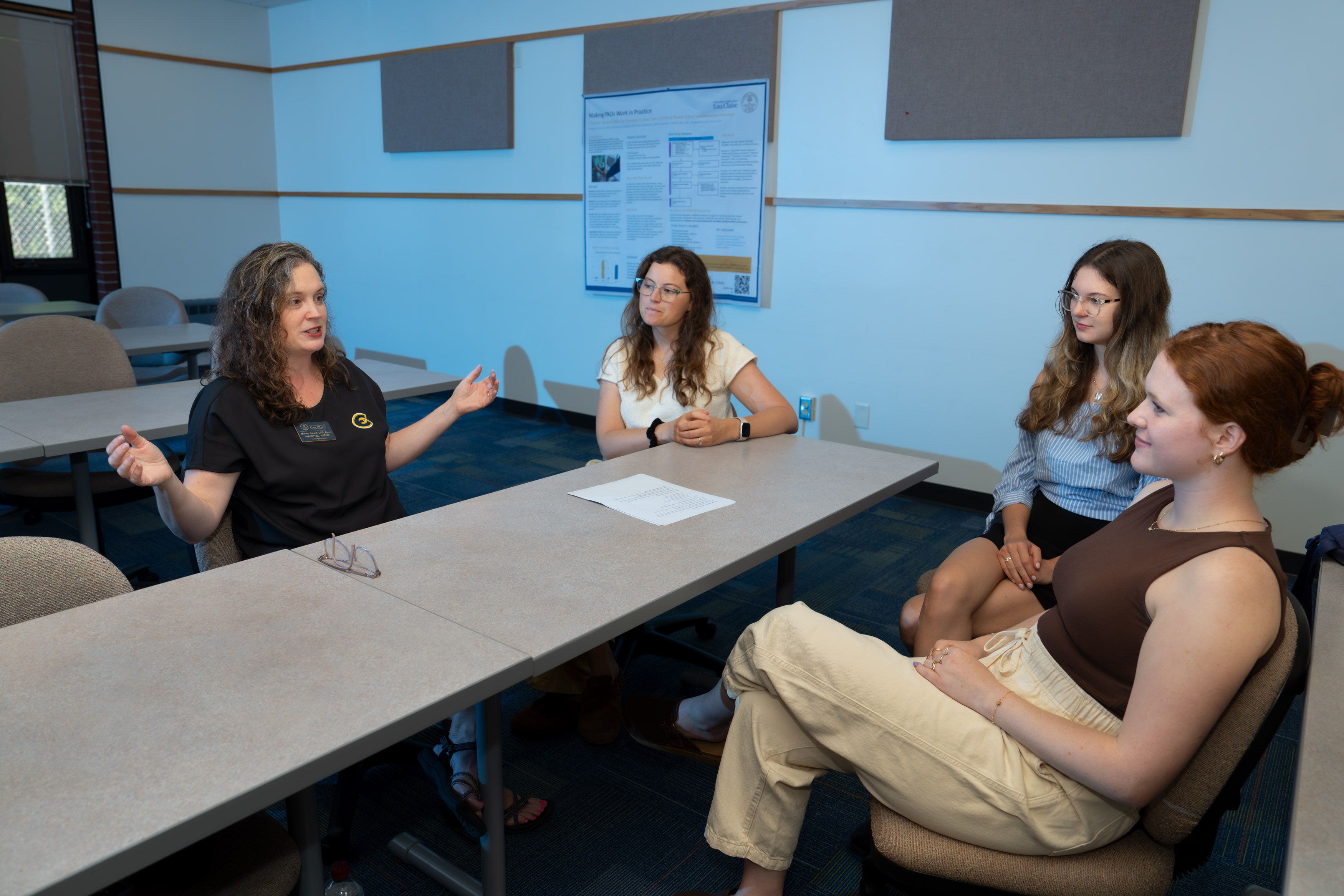
Savannah Dworshak, left, Maddelyn Webster and Emmalyn Pothen discuss psychiatric advance directives research.
Savannah Dworshak, left, Maddelyn Webster and Emmalyn Pothen discuss research about psychiatric advance directives with Dr. Miriam Sward during a meeting in UW-Eau Claire's Nursing Building.
Caroline Klessig UW-Madison medical student
Caroline Klessig, third-year medical student at UW-Madison

The survey will build on a literature review about the success rate of PADs already implemented in 25 states completed by Emmalyn Pothen, who served as a graduate assistant under Sward last year while earning her master of science in nursing degree and will remain involved in the project as a clinical instructor at UW-Eau Claire.

All information collected will ultimately support legislation expected to be introduced in Wisconsin as soon as this fall.

Why PADs are important

Sward has seen firsthand how quickly patients can lose their voice during a mental health crisis, which can result in a traumatic experience. PADs offer a way to bring the individual’s preferences into those decisions.

“This gives them a voice when they cannot speak their own voice,” Sward says. “It may identify treatments they prefer or want to avoid and name someone to make decisions if they temporarily cannot make decisions for themselves.”

Dr. Miriam Sward talks during a psychiatric advance directives project meeting
Dr. Miriam Sward, assistant professor in the graduate nursing program and a dual board-certified adult nurse practitioner and psychiatric mental health nurse practitioner

“In every single one of our classes, our professors preach autonomy, letting the patients make their own decisions,” says Webster, a fourth-year student from Waterloo. “It is an amazing opportunity to research more about how there are things we can proactively do to help patients have the best autonomy in times they maybe cannot make their own decisions or need support making those decisions.”

PADs could also improve care by strengthening communication among families and providers, promoting shared decision-making, potentially reducing conflict and confusion during emergencies and recording treatments that have or have not helped previously.

Legislation alone does not guarantee people will complete or benefit from PADs. Pothen’s review found just 3% of patients completed the document when given little direction compared with 50%-80% when individuals worked with a provider or trained community member.

“Having someone sit down with you, explain what it is and help you walk through the process, that’s the first step,” Pothen says. “We can’t use it if it’s not filled out.”

Recognizing providers may not have time to include PADs in visits with patients, the team wants to utilize a community holistic approach by including nurses, psychiatric nurse practitioners and peer support specialists.

“Eventually, we’re going to have to put more effort into figuring out how to share this work,” Sward says. “Psychiatric advanced directives are something many people know about, but not enough is being done to improve or expand their use. We're hoping to fill that gap, and we hope the need for this work goes beyond Eau Claire and beyond Wisconsin.”

Providing answers and tools for success

The 10-question survey poses multiple choice questions and is intended to be completed in five to 10 minutes. It is currently being approved by an Institutional Review Board and then will be distributed to Wisconsin providers through social media channels and direct interactions at conferences.

The team is hoping for at least a 10% response rate to showcase data trends, which paired with the literature review will identify what Wisconsin clinics need to implement PADs effectively. The group would like to deploy an implementation tool kit which encompasses provider education, patient information, conversation guidance, workflow design and implementation strategies. Once that workflow is developed and published, Sward believes it will save clinics valuable time and effort.

Dworshak has performed psychology research previously for classwork, but says this project feels more impactful.

“It’s real world. There’s a real end goal,” says the fourth-year student from North St. Paul, Minnesota. “When the legislation passes, I’ll be able to say I helped.”

Both Dworshak and Webster are recipients of the 2026-27 James R. Larson and Vicki Lord Larson College of Health and Human Sciences Fellowship, a student research scholarship through UW-Eau Claire’s Office of Research and Sponsored Programs that provides the opportunity to perform research during the summer and fall terms.

While they await approval of their survey, the nursing majors are in the early stages of another literature review analyzing potential cost savings in states that currently use PADs as another way to support a future bill in Wisconsin.

Working together to create change

The team meets virtually one-to-two times per month and is in constant contact through email. Sward assigns small tasks to complete, and Klessig, an aspiring psychiatrist who did not know of PADs prior to the project, says that approach makes everyone feel they can create change.

“She is an exceptional leader. She helps us get to the root of things and approach them in a way that inspires a lot of self-efficacies,” Klessig says. “UW-Madison talks about the Wisconsin idea. We have all this knowledge in these academic centers, and the most important thing is actually redistributing and allowing people in the community to access that. It seems UW-Eau Claire shares a similar philosophy, and I think that's ultimately the best thing for the people in the state.”

For the media
For the media
Image download