ID
Authored on
From a swab to a save: Cadence Cordova’s blood stem cell journey
Published on:
Intro text

As students sat in classroom chairs to start the new semester at the University of Wisconsin-Eau Claire, Cadence Cordova sat in a donation chair.

The nationally recognized Goldwater Scholar and All-American gymnast chose to carve out time from her busy schedule to fly to Kansas City, Missouri, and donate peripheral blood stem cells for a cancer patient on Sept. 1.

Sections

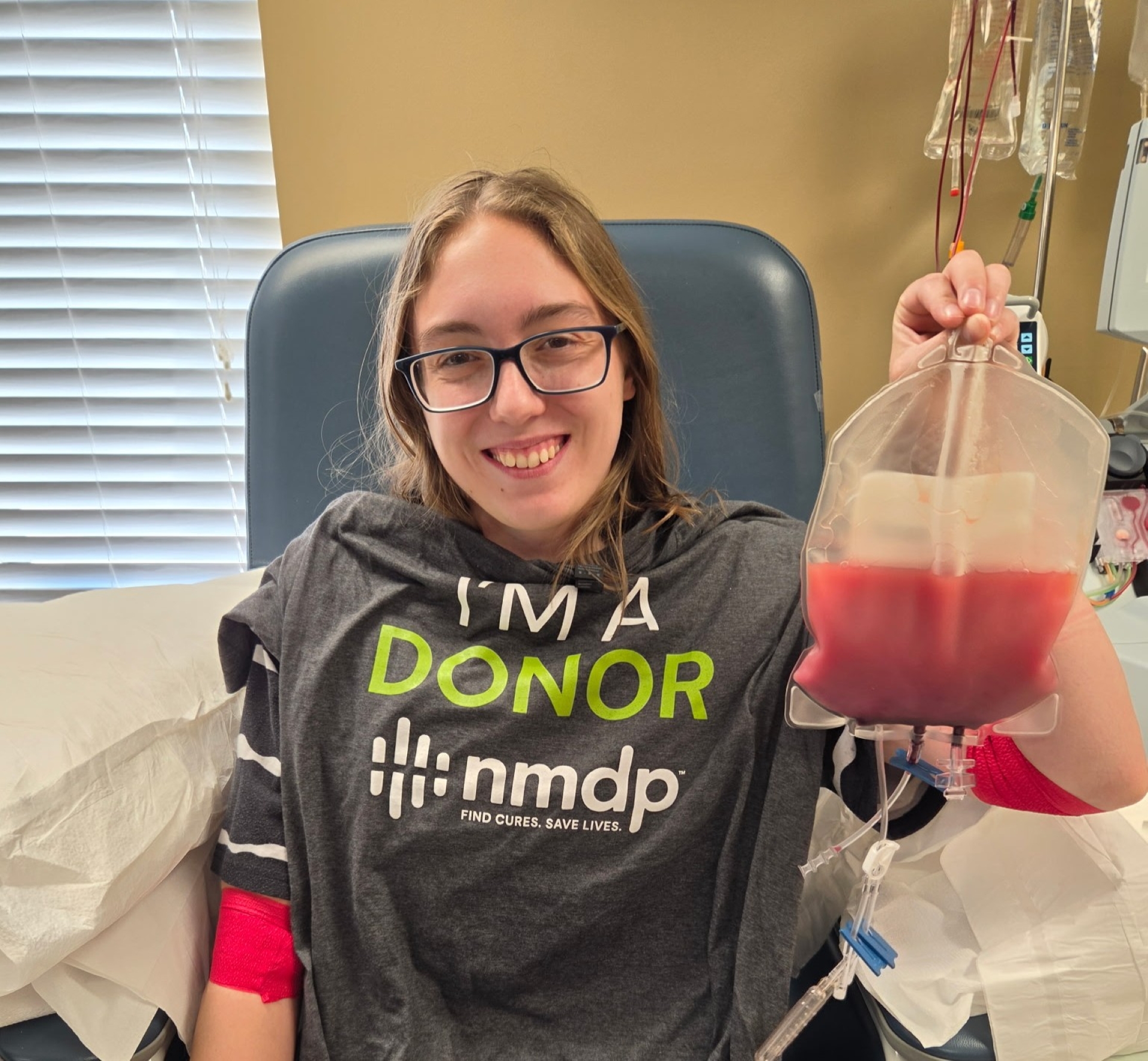
For six hours, Cordova lay covered in warm blankets as she watched blood flow from one arm to the other, passing through a machine that separated stem cells in a process called apheresis. It produced a tingling sensation and pride.

“It was just exciting to be able to help someone else, save someone’s life,” says Cordova, a senior biochemistry/molecular biology major.

Cordova never donated blood or plasma, but she registered with NMDP (formerly known as the National Marrow Donor Program and Be The Match) after volunteering at a drive in May run by the UW-Eau Claire Student Athlete Advisory Committee. A quick cheek swab to determine available proteins, called human leukocyte antigens, and some introductory information was all she needed to sign up.

UW-Eau Claire gymnastics team poses while helping register NMDP donors during a drive in Centennial Hall.
Cadence Cordova, left, joined her UW-Eau Claire gymnastics teammates in May to run a swab drive for students to join the NMDP. (Photo credit: UW-Eau Claire gymnastics)

Most donors wait years before learning they are a match with a patient, but Cadence received the life-changing news in less than two months.

“That was definitely crazy to get that call so soon after my information was put into the registry,” she says.

The call was even more unexpected for her family, who was visiting from Boise, Idaho, for a summer vacation.

A series of health screenings and blood work followed. In the days before the donation, Cordova received injections to increase the number of blood-forming cells in her bloodstream.

Cordova flew to Kansas City, where she was met by her mother, Audrey Cordova, who served as a donation companion. The two bonded over barbeque and hung out in the blood bank as the donation hours passed. Cadence Cordova, an aspiring physician, asked questions about the process and the staff showed her pictures as a plastic bag filled with her blood stem cells.

“They kept commenting on how well her stem cells were coming out. I Just looked over at her and said, ‘she’s always been an overachiever,’” Audrey Cordova says. “Parents are supposed to be the ones that set the example for their kids, but I just kept being in awe watching her essentially save someone’s life.”

The experience was a full-circle moment for Cadence and Audrey, who is married to Cadence’s biological mother, Jessica. Jessica was the recipient of a liver transplant from a stranger two years ago.

“It was really meaningful to have someone be a donor,” Cadence says. “Obviously, giving an organ is a much bigger thing than stem cells. Still, being able to help someone in the way they helped our family was really, really cool.”

According to the NMDP, someone in the U.S. is diagnosed with a blood cancer every 3-4 minutes. A transplant can cure or treat 75-plus diseases, including leukemia and other blood disorders.

While privacy laws limit recipient patient information, Cadence says she will have the opportunity next year to contact the person she helped. There’s a chance Cadence can donate more blood stem cells if the patient requires them. About a year from now, Cadence expects to be eligible to help other patients.

And even as she dedicated three days to helping a stranger, Cadence made sure she didn’t fall behind at UW-Eau Claire. She attended the gymnastic team’s first meeting virtually while donating, then met with professors during office hours upon returning to campus.

On Sept. 8, one week after donating, Cadence was cleared to work out again and woke up early to visit the gym. She followed that with a busy day of classes and biochemistry protein research.

Though she felt a little pain, Cadence knows the payoff of her donation was far greater.

“It wasn’t that much for me to do as a person,” she says. “Being able to save someone’s life and impact them like that is definitely super rewarding.”

For the media
For the media
Image download