ID
Authored on
Come for gymnastics, stay for career-building research: Goldwater Scholar Cadence Cordova
Published on:
Intro text

When the head coach for gymnastics at the University of Wisconsin-Eau Claire, Jessie Deziel, reached out to Boise, Idaho, high schooler Cadence Cordova, the two talked about what Cordova might expect if she joined the Blugold team. Cordova also admitted that she had never heard of the regional university.

“I was like, OK ... I’ll look into it,” says Cordova, who quickly discovered that the little school on the river had a whole lot more to offer her than a continued gymnastics career in a good program.

Sections
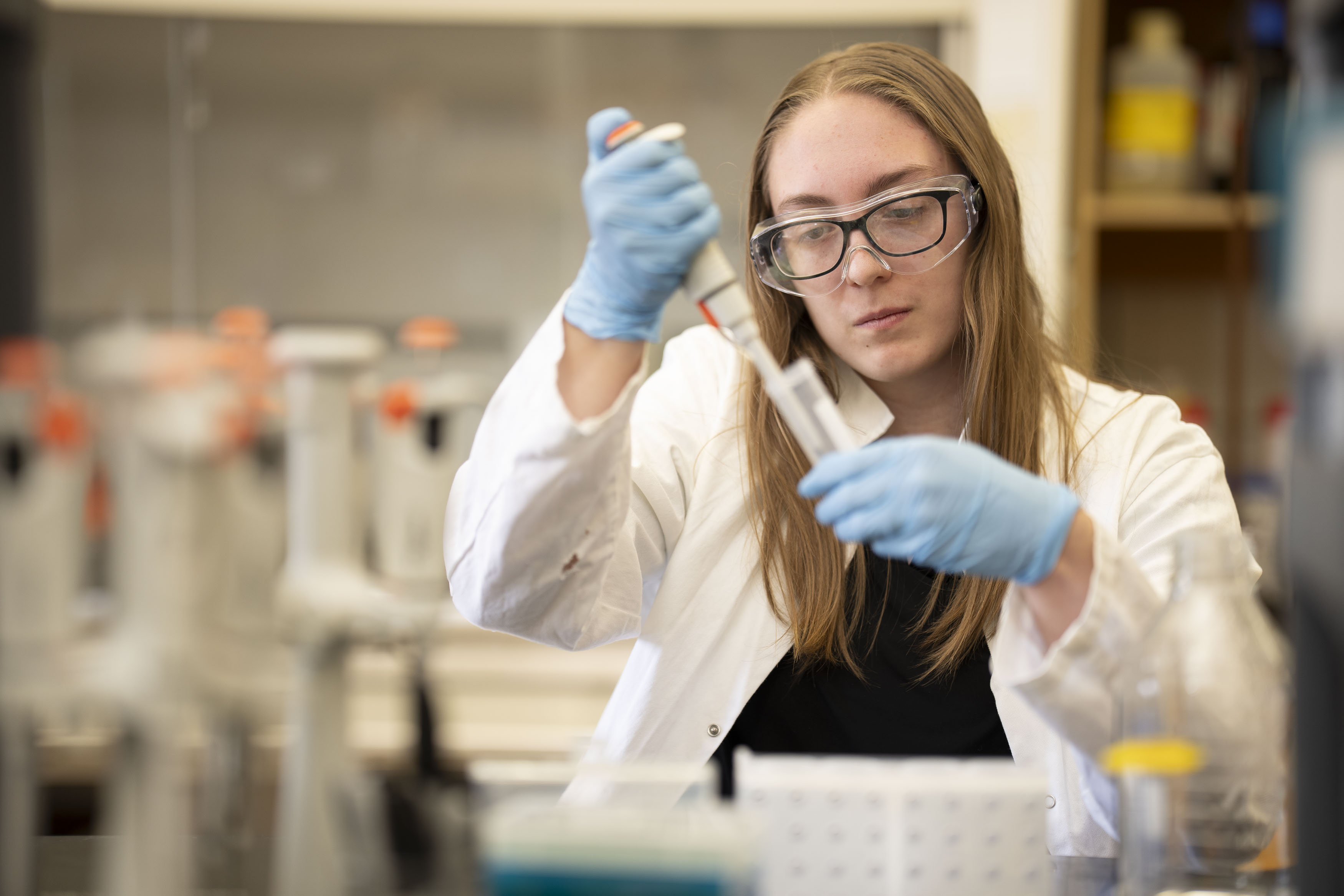
Cadence Cordova lab portrait
Cadence Cordova chose the biochemistry/molecular biology major because it best aligned with her strongest interests in science. "I'm fascinated by the way the chemistry of the human body interacts on a really small-scale level and how that produces large-scale changes. I needed to learn more about that."

“I was immediately interested in the collaborations with Mayo Clinic and the opportunities to work with faculty on research as a first-year student. All the things I was reading were the kinds of experiences I knew could get me where I want to go with my life,” says Cordova, an aspiring physician.

Fast forward three years, and the junior biochemistry/molecular biology major was encouraged by her research mentors to apply for one of the most competitive science scholarships in the U.S., the Barry M. Goldwater Scholarship.

Cordova, who is a dedicated student-athlete with a packed schedule, was skeptical that she could have the amount of research experience needed to win a Goldwater. But she “went for it,” she says, and was so pleasantly surprised to have been selected.

“Because our faculty know us so well and are willing to personally help us in a big application process like the Goldwater, it’s so much more possible at UW-Eau Claire to be recognized for your work,” Cordova says. “This community made it possible for me.”

Two science standouts from UW-Eau Claire

Cordova is one of two Blugolds who received the prestigious Goldwater award this year. The other recipient is junior Jadyn Hartwig, also a biochemistry/molecular biology major.

The national scholarship is awarded to second-and third-year students majoring in STEM fields, and the two Blugolds are among only five students in the state and the Universities of Wisconsin to earn the $7,500 award for the 2026-27 academic year.

The comprehensive major of these two bright scholars has two home departments, chemistry and biochemistry, chaired by Dr. Jennifer Dahl, and biology, chaired by Dr. Derek Gingerich.

“The Goldwater selection of two students in our biochemistry/molecular biology comprehensive major speaks to the strength of the major and to the efforts of the faculty in both departments. It’s great news for Cadence and Jadyn and for our departments,” Gingerich says.

Dahl congratulates these scholars and emphasizes the academic support in place at UW-Eau Claire that can foster this level of national recognition.

“Cadence and Jadyn are outstanding students who exemplify the traits of future leaders in science,” Dahl says. “What sets Cadence and Jadyn apart is their ability to balance the demands of challenging courses, laboratory research, student club activities and athletic pursuits. We hope that more students learn that UWEC is a place where you really can have it all, thanks to the faculty who set the stage for this level of success.”

Cordvoa on bars
Cadence Cordova has competed in gymnastics since she was 8. She holds the current Blugold individual record in vault, with a score of 9.75, and is tied for the current team record in bars, with a score of 9.8. Cordova was named an All-American this season after placing seventh at nationals.

A future rooted in the chemistry of the human body

One of the main research projects Cordova has contributed to is in the biochemistry lab of Dr. Tyler Doyon, assistant professor of chemistry and biochemistry.

“Basically, what we're doing is we're using enzymes, so biological entities that catalyze reactions,” Cordova explains. “We take these proteins that help speed up the rate of reaction and we're trying to break down molecules that are harmful to the environment. We use those biological entities to cause those proteins to make useful things that we can then synthesize new products from.”

As Doyon shared in his letter of support to the Goldwater committee, Cordova exhibited an extraordinary aptitude for kinetic studies, quickly mastering new lab techniques and data analysis that moved the project forward rapidly.

“Within three weeks of joining the group, Cadence had generated publication-quality data for several different substrates and was making great progress on the project,” Doyon says.

What was most impressive about her efforts, Doyon says, was that Cordova had never taken a class in biochemistry, nor operated an analytical pipette prior to this work in his lab.

“She rapidly learned these techniques and applied them with great precision to generate high-quality kinetic data,” Doyon says.

Collecting diverse pre-medicine experiences at UW-Eau Claire

In addition to the research in Doyon’s lab, Cordova has taken advantage of many high-impact practices that she believes will both deepen her understanding of the medical field and science behind it, and will enhance her eventual applications for an M.D./Ph.D. program. These out-of-the-classroom experiences have included:

  • Mayo Clinic Health System-Eau Claire’s Medical Experience (MedEx) program, shadowing clinicians in six different specialties in the hospital, each for a half-day.
  • A six-week internship in Costa Rica, gaining rich experience of the system and practice of medicine in another country.
  • Volunteering as a patient transporter at Mayo Clinic and Marshfield Clinic Community Connections Team, a role that gives a balanced look at many aspects of healthcare logistics.

Cordova says she cannot imagine giving up research, so the M.D./Ph.D. route will best accommodate her strengths and interests.

“My plan is to become a physician-scientist working in academia, with an emphasis on the role of chemistry in medicine,” she says. “I want to conduct research, practice medicine and mentor future physician-scientists.”

Cordova says she has a strong interest in neurology and brain science at the biochemical level. She is especially intrigued by Alzheimer’s research and the intersection of the symptoms and biochemistry at work.

“I am passionate about a career treating the root cause of disease at a molecular level and seeing how these biochemical changes correlate with patient symptoms,” Cordova says.

For the media
For the media
Image download