ID
Authored on
The slow inch of progress: Lauren Jordahl’s fight for sustainability
Published on:
Intro text
Sections

Growing up, Lauren Jordahl learned her love of nature from her family.

“My family always was very respectful of the environment,” she says. “Spending time in nature, going to national parks. It's always been something I'm passionate about.”

From middle school to the present, Jordahl has turned that love active: fighting for increased composting efforts in her hometown of Eagan, Minnesota, and advocating against single-use plastics on the University of Wisconsin-Eau Claire campus.

“I remember learning about the science behind the climate crisis around the time I was in middle school and being so infuriated,” she recalls. “I thought, ‘Why isn’t everyone trying to do something to stop this?’"

As Jordahl prepares to graduate in December with a degree in political science and certificates in sustainability and climate action and earth resources, she remains determined to fight for a planet that, she points out, needs advocates now more than ever.

Persevering toward progress

Jordahl’s love for the natural world first led her to declare an environmental public health major at UW-Eau Claire. By her sophomore year, however, she discovered that her passions lie in the policy-based sectors of sustainability.

“Seeing the impact benchmark regulation such as the Clean Air Act had on environmental efforts, I decided I wanted to approach my learning and future career from a policy perspective,” Jordahl explains. “Changing my major to political science was the natural path forward."

Jumpstarting her experience in the policy world, Jordahl interned in the Administrative Office of Sustainability on UW-Eau Claire’s campus. In close connection with Lily Strehlow, sustainability coordinator, Jordahl aided the work of the university’s Sustainability Tracking, Assessment & Rating System reporting.

Seeing the inner workings of the administrative side of sustainability solidified her passion for environmental policy and catapulted her into the student-led side of AOS, the Student Office of Sustainability 

“Working for the AOS right away helped me learn what everyone was doing and that there's so much more to it,” Jordahl says. “Once I was involved in that way, I was really committed to it.”

That commitment meant taking on the role of student director of SOS in the spring of her junior year. Through meetings, conferences, initiatives and collaboration with AOS, Jordahl has worked tirelessly to improve sustainability efforts at UW-Eau Claire, sometimes one utensil at a time.

Lauren Jordahl canoeing on a student sustainability retreat
Jordahl and her fellow Student Office of Sustainability members canoe during a retreat.

The reduction of single-use plastics on campus has been a primary focus of Jordahl’s, a longtime advocacy that began with her involvement with AOS. In partnership with the Post-Landfill Action Network and their plastic campaigns coordinator, Savannah Robledo, Jordahl has begun collecting signatures in support of a campuswide Break Free from Plastic pledge.

She describes this effort as a very “long-term process,” full of logistical details, pushback and compromise, each an unavoidable part of sustainable solutions that work for everyone.

“Learning how to adapt and take on those challenges has been a really important lesson for me,” she says. “Even when something is not my original plan, I try to see how I can make an impact in a different way with what I’ve been given.”

Making sustainable connections

You might say Jordahl is skilled in making the most of what she’s given, but making change is never a sole endeavor.

During her first semester, as a student in the Mark Stephen Cosby Honors College, she enrolled in a Women of the Civil Rights Movement course, taught by the recently retired director of the Center for EDI Training, Development and Education, Jodi Thesing-Ritter. Then-coordinator of UW-Eau Claire’s Civil Rights Pilgrimage immersion program, Thesing-Ritter encouraged Jordahl to join that semester’s pilgrimage group. It became more than a “really valuable” experience for Jordahl — it was how she explored both the tragedies of injustice and the power of incremental progress.

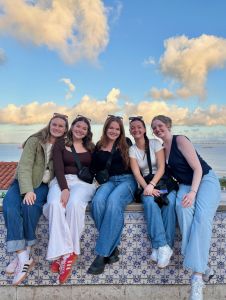
Jordahl poses with other members of the Civil Rights Pilgrimage
Jordahl and her peers with JoAnne Bland, a prominent activist of the Civil Rights Movement, in Selma, Alabama, on the 2024 Civil Rights Pilgrimage.
"I think that's important for everyone, regardless of their major, to understand how institutional systems of oppression work,” she asserts. “And being a part of honors has helped me understand the world better.”

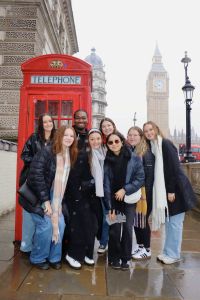
Eager to use that understanding, Jordahl spent a semester abroad in Winchester, England, where she made international friends and traveled to 13 different countries. Her coursework in the honors college, she notes, was central to that journey.

“It helps you talk to a wide variety of people and be comfortable talking about topics that you're not super educated on or that are more difficult to talk about in a classroom setting. It's just brought a lot of diversity to what I've been able to learn in college.”

That training in open discussion and collaboration proved useful across the pond, where Jordahl applied her perspective-taking to international contexts.

“In England, I took an American politics class from (a British) perspective,” she says with a laugh. “It was really interesting to learn about.”

Returning to environmental roots

The past summer, Jordahl’s global orientation returned to the Midwest through an internship with the Public Service Commission of Wisconsin’s Office of Energy Innovation. As the only government intern in that office, Jordahl worked on a wide array of tasks, among them tracking communities that lacked access to energy efficiency rebate programs.

“I got to research and do some geographic information system work, mapping where there's disadvantaged communities and why the programs aren't reaching certain areas of the state. We also looked at grant programs to subsidize people getting reusable power, solar panels and geothermal in their homes.”

But Jordahl is no stranger to government work. She’s worked closely with the Eau Claire City Council, especially council president Jeremy Gragert, who she says helped start SOS at UW-Eau Claire. But going from a university-level plastics effort to state-level energy policy showed Jordahl just how important — and how complicated — scaling sustainability policy is.

“I helped with payment reviews for statewide energy efficiency programs, and I also got to do some policy drafting. I eventually want to be a policy analyst or write policy, and OEI does that a lot in their office, recommending to the governor or to the legislature some changes that they want to see, so that was really cool.”

Jordahl with the Citizen Action of Wisconsin group
Jordahl worked with the Citizen Action of Wisconsin group in 2025 to help push forward environmental policy.

With new professional legislative experience to reinforce old childhood dreams, Jordahl is now applying to graduate programs, hoping to pursue master’s work in environmental policy or environmental management.

“Coming into college I thought I was going to be different; I would have to focus entirely on school,” she says. “But no, you can still be involved in making an impact too.”

Juggling the idealism of environmental protection with the reality of governance and bureaucracy is a balancing act Jordahl knows all too well — but it has only reinforced her tenacity for sustainability, protecting the environment and pursuing the slow inch of progress.

“There's a lot more that I have to learn. There's also a lot of improvements we can make now. That's exciting to me.”


Written by Cami Hoth, a third-year senior studying business communication and marketing at UW-Eau Claire. She is from Stewartville, Minnesota.

For the media
For the media
Image download