Sustainability and Climate Action
Gain skills and understanding of the escalating climate crisis that will enable you to contribute solutions for a more sustainable world.
Help Make a Tangible Difference
Curriculum within the certificate promotes an understanding of how technological advances and changes to policy and behavior can mitigate climate change as well as improve the adaptability of human and natural systems.
With the freedom to select courses you are most interested in, this certificate is designed to complement nearly any field of study. Apply what you learn to a wide variety of future academic pursuits or career paths — all while helping to save our world.
Program Details

The impacts of climate change are ever-increasing and far-reaching. Through foundational courses in climate science, policies and systems, you will gain the knowledge to amplify current solutions — and contribute new ideas — to address the pressing issue of climate change.

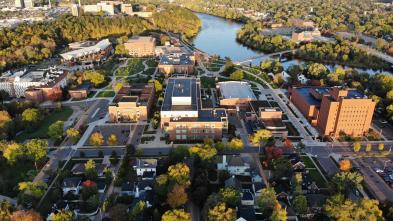
UWEC has a Student Sustainability Resource Center, which is a space for all student activity, outreach and research related to sustainability. Here, you can be a part of a campus community that shares your value of conservation and passion for making the world a better place.

With courses from a variety of disciplines, including biology, chemistry, geography, and physics, the sustainability and climate action certificate is far from one-dimensional. You'll gain an in-depth, interdisciplinary understanding of climate change as well as how it can be sustainably and effectively addressed.
Blugold Stories


JustThe Facts
Curriculum within this certificate will give you the tools to explain climate change from a scientific viewpoint while excluding false narratives. Coursework will focus on four core areas: climate science fundamentals; climate policies and systems; scientific and technological solutions; and societal transitions. You will also identify and interpret connections between social and climate systems, including how policy decisions impact climate change and how climate change threatens social systems.
Here are a few courses in Sustainability and Climate Action at UW-Eau Claire.
ENV 101
Foundations of Sustainability
Around the world, sustainability has become an organizing principle for organizational change. This course applies different definitions of and frameworks for sustainability as it examines fundamental planetary limits and how to achieve sustainability within them. Labs integrate key course concepts with personal experience to build skills for application to students' personal and professional lives
ENV 310
Sustainable Cities
Using Portland, Oregon, as a case study, the course will explore sustainable cities from the perspective of health, the environment, and social cohesion.
ENV 330
Resources & Society: Energy, Food, and Waste
An interdisciplinary overview of the systems involved in the production, consumption, and disposal of key resources, with an exploration of more efficient and sustainable alternatives. Specific topics include: energy production and use, the food supply chain, resource extraction, and the waste stream.
Get More Info
Sign up to receive additional information about our campus.
Meet the Faculty




What's Next?