ID
Story Categories
Authored on
Faculty, fellow artists inspire Blugold to bring story of immigration to life in oil paintings at Pablo Center
Published on:
Intro text

There was a time when Gabriela Fuentes-Matamoros did not think she would ever become a Ronald E. McNair Scholar. And there was a time the studio art major would never have imagined her artwork would be part of a public exhibit at Pablo Center at the Confluence in Eau Claire.

But much like the subjects depicted in her artwork, Fuentes-Matamoros is inspired to overcome obstacles, and she is busy charting a path to success.

Sections

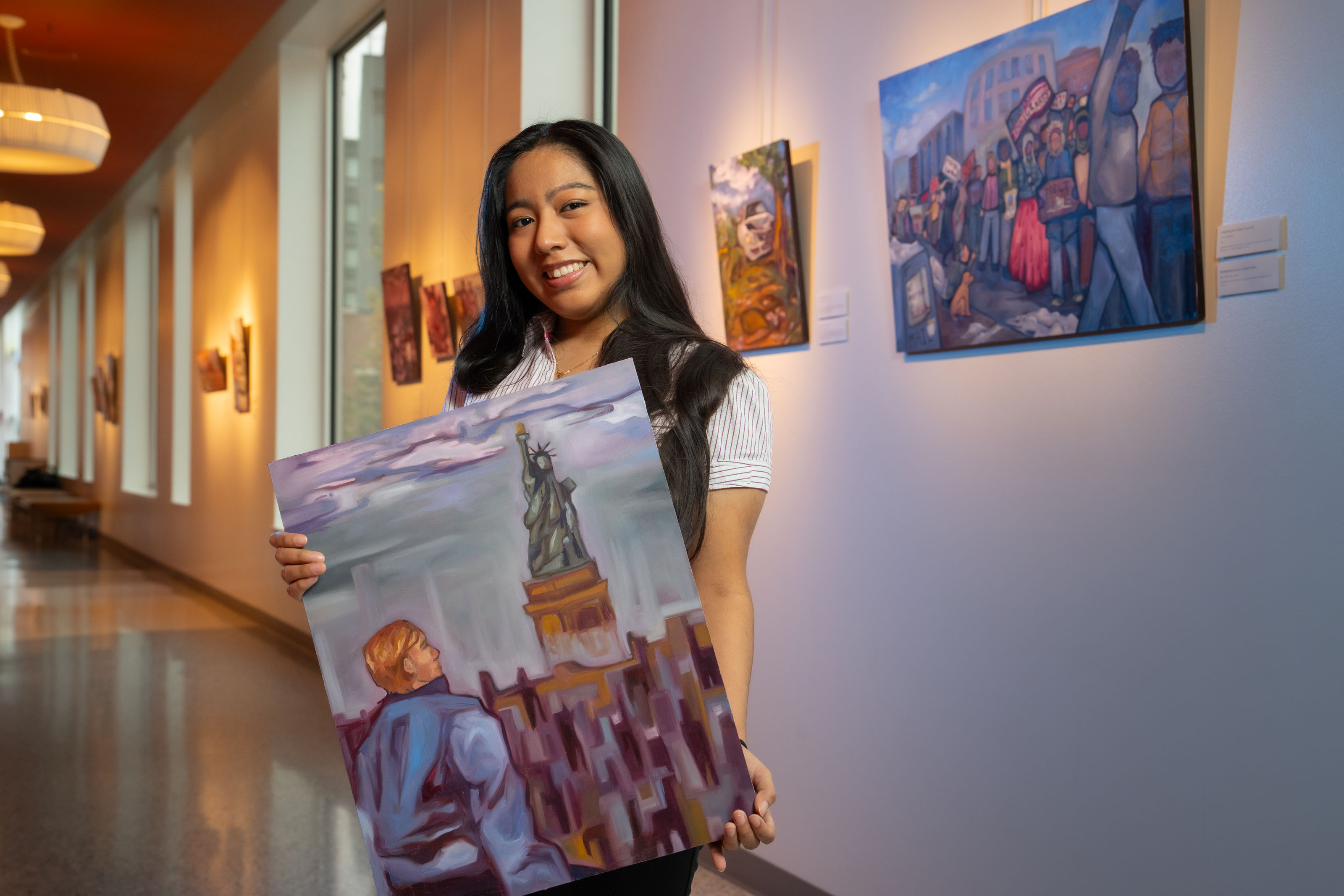
Fuentes-Matamoros’ vision and talent are currently on display at Pablo Center in “The History of Crimmigration in the USA.” The University of Wisconsin-Eau Claire junior and Ronald E. McNair Scholar’s solo exhibit takes its viewers on a walk through time, chronologically displaying immigrant history in the U.S. in a series of 14 oil paintings.

Starting with the Chinese Exclusion Act of 1882, the series also displays scenes including immigrant arrival to Ellis Island, Operation Wet Back, privatization of prisons and discrimination against immigrants after 9/11. It ends with a call to action with the piece “Protesting for a Better Tomorrow.”

Fuentes-Matamoros’ work is original, but two artists, Jacob Lawrence and Judy Baca, inspired her stylistically in the series. Lawrence was known for using his style of dynamic cubism to depict African American history, while Baca is most well known for her large-scale mural “The Great Wall of Los Angeles.”

“Before painting this series, I would have said that my painting style was much closer to realism,” Fuentes-Matamoros says, “but because I was inspired by (Lawrence), I abstracted the work a little bit in this series.”

Lawrence also inspired Fuentes-Matamoros’ decision to exclude specified features on most of the faces in the series. She hopes that with this abstract choice, “people can see themselves within the paintings and within the people who have been painted.”

Fuentes-Matamoros’ painting “Chinese Exclusion Act of 1882: The Criminalization of Immigrants Based on Race” illustrates the Chinese Exclusion Act of 1882, which marked the beginning of legal restrictions against Asian immigration into the U.S.

Fuentes-Matamoros’ passion for art has been lifelong. Growing up in Janesville, her love for oil painting grew significantly in her advanced high school art classes. That love expanded into her classes when she arrived at UW-Eau Claire.

“I love that UW-Eau Claire really prioritizes student-faculty collaborative opportunities,” Fuentes-Matamoros says while reminiscing about her decision to become a Blugold.

Learning about and making connections with faculty and fellow students has played a large role in her initial involvement with the McNair Scholars Program, a federally funded program that prepares eligible undergraduate students for doctoral study through involvement in research and scholarly activities. Fuentes-Matamoros recalls being unsure if she was eligible for the program as a student in the arts.

“On the website it really seemed to be geared toward STEM students, so I had kind of just thrown it in the back of my mind like, ‘I wish I could have done that.’”

After a faculty member encouraged her to take a chance, Fuentes-Matamoros met a former McNair Scholar and eventually applied.

“I’m really thankful to all of them for leading me that way,” Fuentes-Matamoros says of the support and encouragement she received from fellow Blugolds.

In her first year at UW-Eau Claire, Fuentes-Matamoros had a class with Dr. Elena Casey, associate professor of Spanish. That experience led Fuentes-Matamoros to choose Casey as her project mentor for the McNair program.

“When it came to deciding who my mentor would be, I already had a great relationship with her,” Fuentes-Matamoros says. “The project is a very interdisciplinary project so I needed as much help as I could get, and I was the most comfortable with her. I think that’s what was really important to me.”

UW-Eau Claire’s art & design department gave Fuentes-Matamoros funding for some of the supplies she needed. With the support from faculty and staff and her love for the characteristics of the medium, Fuentes-Matamoros knew that using oil paint for the exhibit was a no-brainer.

“I thought, I have money, I have funding, let me use it in the right way,” Fuentes-Matamoros says of the support she received.

Fuentes-Matamoros’ painting “1983 and 1984 Marks the Privatization of Prison: Using Detention for Profit” relates to the reality that most immigrant detention centers today are owned by private prison operations that profit from the people who are detained.

Fuentes-Matamoros says her decision to profile the history of immigration was very intentional.

“I hold the immigrant community very close to my heart, so this whole series I have been trying my best to learn their history in hopes to teach this history back to them,” Fuentes-Matamoros says. “I keep thinking of being inspired by the immigrant community and painting for them.”

This thoughtful approach influenced her decision to include Spanish and Hmong translations beside every piece, to deepen the relevance of her work and encourage accessibility for all members of the Eau Claire community.

The complete series is not on full display yet. Fuentes-Matamoros plans to unveil an ofrenda at her artist reception, set for 5-7 p.m. Nov. 13 in the Manz Green Room of Pablo Center.

The ofrenda, Spanish for “offering,” is an altar created to honor deceased loved ones. It will include other mediums of her art, specifically highlighting some of her ceramic pieces. The ofrenda will bring in a more personal tie for Fuentes-Matamoros as the series expands.

“The ofrenda is more specific to my culture. It’s something that I grew up with, something that’s at my house, and it has always been a place of healing. I know the paintings could be a lot for some people, so I want them at the end of the series to have a moment to breathe and to heal, and to just really be with themselves.”

“The History of Immigration in the USA” will remain on display at Pablo Center through Dec. 6. Fuentes-Matamoros hopes her exhibit will leave her viewers with “a better understanding of our history here in the U.S., the policies that have played a part into the immigrant experience and more understanding toward immigrant communities.”


Written by Megan Odegard, an intern in University Communications. She is a junior from River Falls majoring in critical studies in literatures, cultures and film with a minor in art and a certificate in rhetorics of science, technology and culture.

For the media
For the media
Image download