ID
Authored on
Gabriel Tapia Martinez: The methodology of a fresh start
Published on:
Intro text
Sections

University of Wisconsin-Eau Claire senior Gabriel Tapia Martinez navigates life through a clear methodology: true or false, yes or no, correct or incorrect. He finds comfort in concrete questions with concrete answers.

“I've always been good with sciences, or things that have a clear yes or no answer,” he shares. “I’ve been programming since I was quite young, because it's the same logic. It's just a series of steps and you get to an answer.”

Originally from La Paz, Bolivia, Tapia Martinez began college in his home country studying physics. He quickly discovered, however, that something different was calling him.

“I was looking for a fresh start: choose a different major, a different path.”

Honors student Gabriel Tapia Martinez smiles in front of a city skyline in a colorful shirt

After considering universities all across the U.S. and Germany, Tapia Martinez chose UW-Eau Claire as his temporary home, aiming to push himself out of his comfort zone.

“I chose Eau Claire because it was the farthest up north, and I wanted to be as far from home as possible,” he chuckles. “If you go towards the south, then I don’t even need to speak English.”

Challenge is what brought Tapia Martinez to UW-Eau Claire, and he’s certainly risen to it. The soon-to-be December graduate has honed his fondness for binary logic by pursuing a degree in computer science, explored interdisciplinary coursework in the Mark Stephen Cosby Honors College and stumbled upon an important middle space between the 1s and 0s.

New goals, new mentors

Tapia Martinez was drawn to UW-Eau Claire in part because of the access he’d have to research, especially with partners like Mayo Clinic. He applied his first year for a Mayo bioinformatics research internship, and though he did not leave that interview with an offer, he found a newfound sense that research would be the next stop on his educational journey.

At the time, Tapia Martinez was enrolled in the Cosby Honors College first-year student seminar, Honors 100, a course that aims to provide professional tools, college support and peer mentorship for students beginning their undergraduate journeys at UW-Eau Claire. There, he was encouraged to connect with faculty in his discipline.

“They told us to find a mentor,” he recalls. “So that's how I started reaching out to Dr. Gomes.”

Dr. Rahul Gomes, associate professor and chair of computer science and the current Ramsey Mayo research professor, was quick to support Tapia Martinez in his research ambitions. It was a relationship that lasted. Over the years, Gomes has guided Tapia Martinez and several of his peers through three different research projects.

One of those projects worked to upscale decades-old satellite imagery. Training an artificial intelligence model on current satellite images, Tapia Martinez and his team found they could enhance images that used older technology. Another project, “Integrating Soil Sensing and Machine Learning for Precision Agriculture,” used related methods and was recently published by the Institute of Electrical and Electronic Engineers.

He compares the process to an all-too-familiar Hollywood trope: “It was kind of like in spy movies where they go ‘enhance’ and it enhances the image.”

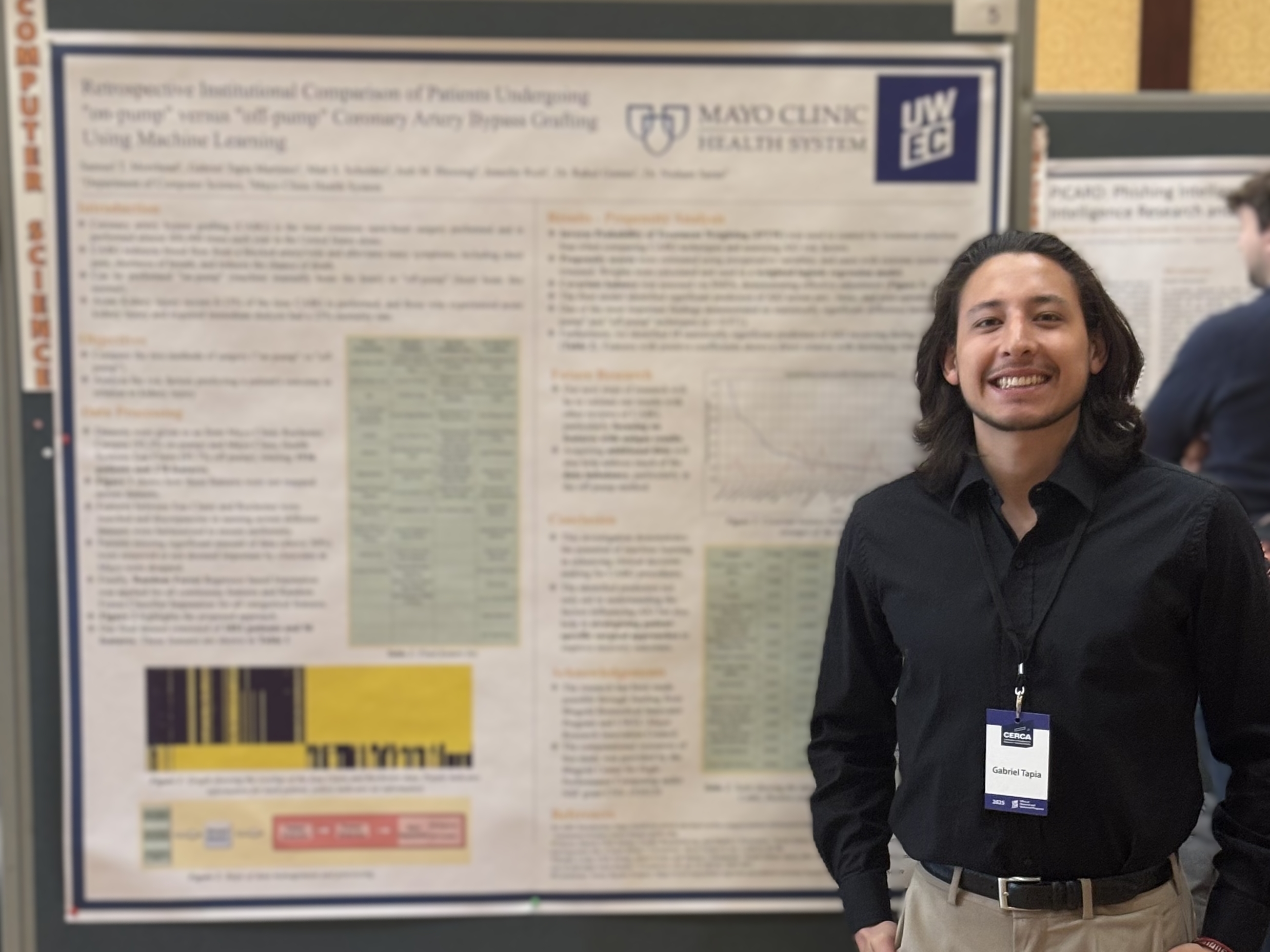
Tapia Martinez and peers present their research poster

That Tapia Martinez has helped make possible the unlikely realm of “Mission Impossible” is no small thing. He attributes his success to Gomes’ mentorship style, describing it as an expert balance between supportive counsel and challenging goals, two crucial elements of experimental research.

“I had really good guidance from him,” Tapia Martinez says. “He gave me the tools, but he didn't explicitly tell me how to use them.”

With new space to learn, new research to accomplish and new technology to accelerate the process, Tapia Martinez started fresh on an old pursuit.

“While I was doing research with Gomes, I did a project with Mayo Clinic, which was on analyzing coronary artery bypass grafting. With that experience, I reapplied to that Mayo internship, and I got it.”

Transitioning into medical data and bioinformatics research was a challenge, but one Tapia Martinez didn’t shy away from.

“I worked this past year directly with physicians on AI and bioinformatics. It was a lot of hard work. But at the end it’s really rewarding because you know that it's going to help real people.”

New beginnings, next chapters

Despite immersing himself into the methods of research, Tapia Martinez made time to try new things and take advantage of life’s opportunities. From the ultimate frisbee team to the Student Senate’s Information Technology Commission, his resume of involvement, activities and leadership is almost hard to believe.

In his first semester at UW-Eau Claire, Tapia Martinez joined the Student Association of Computing Machinery. As a general member and eventual vice president, he enjoyed the discovery-rich camaraderie the organization provided.

“SACM was a good place to start getting to know all these technologies that people in computer science use,” he says.

Membership in the International Student Association has served a similar purpose for Tapia Martinez, who has an ease that helps him cultivate community wherever he goes. The ISA connected him with others at UW-Eau Claire who are navigating college in a new country and language.

“I've had so many friends who are international,” Tapia Martinez says with a smile. “You're all here in a new place and trying to learn how everything works.”

He found more of the same in the Honors College. In (now emerita) Jodi Thesing-Ritter’s Race, Racism, and Anti-Racism honors course, he participated in the Civil Rights Pilgrimage, the annual, longstanding experience for students, staff and faculty that explores issues of social justice and the history of the U.S. Civil Rights Movement.

“I'm so glad I went,” Tapia Martinez says. “I got to learn so much about the history of the U.S. and understand a lot more about where all the culture of the U.S. comes from.”

Tapia Martinez and fellow honors students at Dunbar High School in Washington, D.C.
Tapia Martinez and fellow UW-Eau Claire students and staff on the Civil Rights Pilgrimage, outside Dunbar High School in Washington, D.C.

Tapia Martinez took another honors course, The Quiet One: The Art of Musing with professor CV Peterson, initially as a diversion from his usual process-based STEM coursework. But the course offered him an opportunity to pause, to appreciate the pace of the world around him and to wonder about the areas of gray in between pairs of black and white.

It was a new methodology and another fresh start — and invaluable perspective, for a researcher always looking for new ideas in old problems.

“That class helped me to not only be in the race for my career or for who I want to be, but to also just take a moment and appreciate life,” he explains. “It was not necessarily something that you expect to learn in college or just in a classroom.”

Honors has prepared me in so many ways. While being in honors, I realized that, yeah, it actually works, just reaching out to people. I met a bunch of different people here because we're all interested in just learning.
Gabriel Tapia Martinez

Paired with his Eau Claire-grown research bona fides, that newfound appreciation is keeping him flexible about future plans. Since his research requires access to advanced data infrastructure, for now, a Bolivian return is on hold.

“Eventually I want to go back to Bolivia, work with the government to do something to help Bolivia in general. I'm gaining all this knowledge, and there's so much room for growth back home.”

As he nears graduation, he’s focused on completing his studies, interviewing for jobs or perhaps pursuing graduate work. But home, he says, will always be the finish line.

“Bolivia and I will catch up at some point, (when) I'm able to go back and do some good work.”


Written by Cami Hoth, a third-year senior studying business communication and marketing at UW-Eau Claire. She is from Stewartville, Minnesota.

For the media
For the media
Image download