ID
Authored on
UW-Eau Claire receives federal grant renewal to continue supporting people with brain injuries
Published on:
Intro text

The University of Wisconsin-Eau Claire, through a partnership with the Brain Injury Association of Wisconsin, will continue to provide support for Wisconsin residents with brain injuries thanks to a three-year, $600,000 federal grant renewal.

The unique partnership was first funded in 2023 through a three-year grant from the Administration for Community Living, a division of the U.S. Department of Health and Human Services, with the ability to renew for three more years. The renewal has been awarded and will provide funding through 2029.

Sections

The primary goal is to strengthen advocacy efforts for individuals with brain injuries and their families, including access to information, referrals and resources. It also provides opportunities for UW-Eau Claire students to participate in designing goals, activities, interventions and research with people with brain injuries.

“This grant renewal allows our faculty and students to continue the essential work of identifying individuals with brain injuries and connecting them with ongoing support services,” says Dr. Carmen Manning, special assistant to the chancellor for healthcare education and dean of the College of Health and Human Sciences. “We are creating a space where everyone has access to preventative, diagnostic, post-injury care and management of chronic brain injury.”

Headshot
Dr. Carmen Manning, special assistant to the chancellor for healthcare education and dean of the College of Health and Human Sciences

UW-Eau Claire and BIAW will once again provide $300,000 in matching funds to the grant through its public-private partnership to further serve the community and educate students.

The first three years of the grant expanded and restored support group networks in Wisconsin and created multiple screening partnerships. UW-Eau Claire and BIAW hosted three brain injury conferences and statewide support group summits and completed qualitative and quantitative statewide needs assessments. The partnership also resulted in a Traumatic Brain Injury Special Emphasis Report completed by an epidemiologist at the Wisconsin Department of Health Services, providing a better understanding of the scope of the traumatic brain injury landscape across the state.

The grant led to the implementation of ConnectAbility, an online telehealth intervention for individuals with brain injuries and their families or support networks in Wisconsin, a new screening tool called the Online Brain Injury Screening and Support System and a new case management software specific to resource facilitation called Brain Injury Connections of Wisconsin. In February, the first full-time resource facilitator was hired to serve Wisconsin.

The past three years significantly expanded UW-Eau Claire’s and BIAW’s reach in the community, but the next three years will offer opportunities for even greater impact, says Dr. Jerry Hoepner, professor and assistant chair of the speech, language, and hearing sciences department at UW-Eau Claire, who serves as the principal investigator for the grant.

“I think we're just getting closer to starting to blossom and meeting the needs of people in Wisconsin,” Hoepner says. “We’re a long way from our ultimate goal, but at least we can kind of see the playing field.”

Dr. Jerry Hoepner_2022
Dr. Jerry Hoepner, professor and assistant chair of the speech, language, and hearing sciences department

This year’s funding came with designated priorities to increase screenings and focus on resource facilitation. That should result in a better understanding of how many people are affected by brain injury and how to help them, says Audrey Nelson, executive director of the BIAW.

“There have been people who haven’t been served all this time,” says Nelson, a UW-Eau Claire alumna and brain injury survivor. “I’m hoping we can be able to be there at the forefront, like at the front door instead of in the backyard.”

Audrey Nelson, executive director of the Brain Injury Association of Wisconsin

Hoepner referenced the Wisconsin Department of Health Services Special Emphasis Report that said nearly 20,000 Wisconsinites go to the hospital for brain injuries each year. It is estimated that far more, perhaps another 80,000 people, choose not to be seen, don’t have access to care or misunderstand the severity of the situation.

To combat that, the Wisconsin State Brain Injury Partnership Program has established screening partnerships with BRAIN Fox Valley, UW-Madison, UW-Milwaukee, UW-Stevens Point, UW-Whitewater and Viterbo University. The program also connected with Disability Rights Wisconsin, Epilepsy Foundation of Wisconsin, Wisconsin Department of Health and Human Services epidemiology and Mayo Clinic Health System’s Traumatic Brain Injury Model System advisory board.

These collaborations are only scratching the surface, though. Hoepner and Nelson want to work more closely with K-12 schools, homeless shelters, senior centers, veterans' groups, Indigenous tribes, jails and prisons.

“Now we have something to offer,” Nelson says. “It’s a better, stronger network. It feels really good.”

The duo also wants to hire another resource facilitator this cycle to better serve Wisconsin’s 72 counties, which they believe will increase referrals to services and support options, as well as demonstrate the need for more funding and resources.

More opportunities for students

During the first grant cycle, student authors helped write publications to advance brain injury rehabilitation, and three social work students advocated for brain injury at Hill Day in Washington, D.C.

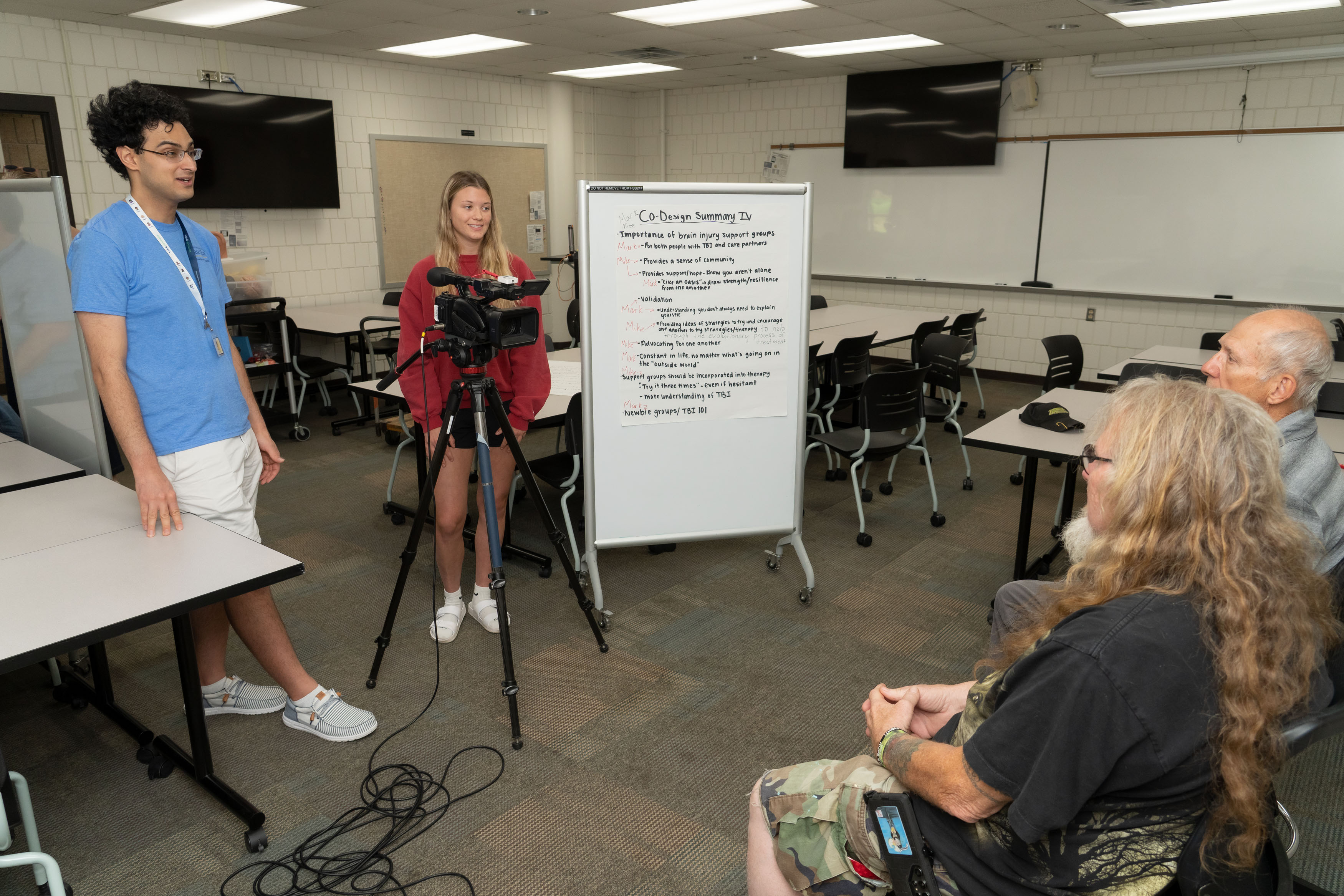
This past June, nine SLHS students and two kinesiology students participated in the Brain Injury Intensive Comprehensive Treatment Program on campus, where they helped facilitate a week of sharing experiences, recovery tips and community engagement. Another two student-involved publications are forthcoming.

As the Wisconsin State Brain Injury Partnership Program enters its next chapter, Hoepner and Nelson are creating new opportunities for student participation and want to collaborate with more university departments outside of speech, language, and hearing sciences.

“We’ve done some partnering with the kinesiology department and they’ve been fantastic. We would like more,” Hoepner says. “There are a million possibilities.”

“Looking at the academic outcome or the personal outcome, I just think here we marry all that together,” Nelson says. “It’s all rolled up right here in this grant.”

Learn more about the Wisconsin State Brain Injury Partnership Program by visiting the BIAW website.

For the media
For the media
Image download