ID
Story Categories
Authored on
UW-Eau Claire professor wins national award for undergraduate research with helping hand from amazing students
Published on:
Intro text

Four years ago, Dr. Nic Wheeler arrived at the University of Wisconsin-Eau Claire feeling both excited and uncertain about his first teaching role. The assistant professor of biology knew he had found a university where he could provide the same level of mentorship that had a profound impact on his undergraduate education and helped him discover his dream career. However, Wheeler didn’t know if he would be able to conduct cutting-edge research — his other passion — at a predominately undergraduate institution.

Sections

Wheeler soon realized he wasn’t giving up impactful research to be a great mentor. His mentorship of UW-Eau Claire undergraduate students would become the heart of a multiple-year research project poised to help millions of people.

That project has also brought Wheeler into the national spotlight. He joins the company of faculty from top-tier research universities after receiving the 2026 Take-Off Award from the American Committee of Molecular, Cellular and Immunoparasitology, a subgroup of the American Society of Tropical Medicine and Hygiene. The award recognizes an early-career scientist for significant contributions to cellular, molecular and immunoparasitology.

The selection committee commended Wheeler’s research on schistosomes, parasitic flatworms that infect humans. The parasites cause a chronic illness called schistosomiasis, which the World Health Organization classifies as a neglected tropical disease as it affects 200 million people in the most marginalized areas of the world.

It’s an overlooked public health issue that keeps Wheeler up at night. But Wheeler has found a promising path to a solution, and snails are guiding the way. Before the parasites can infect humans, they must first infect and fully develop inside freshwater snails.

“What my lab studies is how the parasites find snails. If we can get them to stop finding snails, they can never reach the lifecycle stage that can infect humans,” Wheeler says.

Wheeler took 70 years of research to a new level with innovative experiments conducted entirely by undergraduate students.

“We developed a new approach and technology to understand (how parasites find snails) with more precision,” Wheeler says. “What we were able to do is record parasites swimming around water and finding snails with, essentially, a fancy recording studio for worms. We then used the supercomputer on campus to analyze the patterns in their movements.”

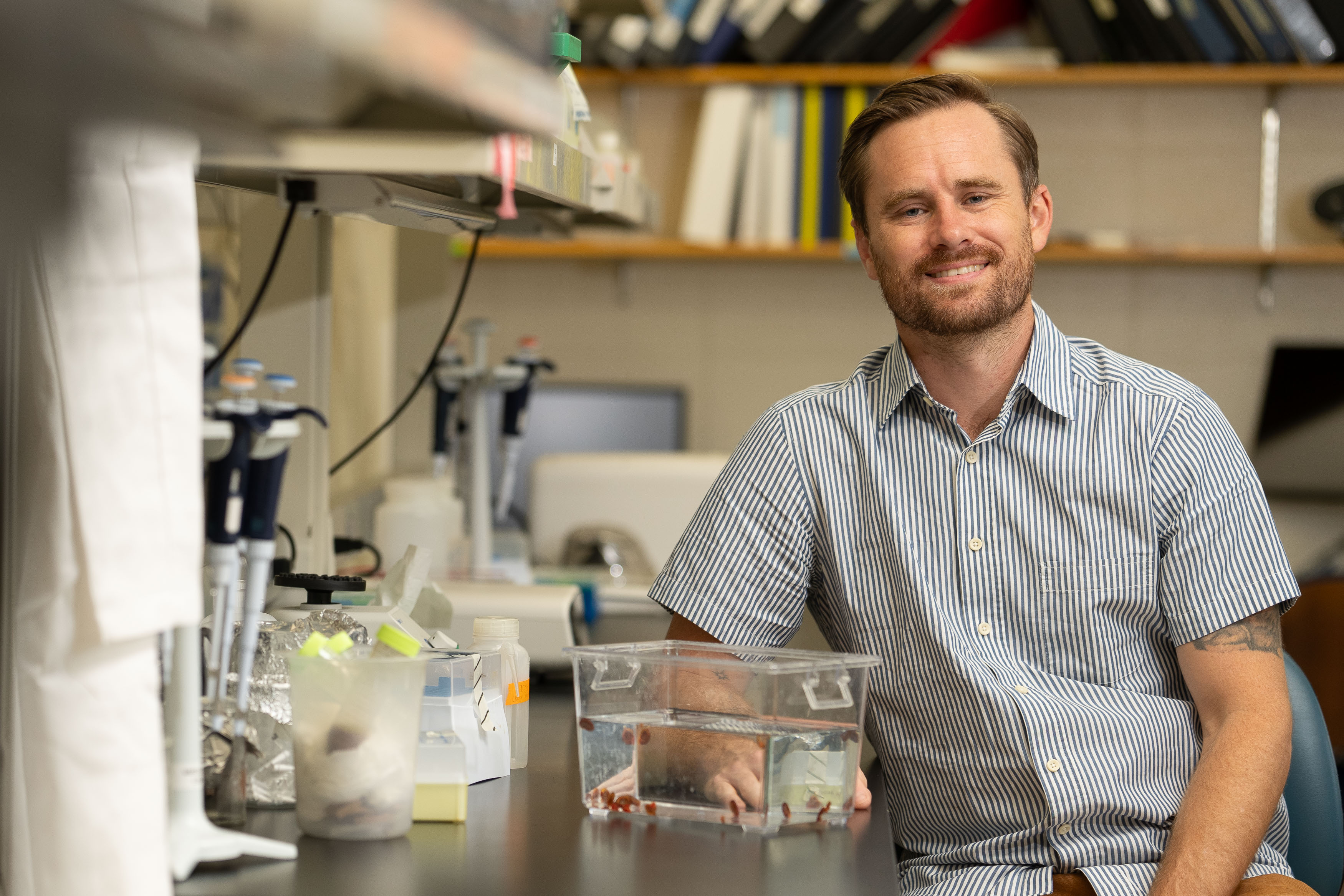
Dr. Nic Wheeler with the snails he studies
Dr. Nic Wheeler stands behind a container of freshwater snails, the initial hosts of schistosomes that play a key role in his research with students.

The project brings the science community one step closer to preventing future cases of schistosomiasis and makes Wheeler the first Take-Off Award recipient from a primarily undergraduate institution.

“It can be challenging for a faculty member at a place like UW-Eau Claire to compete with labs at R1 institutions that have graduate students and postdoctoral researchers,” says Dr. Derek Gingerich, professor and chair of the UW-Eau Claire biology department. “To produce research that has an impact on the field, without those resources, speaks to (Wheeler’s) ability not only as a researcher but mentor. He’s an outstanding mentor who has had more than 15 students in his lab and multiple publications with student co-authors. He’s preparing the next generation of scientists.”

Sonja Olson is one of those students. The fourth-year biology major asked to join Wheeler’s project during her freshman year, when she was a student in his Foundations of Biology I course.

“He’d talk about his research in class and that intrigued me. He’s very passionate about it and got me excited about worms and issues I had never really heard of before,” Olson says.

In just one year, Olson went from knowing nothing about schistosomes to coordinating behavioral experiments in the groundbreaking research. She also helped write the 2025 research paper published in PLOS Pathogens, a prestigious science journal. It was the journal’s only 2025 article to come from a predominately undergraduate institution, another feat that caught the attention of the Take-Off Award committee.

“Dr. Wheeler was really supportive throughout the whole process,” Olson says. “He explained the background of different things and how to use different techniques. He’d also give us some independence to figure things out ourselves, but it was never expected that we had to know everything right away. He encouraged collaboration, asking questions and making mistakes because that’s how we learn. And, as someone who is kind of a perfectionist, this experience helped me get over that in a way and become more confident in my abilities as a researcher.”

“It's just been fun to be able to do both, to mentor students as my primary mission and do work that's recognized by the community as being impactful,” Wheeler says. “And it all goes down to the quality of the students that we have here. It wouldn't be possible at other places that don't prioritize undergraduate research. It's just really great to have students who love the work and have really high capacity.”

Wheeler’s undergraduate mentorship isn’t confined to his lab, however. He inspires his students to do what seems impossible in all aspects of their education.

Olson just returned from a summer abroad she never could have imagined for herself. With Wheeler’s encouragement, Olson successfully applied for a grant to complete molecular research at the Natural History Museum in London, England. Her work attracted the attention of multiple parasite experts, who invited her to present her research at the University of York and the London School of Hygiene & Tropical Medicine.

“Dr. Wheeler has really pushed me to try so many new things,” Olson says. “If you told me a year ago that I would be traveling to London and giving presentations, as someone for whom public speaking isn't a strong suit, I don’t know if I would have believed you. It’s amazing to think how much I’ve changed and grown working with him. I’m just grateful for his optimism and can-do attitude that helped me step outside of my comfort zone.”

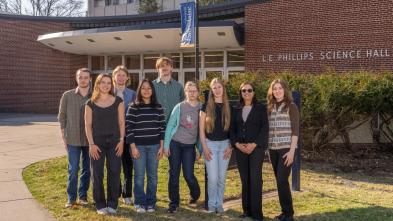
Dr. Nic Wheeler and his student research group in Madison
From left, Dr. Nic Wheeler and UW-Eau Claire students Declan Algrem, Bailey Stuart, Sky Consiglio, Sonja Olson and Theodore Schwantes enjoy the views of the Wisconsin state Capitol and downtown Madison while attending the Midwest Neglected Infectious Diseases Meeting.

Wheeler’s team of student researchers continues to uncover new insights about schistosomes, and Olson plans to stay involved until she graduates. The project’s new focus consists of two parts: identifying molecules that prevent parasite transmission and understanding how the parasites use light to detect hosts.

“We have some data now that might be even a bigger deal than this previous paper, so it’s super exciting for us,” Wheeler says.

These ongoing breakthroughs are evidence of not only Wheeler’s skill as a mentor but also as an innovator and an inventor. To drive scientific progress, Wheeler has often had to build research equipment that doesn’t exist, notably the InVision device that Olson and the rest of the team used to record experiments.

“Another strength is his ability to create the infrastructure needed to address a research question, even if the equipment is not commercially available,” Gingerich says. “I think he’s going to continue to be very innovative in his research, and his research will continue to uncover new things that will be impactful for his field.”

While his name is on the award, Wheeler emphasizes that this research is a team achievement.

“The students are the reason that all of this happens,” Wheeler says. “I did zero experiments, right? I want them to know this recognition is for them as well, and I'm proud of them.”

Wheeler will be honored at the American Society of Tropical Medicine and Hygiene Annual Meeting in November in National Harbor, Maryland, where he has been invited to present in a symposium on mentoring.


Written by Kelly Austin, a writing intern in University Communications. She is a senior at UW-Eau Claire majoring in English with an emphasis in creative writing and minoring in interdisciplinary linguistics. She is from Eau Claire.

For the media
For the media
Image download