ID
Authored on
An uncommon thread: Hannah Schindler’s community tapestry
Published on:
Intro text
Sections

When Hannah Schindler first stepped onto the University of Wisconsin-Eau Claire’s campus, she did not describe it in terms of academic plans, rankings or outcomes.

“I told my mom the first time I toured that it felt like a summer camp,” Schindler remembers with a laugh. “I toured five other schools, but I could really only see myself here. I loved that I could walk from Hibbard to Davies in five minutes and always see at least one person I know.”

For Schindler, a political science major with a psychology minor from St. Cloud, Minnesota, belonging was not simply a perk of the university but the deciding factor. As college unfolded, her community became the power of both her higher education and her future in public service.

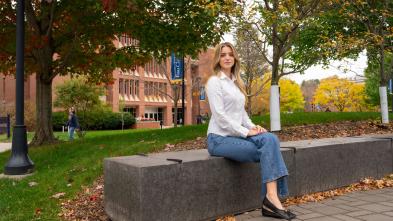
Honors student and class of 2026, Hannah Schindler

First fibers of connection

Schindler's commitment to community blossomed in childhood, cultivated by parents who modeled what it meant to show up for those around you.

“My parents have always been pretty involved in community organizations. We were really involved in the Epilepsy Foundation of Minnesota because my dad has epilepsy. I saw how impactful those organizations were, even in smaller communities.”

Watching her parents support families, plan events and build networks of care taught her early on that community is not abstract; it is built through relationships, consistency and compassion.

In high school, she stepped into leadership roles that mirrored her parents’ example, serving on student council and founding the Interact Club of St. Cloud, a youth branch of the Rotary Club. More recently, she’s spent her summers interning with the St. Cloud mayor’s office.

A third-year graduating senior, part of Schindler's success at UW-Eau Claire is owed, she thinks, to chasing those same connections wherever she goes — seeking out chances to join communities and make friends she never would have known otherwise.

“That was influential on why I want to give back in local government and why I'm so involved in trying to be involved.”

Weaving into honors

When Schindler first arrived at UW-Eau Claire, she worried she’d never replicate her tight-knit high school community — but those apprehensions did not last long.

“Honors really gave me that community from the start,” she explains. “I did the JumpStart program, and even just having the physical location of the Honors Commons, knowing Heather, Kim and Sean were there to support me, was huge.”

The Mark Stephen Cosby Honors College living learning community's JumpStart program gave incoming first-year honors students an opportunity to move in early for community building and programming. That soft landing was so successful, in fact, that the program is now a weeklong endeavor called Catalyst, which offers students like Schindler a weeklong head start on college — a chance to study, talk and meet with people who care as much about others as they do about ideas and academics.

Among her earliest college memories, Schindler mentions walking with her summer group to a concert at Owen Park.

“We all sat in a circle and talked, and it was so cute,” she recalls. “I’d just met these people two days ago, but already we were forming our own little community. And I still live with them. My entire house this year is filled with people that I met at JumpStart.”

The discussion-based intimacy of honors courses shaped her growth, too, teaching her not just how to discuss unfamiliar ideas but also how to listen to them, and helping her build a people-centered worldview among a community rich in difference.

Campus patchwork

The fabric of Schindler's campus connections reads like a collage of honors communities she’s helped to sew together: Honors Student Council, the Honors Living Learning Community, JumpStart, the Honors New Mexico domestic immersion and the Cosby Honors Advisory Board.

But her community impact has spread far beyond honors. Schindler is also a member of the Lutheran Student Association, which helped her find a faith-based community similar to the one she cherished at home, and an active member of the College Democrats.

The role she speaks most highly about, however, is the UW-Eau Claire Campus Ambassadors, which she joined in spring 2025. As a tour guide and ambassador for UW-Eau Claire, she welcomes new students into the vibrant campus community she’s helped stitch together.

“I’m a big fan,” Schindler notes happily. “I love talking to people, and Ambassadors gives me a chance to help students feel like they belong here.”

Hannah Schindler (right) poses with Blu the Blugold (left)

Threads of curiosity

Prior to entering college, Schindler believed research was only for the “intense” sciences and technology fields. That view shifted when she began conducting political science research with fellow student Emma Steffen.

Their project examines how people interpret electoral closeness and why individuals draw different conclusions from election results. Schindler and Steffen presented their findings at the Southern Political Science Conference in New Orleans, Louisiana, over three days.

Schindler recalls fondly seeing other undergraduate students presenting on panels and feeling a sense of awe and shared pride among like-minded peers. Aside from affirming her own academic confidence, that experience expanded her sense of what both political science and politics could achieve, given common purpose and the right community.

Hannah Schindler posing at the Southern Political Science Conference (SPSC) in New Orleans

Pattern-making and public service

Schindler has one long-term goal: local government, where gathering and serving community voices is paramount, and where she can see the direct impact of her work. In service of that aim, Schindler currently works as an intern with the Community and Economic Development Associates, where she writes newsletters and develops county websites, hands-on tasks that connect her directly with the people she hopes to serve.

“They act as the planning department for smaller cities that don’t have the money to fund that. They also work with communities and small businesses within those communities.” She chuckles at this. “Again, we’re back to community!”

Schindler has hopes to stay with CEDA long term, but she’s open to joining a local city government in Eau Claire or Chippewa Falls. Wherever she is, her goal remains the same: to build stronger, more connected communities.

Close-knit futures

When asked for highlights of her college experience, Schindler mentions only in passing her political science research and leadership roles, sections of her resume that are anything but threadbare. Still, as always, she lingers on relationships, on people.

“I really do think it’s the community I’ve cultivated. I’ve had days where I’m going from one place to another and I’ve had conversations with four people between three buildings. On a campus of 10,000 people, I’ve been able to make those connections, and I think that's probably what I'm most proud of.”

As Schindler prepares to don cap, gown and various cords at her May graduation, she insists all of that attire is cut from community cloth: friends and family in St. Cloud, Minnesota, her JumpStart cohort, honors peers, a faith community and research teams. Add to these countless other UW-Eau Claire students and faculty stitched together through her common belief — that communities thrive when people show up for one another.


Written by Zoe Eineichner, a third-year junior at UW-Eau Claire, double-majoring in psychology and organizational communication and pursuing a graduate degree in industrial-organizational psychology. Her hometown is Mukwonago.

For the media
For the media
Image download