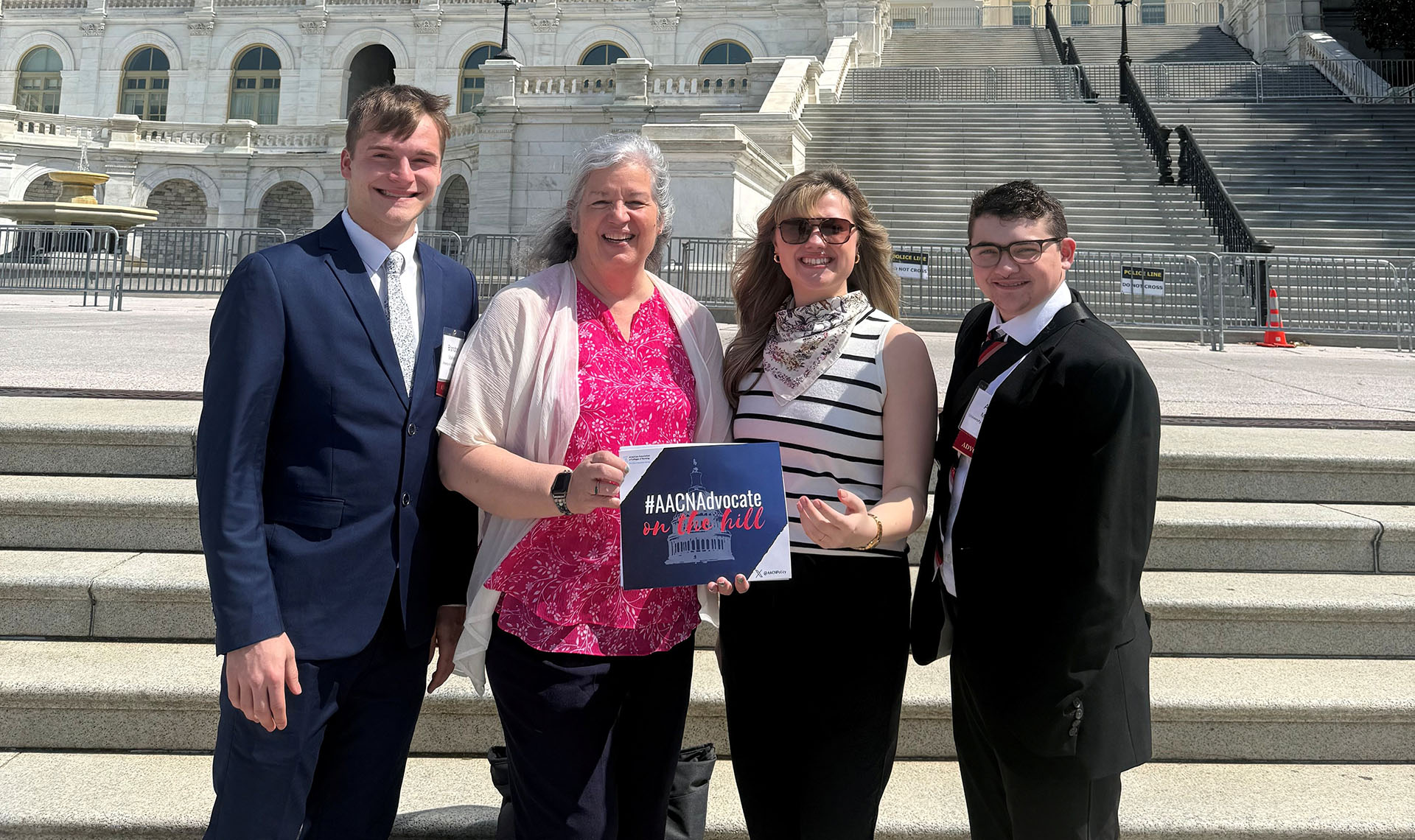
Hannah Berndt, Brandon Voelker and Aspen Morman, students in the bachelor of science in nursing program, attended the 2026 American Association of Colleges of Nursing Student Policy Summit alongside Dr. Kristen Abbott-Anderson, dean of the College of Nursing, at the national advocacy event.
The summit is a two-day conference open to baccalaureate and graduate nursing students enrolled at an AACN member institution. Students are immersed in sessions focused on the federal policy process and nursing’s role in professional advocacy, with the goal of helping future nurses connect their clinical perspectives to the policies that influence care nationwide.
From bedside experiences to policy conversations
Before the trip, Berndt says she understood that policy mattered — but it felt far away from the day-to-day work of nursing.
“Before attending the AACN Student Policy Summit, I knew that nursing and health policy were connected, but I did not fully understand how direct or impactful that relationship really was,” Berndt says. “Policy felt distant and difficult to influence, especially with how complex and polarized it can seem.”
After learning how federal decisions ripple into staffing, access and education, Berndt says her perspective shifted. “I now see that nurses bring real, lived experience from the bedside that directly informs policy decisions,” she says. “Federal health policy clearly shapes patient care, and nurses are in a unique position to speak into that space.”
Abbott-Anderson says experiences like the summit help students envision nursing as both a profession and a platform for leadership.
“The exposure to peers and to leaders in nursing helps students recognize and envision where a career in nursing can take them — and that leadership is an integral part of nursing,” Abbott-Anderson says. “Through these types of experiences, role modeling takes place as students are empowered to use their voice to support the nursing profession in a safe space, supported by deans and other nursing leaders.”
A broader view of nursing — and the work behind the work
Voelker says the summit expanded his understanding of how closely patient outcomes are tied to what happens outside the hospital walls.
“Before attending the summit, I mostly viewed nursing as focused on patient care within hospitals or clinics, and I did not fully understand how involved nurses can be in health policy,” he says. “After attending the summit, I now see that nurses play a critical role in advocating for laws and regulations that improve patient outcomes, access to care and working conditions for healthcare professionals.”
For Abbott-Anderson, that connection is a vital part of nursing education. She says exposure to policy helps students look beyond daily tasks and see how the profession must advocate collectively — for patients and for the future workforce.
“Exposing students to health policy and advocacy provides an opportunity for students to look beyond the tasks of nursing … to take in the broader picture of the nursing profession as a collective body through which it is imperative to advocate,” Abbott-Anderson says. “To support pathways to nursing, to support additional nursing faculty and to support preparing more well-equipped nurses to serve the ever-widening gap of the nurse shortage.”
A national community — and a shared sense of purpose
For Morman, one of the most powerful parts of the summit was realizing how many nursing students and faculty across the country are working toward the same goal.
“One session moment that had an impact on me was seeing how many states were present for the summit,” Morman says. “Getting to talk to people from around the country was so impactful … It really showed me the sense of community that we as nurses should have.”
That national perspective, he says, helped make the issues feel both urgent and shared — and it built confidence.
“I feel much more confident advocating for patients, communities and the profession after this,” Morman says. “This summit taught me that you don’t need to know everything about legislation or the government to be an advocate.”
Why advocacy matters for rural and Midwestern communities
In Wisconsin and across the Midwest, healthcare challenges can look different than they do in major metropolitan areas — from longer travel distances and limited specialty access to workforce shortages that hit smaller systems hardest. The students attended the summit with those realities in mind.
Abbott-Anderson notes that many of the priorities addressed during national advocacy discussions include support for rural and underserved communities.
“Several of the legislation items we advocate for specifically ask for support focused on rural/underserved areas,” she says. “This brings awareness of unique needs of rural areas and empowers students to speak knowledgeably about healthcare needs, especially those in rural/underserved areas.”
Berndt says nurses bring the context that helps policymakers understand what data alone can’t show.
“During conversations with congressional staff, I realized I was letting them in on a perspective only nurses really see,” she says. “As nurses, we were bringing the ‘real story’ behind the data, acting as bridges between patients and policymakers, and ensuring community needs are understood and represented.”
Bringing it home: paying advocacy forward
Abbott-Anderson says the value of sending students to the summit doesn’t end when the plane lands back in Wisconsin. Students return with tools and strategies — and a responsibility to share what they’ve learned.
“The partnership between the students and leadership valuing the importance of advocacy for our profession is significant,” she says. “Students see leadership engaging in advocacy for nursing, and this serves as a role model for how the future nurse will be able to engage in advocacy.”
Voelker says he plans to bring advocacy conversations back to classmates and future co-workers, especially for peers who don’t see themselves as “policy people.”
“Advocacy and policy involvement do not require being a politician or policy expert,” he says. “Nurses already advocate for patients every day in clinical settings. Becoming involved in policy is simply another way to expand that advocacy and make a broader impact.”
Berndt says the experience strengthened her commitment to stay engaged.
“The AACN Student Policy Summit helped challenge my doubts and showed me that this path is both meaningful and possible,” she says. “It helped me better picture the kind of nurse I want to become — someone who is engaged in advocacy and committed to making an impact beyond direct patient care.”
For Abbott-Anderson, the message is simple and future focused.
“It sends the message that the nursing voice is an important one in healthcare,” she says. “As the largest sector of healthcare professionals, it is imperative for nurses to use their voice to advocate for the profession, and more importantly, the health of patients and our communities.”
Written by Kaylan Petrie, administrative coordinator, UW-Eau Claire College of Nursing
Photo caption: From left, Brandon Voelker, Dr. Kristen Abbott-Anderson, Hannah Berndt and Aspen Morman in Washington, D.C.