ID
Authored on
Helen Gensch discovers new passion while affirming desire to serve in public health
Published on:
Intro text

Helen Gensch wanted to position herself for medical school, but she also wanted to explore along the way, even if it meant touching bugs.

The Eau Claire native developed an early interest in biology and chose to attend the University of Wisconsin-Eau Claire to conduct research both in the lab and across the campus’ surrounding natural areas. What she discovered during her four-year journey was exciting subjects outside of her required classes.

Sections

Pursuing a liberal arts bachelor’s degree in biology with a pre-professional health science minor gave Gensch the freedom to customize her elective courses based on her interests, which included entomology.

“I never thought I’d like that because I grew up terrified of bugs,” Gensch says.

Helen Gensch mosquito lab portrait
Helen Gensch poses in one of her lab spaces inside Phillips Hall.

Before she became interested in insects, Gensch knew she was interested in research. She contacted Dr. Nic Wheeler, assistant professor of biology, as a first-year student and applied to work with him through the Biology Research Scholars Program, which granted her access to research through seminar coursework and a summer research experience.

“I saw it as an opportunity to integrate my interests in science and my personal values,” Gensch says.

Headshot of Dr. Nic Wheeler
Dr. Nic Wheeler, assistant professor of biology

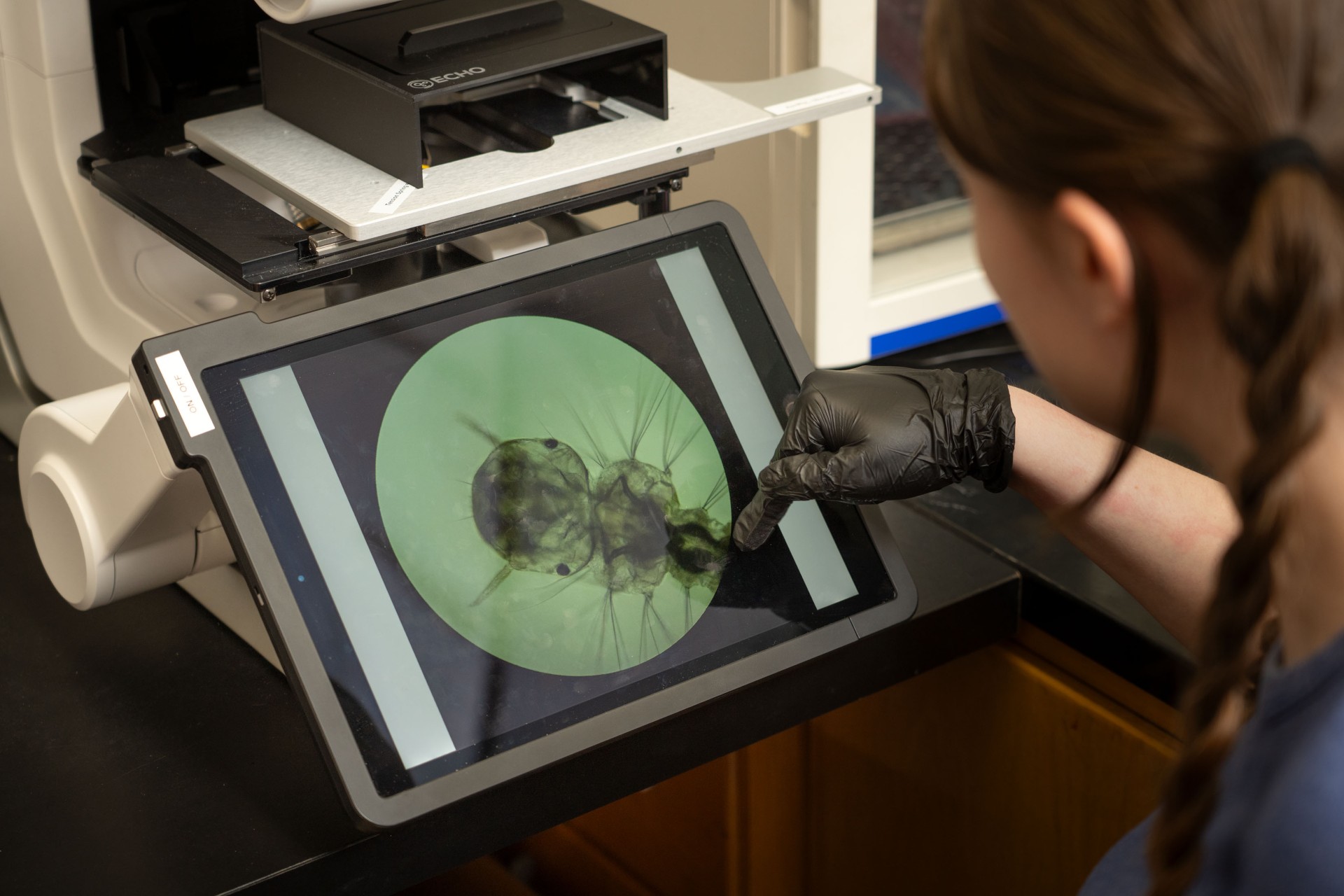
Mosquitoes happened to be the focus of the project with an open seat in Wheeler’s lab. Gensch’s work centered on neglected tropical diseases, studying basic research of mosquito vectors and their biology. She and classmates worked specifically with mosquito larvae, which haven’t developed enough to transmit disease.

"We are investigating the sensory behavior of Aedes aegypti, a significant disease vector that contributes to the millions of cases of Zika, dengue, and yellow fever around the world each year," Gensch says. "Specifically, we are interested in the larvae of the mosquito. Less is known about sensory capabilities of the larvae, even though they cannot spread disease and are an important target for public health initiatives worldwide.”

With Wheeler’s mentoring, Gensch developed her own research methods and protocols. She also spent hours studying and observing Aedes aegypti mosquitoes to understand their life cycle and development. Her research culminated with a presentation at the Provost’s Honors Symposium on May 1 where she shared her work.

Once she graduates, Gensch will proudly leave campus knowing the next group of student researchers can discover new information based on her methods.

“It’s not that I have a perfect data set, but I’m going to pass this off to somebody who now has a working foundation to study all these things,” she says. “I’m really proud of that.”

Wheeler instantly recognized Gensch’s passion for and knowledge of biology, which is why he encouraged her to apply for BSRP her first year. He then watched her interest and excitement about mosquitoes and entomology grow during her time on campus.

“It didn’t divert her path in any way. She’s still going to go to medical school to be a physician, but she allowed herself to be open to entirely new ways of doing biology that she hadn’t considered,” Wheeler says. “That speaks to what UW-Eau Claire is as a liberal arts institution and the idea that we want to develop well-rounded students and citizens, not just laser-focused technicians.”

Helen Gensch and Dr. Nic Wheeler have worked together
Helen Gensch and Dr. Nic Wheeler discuss mosquitoes in their Phillips Hall lab space.

A future in public health

Gensch will turn her attention back to medical school after graduation, focusing on the Medical College Admission Test she never found time to prepare for as an undergraduate.

“I want to get the most out of my courses, and I tend to engage a lot with the content of my courses by reading research in that topic, and that takes up a lot of time,” says Gensch, a 4.0 student. “I’m going to take a full year studying for the MCAT so I can really feel confident with that.”

She’ll apply to medical schools within the Midwest, in the hopes of landing near family in either Minnesota or Wisconsin. While she doesn’t know what specialty she wants to pursue as a physician, Gensch knows she wants to prioritize patient education and science communication in her career.

“You cannot expect everybody to be an expert,” Gensch says. “I have the skills to translate something really, really complex into something easier to understand. I’ve learned a lot of that through research, because you have to go through so much literature and understand what’s actually going on and then present it to people who might not necessarily be in that discipline.”

Gensch served as a chemistry tutor and taught a section of an introductory honors seminar for freshmen. She also volunteers at the Chippewa Valley Free Clinic, which provides quality healthcare and advocacy for individuals with no reasonable alternative. She hopes to continue that work once she’s established in her career.

In her free time, Gensch plays the cello as part of The String Connection, which performs free concerts within the community. She considers it another important aspect of public health.

“It’s not strictly about promoting physical health, but also general well-being,” Gensch says.

If you think Gensch has experienced all she could in college, she feels the same way. Yet she surprised herself with all the opportunities she discovered in her own backyard.

“There are a lot of things the university does for the community I’ve benefitted from and now I am happy to pass that on to future students,” she says. “I can move forward in my career and explore new ways to impact public health. It was incredibly rewarding to give back to the community I grew up in.”

For the media
For the media
Image download