ID
Authored on
As first students graduate, new master of science in exercise physiology program continues to grow
Published on:
Intro text

Excitement fills the halls of McPhee Physical Education Center as the first cohort of students to receive the master of science in exercise physiology degree prepares to graduate from the University of Wisconsin-Eau Claire this spring.

As the new graduate program within the kinesiology department finishes its second year, five students have set the tone for strengthened exercise physiology opportunities in research and education, and 11 others are following close behind.

Sections

Funded by a $9.4 million Workforce Innovation Grant from the Wisconsin Economic Development Corp. in December 2021, the 36-credit graduate program provides foundational knowledge and clinical experiences. Students prepare to work with clients in preventative health programs, medically based fitness programs, cardiac rehabilitation and other clinically related areas such as aging, diabetes management, cancer and neurology.

“It seems like this has been around forever, but I know it’s only been a year and a half,” says Dr. Jeff Janot, professor of kinesiology, who helped create the program. “This graduate program really took off fast. It’s incredible how well it’s gone.”

Jeffrey Janot
Dr. Jeff Janot, professor of kinesiology

The first cohort features three traditional undergraduate students finishing the program in two years and a pair of students following the MSEP accelerated plan to receive their bachelor’s degree and master’s degree in a total of five years. Multiple students from the class are planning to pursue Ph.D.s, which Janot never thought would happen.

Dr. Saori Braun, professor and director of the master of science in exercise physiology program, says working with familiar faces made launching the program a smoother process, especially while ensuring course offerings align with the degree requirements. She’s currently leading the program through an accreditation process with the American College of Sports Medicine, which has further strengthened UW-Eau Claire’s offering.

“We now know that our program has all of the skills and knowledge necessary for students to pass the clinical exercise physiologist exam,” Braun says.

Headshot of Saori Braun
Dr. Saori Braun, professor and director of the master of science in exercise physiology program

A program with multiple strengths

Braun believes a strength of the program is its dual credential with the master of public health degree, which is also graduating its first cohort thanks to the same WEDC grant. Exercise physiology students can take elective courses in public health to become more effective healthcare providers while earning a 12-credit graduate certificate. In return, public health students can take a course in applied nutrition.

A more traditional strength of the kinesiology department is research, which Braun says has been elevated to new heights through the graduate program. Students are delivering more presentations at regional and national conferences and “are excited to take on those challenging opportunities,” she says.

Elizabeth Packer, who will graduate in May through the accelerated plan, is a great example of this strength. The Duluth, Minnesota, native was selected to give an oral presentation on sleep monitoring among college students at the ACSM annual meeting in Salt Lake City next month.

“I have been so grateful for the support of my professors and peers to have been able to achieve these milestones and pursue my areas of interest at such a high level,” Packer says.

Elizabeth Packer master of science in exercise physiology
Elizabeth Packer, MSEP accelerated plan student

Joining Packer at ACSM 2026 is Calla Dexheimer, who will present her research on aerobic and anaerobic profiles in college women rugby players. The River Falls native is also finishing her thesis on the combined effects of vibrotactile glove usage and resistance training on Parkinson’s disease, research backed by Mayo Clinic Health System funding.

“I always wanted to work in a lab. Now, working with people in Parkinson’s just around the community, I’ve really valued helping others. I think that’s where I want to take my future after having that experience in this master’s program,” says Dexheimer, who will pursue Ph.D. in biomechanics at the University of Nebraska at Omaha starting in June.

Calla Dexheimer Northland ACSM 2025 in Mankato, MN
Calla Dexheimer at Northland ACSM 2025 in Mankato, Minnesota

Students’ success starts with faculty

Dexheimer credits faculty for providing direction and flexibility to shape her experience. Ryan Lahey, an accelerated path student from Waunakee, adds faculty do a great job balancing the needs of graduate and undergraduate students while integrating their perspectives within shared classes.

Ryan Lahey
Ryan Lahey, MSEP accelerated path student

Braun says an emphasis when creating the new program was maintaining the integrity of the undergraduate program. Too many graduate students with theses and research could overwhelm the faculty and underserve the higher number of undergraduate students.

That hasn’t happened.

“We all just enjoy interacting with them,” she says. “To watch them gain confidence, knowledge and be excited about their research and having that desire to disseminate beyond what’s required in a course setting, that’s really a professional development that we like to see in students.”

Clinical experiences are key

After he graduates next year, Lahey wants to continue research involving exercise, thanks to another strength of the program: clinical experiences.

Students are involved in several community research projects, including the Community Fitness Program, Physical Activity and Recreation for Individuals with Disabilities in the Eau Claire Area (P.R.I.D.E.), P.R.I.D.E.4Adults, Parkinson’s Exercise Program, and Cancer Recovery and Fitness.

“That is what’s so cool about this program. It sets you up for so many different opportunities and you can take whichever one you find the most interesting,” Lahey says.

Dr. Marquell Johnson, professor and chair of the kinesiology department, who serves as director of the P.R.I.D.E. programs, says graduate students have enhanced the ability to perform physical activity assessments and biometric measures with clinical populations with disabilities.

“It allows me to be more accountable on my deliverables besides just providing great opportunities for children with disabilities,” Johnson says. “Some students come back and do an independent study or internship with me. To have grad students who can serve more in a leadership role or a contributary role, it’s always great to have extra eyes.”

Marquell Johnson
Dr. Marquell Johnson, professor and chair of the kinesiology department

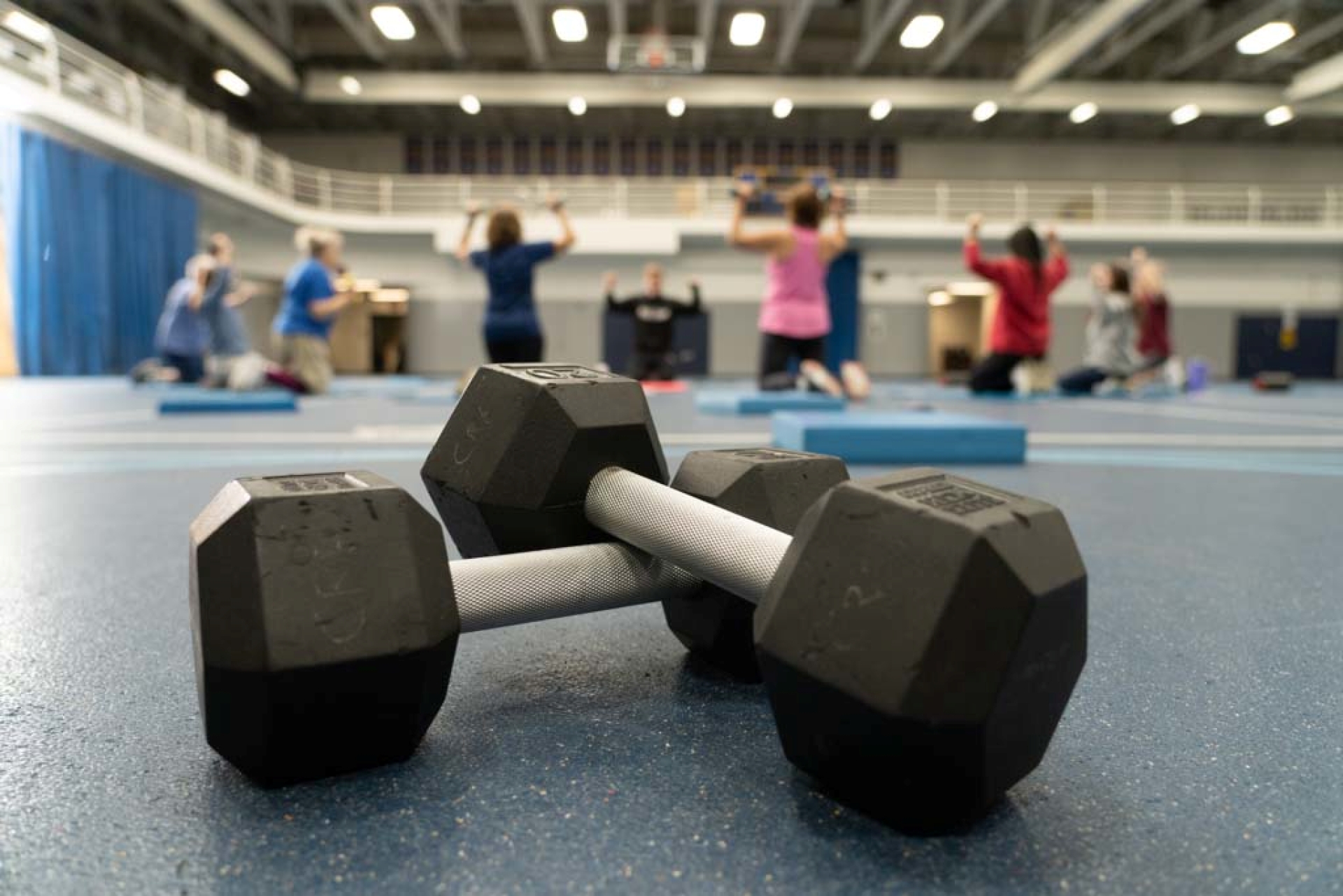
Another impactful experience has been partnering with the Augusta Senior and Community Center. What started as a summer project two years ago has become a core piece of a class Braun instructs where students teach community members exercises and inform them about diabetes, hypertension, cardiovascular disease and other topics.

“It’s been an eye-opening experience for our students,” Braun says. “The energy level that students have, the community members appreciate so much. But then the students see the responses they get that it matters that we bring the services to them.”

Dexheimer participated in the collaboration as a data analyst and went on to present the findings at a conference. She says it was great to use her skills outside of the immediate Eau Claire area, just as the WEDC grant intended.

Janot says there’s no other exercise physiology grad program he knows of that offers that type of diversity.

Still work to do

Braun says she is working to secure external funding to continue the work started by the WEDC grant. The program plans to be sustained by the tuition of ideally 15 students per cohort but supporting rural communities will require additional resources.

Janot wants to develop sites that can take graduate-level interns and utilize them like staff members, ultimately leading to full-time jobs or additional internships after graduation.

He remembers a recent conversation he had with his physician about increasing quality of life in rural areas and how important outreach programs like UW-Eau Claire’s are.

“It’s going to be way cheaper to be preventative than it is to be rehabilitative,” Janot says. “Physicians and nurses are very good at what they do and so are exercise and rehabilitation professionals. So, in a rural setting, if the goal is to increase prevention and management of chronic disease, we should have a place in the conversation regarding the implementation of physical activity and exercise for these individuals.”

For the media
For the media
Image download