Next stop, medical school, for four UW-Eau Claire grads
The University of Wisconsin-Eau Claire is no stranger to graduate and alumni outcomes that include the celebration of medical school acceptance letters each year. There is a long history of successful Blugold physicians and medical researchers nationwide.
The path to a career in medicine takes all forms, often including a “gap year” (or several) for myriad reasons and opportunities. But as May commencement approaches, we thought we would share the good news of four Blugolds who already know they are off to medical school as their next step.
The following graduate profiles help tell the story not only of four hard-working students and their determination to pursue careers in medicine, but also the many ways they say their undergraduate experiences and relationships at UW-Eau Claire helped make their dreams a reality.
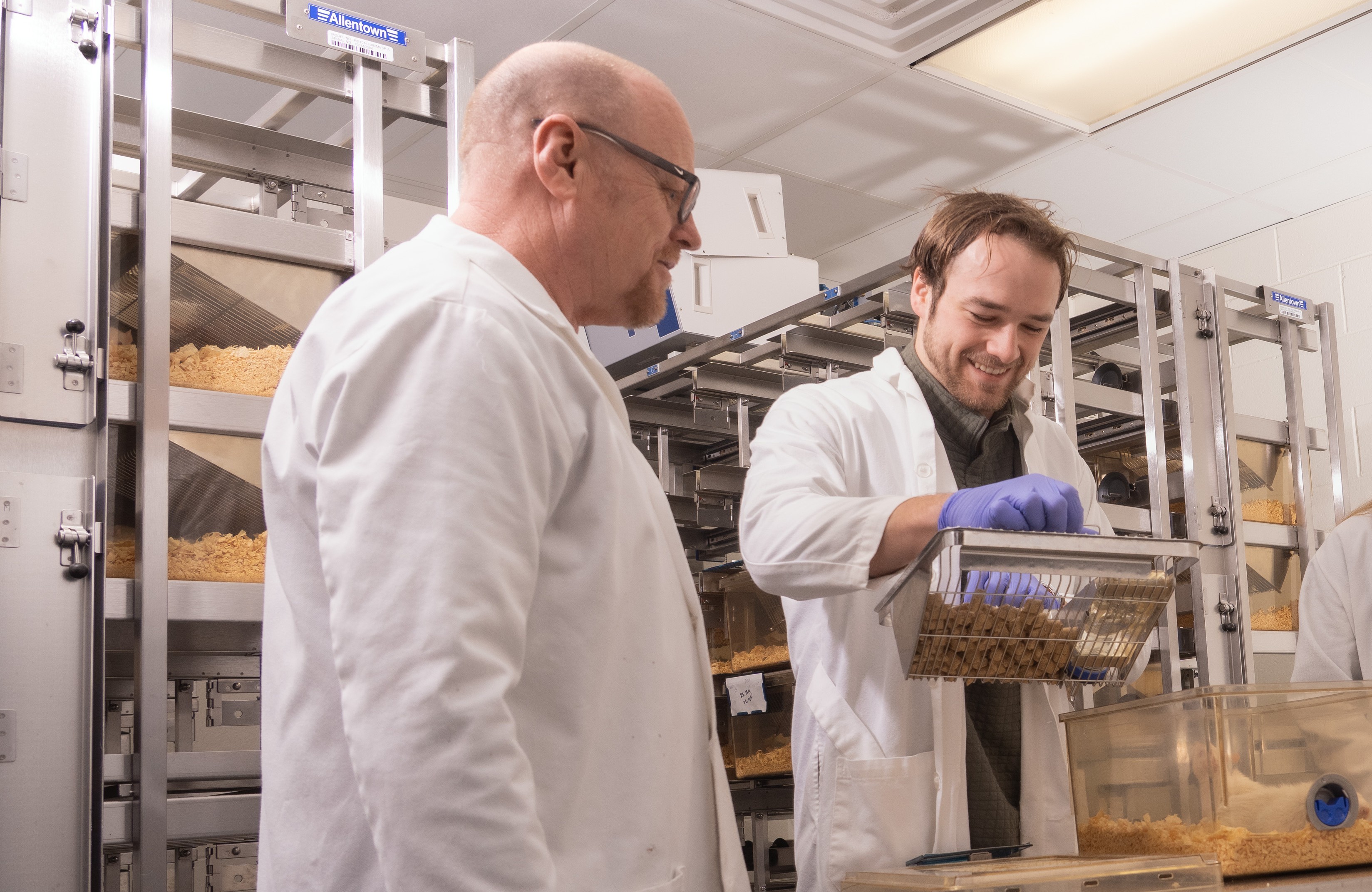
Top image caption: Dr. Douglas Matthews and Sam Stumo in the neuroscience lab where they have collaborated on research projects related to the science of addiction.
Catalina Decker, biochemistry/molecular biology major from Eagan, Minnesota
Attending the University of Rochester School of Medicine in Rochester, New York
While medical school applicants are all looking to serve others in a career, few graduating Blugolds have demonstrated quite the level of specific goals of service as Catalina Decker.
With a biochemistry/molecular biology major, a minor in Spanish and a certificate in American Sign Language, Decker has carefully designed an academic foundation to help serve specific communities as a medical practitioner.
“I applied to about 15 schools, got interviews at four and was accepted at the University of Rochester,” Decker says.
“The main reason I applied to Rochester was the programming they have that integrates the deaf community in the city with the hospital. Deaf patients interact with the medical students regularly. Many med students have had few, if any, clinical interactions with deaf individuals, so it’s a unique opportunity that I’m excited about.”
Adding to her course-based learning, Decker had many hands-on opportunities offered to health science students through the Health Careers Center. She says that these unique programs went far in building both her curiosity and confidence in her pre-medicine training.
Decker worked with community members who have Parkinson’s disease as part of an exercise program in the kinesiology department. She also did the MedEx shadowing and procedural skills training sessions offered by the HCC.
“As a freshman, I shadowed Mayo doctors in several specialties. And every semester we have health professionals from around the state come teach us specific skills like intubation or a cricothyrotomy or even delivering a baby — those kinds of opportunities can’t be beat,” Decker says.
Decker says that she is not yet thinking of an exact medical specialty to pursue, but that becoming an effective and compassionate communicator is a professional trait she will aspire to build.
“Our family has a lot of experience interacting with physicians,” says Decker, whose father has had a years-long battle with cancer.
“I know the caregiver role well and was inspired to become a physician through that experience,” Decker says.
Decker spent four years as a Biomedical Innovator Scholar, doing research in the lab of Dr. Elizabeth Glogowski, professor of materials science and biomedical engineering. The ongoing project is the development of a medical-grade foam designed to protect healthy organs and tissue during treatments of cancerous tumors.
“It’s been really exciting to be part of this ongoing project, seeing how it has evolved and getting closer to a publication with Dr. G,” Decker says.
Glogowski says that Decker is the type of lab student she will miss but is grateful for her steady presence in the foam lab.
“Catalina jumped into lab work her first day on campus at 150%,” Glogowski says. “Now she is an excellent peer mentor who models compassion, patience and dependability in teaching new research students how to be successful peer mentors themselves.
“It is always bittersweet when students like Cat leave, but I am so excited for her future,” Glogowski adds.
Evan Stemper, December 2025 biology graduate from Sussex
Attending the Medical College of Wisconsin in Milwaukee
For Evan Stemper, beginning his medical training this summer in the Froedtert Hospital at Milwaukee's Medical College of Wisconsin will be a full-circle moment in his life.
“I’m so grateful that I was accepted at this school near my home, close to family,” Stemper says. “It’s also the place I learned as a high schooler that I had cancer, and the place I received my years of successful treatment. I guess it’s sort of a redemption story, being back there for the first time as a medical student, alive and well. It will be nice to know the place for all new reasons.”
As a senior in high school, Stemper was diagnosed with chronic myeloid leukemia and spent much of his Blugold career in active treatment. Stemper’s cancer is now, according to his oncologist, close to an official stage of remission and he is feeling very well. He will, however, remain on anti-cancer medication for the rest of his life.
“The supports available to me were so helpful,” says Stemper, who was set up with a single residence hall unit so he would be able to manage the side effects of medications in his own space. Services for Students with Disabilities helped Stemper with accommodations like flexible scheduling of classes and exams. For the most part, Stemper says, he tolerated his treatments well and did not lose too much time making his planned graduation date.
When it came to the planning and preparation for medical school applications, Stemper says the Health Careers Center was a great asset.
Dr. Julie Anderson, director of the HCC, got to know Stemper well, eventually helping him narrow down his application list and fine-tune his personal statement. She says his positive attitude was impressive and will serve him well in a medical career.
“From the start, Evan approached his health challenges with a level of courage, grace and personal responsibility that is rare. These qualities will undoubtedly shape him into a physician who brings deep empathy and sensitivity to the care of his future patients," Anderson says.
Stemper says Dr. Nic Wheeler, assistant professor of biology, stands out in his story as having significant impact.
“I had several classes with Dr. Wheeler, and he was the first professor I had when I was finally feeling good, and his support was amazing. His door was always open, and not just for academics. He has been a wonderful overall mentor.”
Wheeler says that watching students like Stemper persevere and reach their goals is the payback of a teaching career.
“I am very proud of Evan and his accomplishments at UW-Eau Claire,” Wheeler says.
In his junior year, Stemper took two upper-level classes with Wheeler, one of which included a final group project that required his team to develop a grant proposal to study a cancer of their choice.
“It was a full-circle moment for me as well, seeing him lead his group to propose research of the very cancer he was battling,” Wheeler says. “Now I get to see him continue that path and do it in real life. Evan is the type of student that makes this job so rewarding.”
Stemper is open to a variety of specialties for his future, though he admits that oncology and hematology hold a special place in his heart.
“A decision is far down the road, but these two specialties, these kinds of doctors have been very influential in my life and my desire to pursue medicine,” he says.
Sam Stumo, neuroscience and psychology double major from Sherwood
Attending Western Michigan University Homer Stryker M.D. School of Medicine in Kalamazoo, Michigan
It’s no surprise that many graduates bound for medical school were high-achieving, often high-engagement, active undergraduates who sought opportunities and extras to match their interests and abilities.
Sam Stumo, by all accounts, has exceeded that standard in his time at UW-Eau Claire. Coming in his first year as a fully funded Biomedical Innovator Scholar, Stumo dove immediately into research, eventually joining a neuroscience lab with Dr. Douglas Matthews, professor of psychology.
In addition to four years of in-depth lab-based research, many presentations and 5 article publications (4 published, 1 pending), Stumo’s list of high-impact experiences also included:
- The varsity Blugold men’s track and field team
- Campus Ambassadors program
- Job shadowing physicians at Mayo Clinic Heath System-Eau Claire
- EMT training and license supported by Mayo Clinic Heath System-Eau Claire
- Emergency department technician job at Mayo Clinic Heath System-Eau Claire
- Peer advising in the Health Careers Center
- Mark Stephen Cosby Honors College
- Member of a local band through college, The Doghouse
Stumo says that a student mentor he met his first year in the Health Careers Center had tremendous impact on his student journey.
“I had a peer advisor named Blake Vender Weide who was a year or two ahead of me in neuroscience,” Stumo says. “He helped me line up the best progression of classes, steered me to medical school application boosts like research, volunteering, patient care experiences, timing the MCAT — all the extras I should consider. Honestly, I wouldn’t be here with an acceptance letter at this time without his help.”
Stumo says that Vander Weide’s advice was the reason he also chose to become a peer advisor in the HCC, helping students make their way through an often-complicated process.
Matthews, Stumo’s primary research mentor, has described Stumo as a “golden story” of undergraduate success — one of a “small-town, first-generation kid who made it all happen,” with a lot of hard work.
“When I think about Sam, what strikes me is his character,” Matthews says.
“Sam perfectly balances being friendly with being professional. He is willing to learn new things while also being willing to help someone else learn something new. He is always willing to take the lead but equally fine following someone else. He is exactly the type of person I would trust as my doctor.”
Stumo says he’s excited to get his medical studies underway at Western Michigan, adding that he is staying open to most fields in terms of a specialty.
“The only thing I may have ruled out at this point is a career that’s strictly surgery,” Stumo says. “That wouldn’t be for me. So far, the fields I’m thinking about most are cardiology and neurology, but we’ll see, I guess.”
Hannah Zwiefelhofer, biochemistry/molecular biology major from Eau Claire
Attending Alice L. Walton School of Medicine in Bentonville, Arkansas
As a high school senior, Eau Claire native Hannah Zwiefelhofer had solid plans to attend the University of Minesota Twin Cities. She even had a roommate lined up and was looking at classes for registration. But she says she had a change of heart and decided that UW-Eau Claire aligned better with her goals.
“I made that late decision, changed all the plans, and I could not be happier that I did,” Zwiefelhofer says. “I know that the range of opportunities I’ve had here are unparalleled, and they may not have happened to the same degree at a large university like the U of M.”
Some of those extras, or out-of-classroom learning opportunities for Zwiefelhofer have been:
- Supplemental instruction leader for two levels of organic chemistry courses for two years
- Lab student academic apprentice position for an honors 100-level chemistry lab course for two years
- Held leadership roles on Residence Hall Council and Residence Hall Association executive board, redesigning the placement system for rooms from lottery to credit based
- Emergency medical responder training through Chippewa Valley Technical College
- Patient care assistant job at Mayo Clinic Health System-Eau Claire for two years
- Summer medical mission trip to Santa Cruz de la Sierra, Bolivia, with Coptic Medical Association of North America addressing medical needs of rural and underserved populations
- Undergraduate research in both biochemistry and 9-1-1 activation in rural communities
“My project with the Residence Hall Association was especially meaningful to me. It pushed me to build real leadership skills while addressing genuine student concerns,” Zwiefelhofer said. “I’m proud that I took student feedback on housing placement and turned it into a universitywide system that better meets our needs. At a larger institution, I wouldn’t have had the opportunity to initiate and implement a project of that scale.”
Medical school applications and essays helped Zwiefelhofer clearly articulate the kind of physician she hopes to become.
“For myself, a career in medicine must have three components for me to be truly fulfilled — strong patient connections, research, and leadership opportunities and teaching,” she explains.
Dr. Tyler Doyon, assistant professor of chemistry and biochemistry and Zwiefelhofer’s faculty mentor in biochemistry research, calls her one of the “most impressive students I have mentored or taught at UW-Eau Claire.”
“Hannah has begun research with a Mayo Clinic cardiologist on socioeconomic barriers to the use of EMS services in rural communities,” Doyon says. “This work is important, as barriers to calling EMS often lead to poorer outcomes in these situations.”
After weighing the options of three medical schools to which she was accepted, Zwiefelhofer has chosen the Alice L. Walton School of Medicine.
“This school is fairly new. It takes a novel approach to healthcare education, a holistic approach that centers on ‘whole health’ and preparing graduates to make meaningful change in their communities. That is exactly what I hope to achieve in a future medical practice,” Zwiefelhofer says.
For more information about the Health Careers Center, visit the HCC website or email HCC@uwec.edu.
You may also like