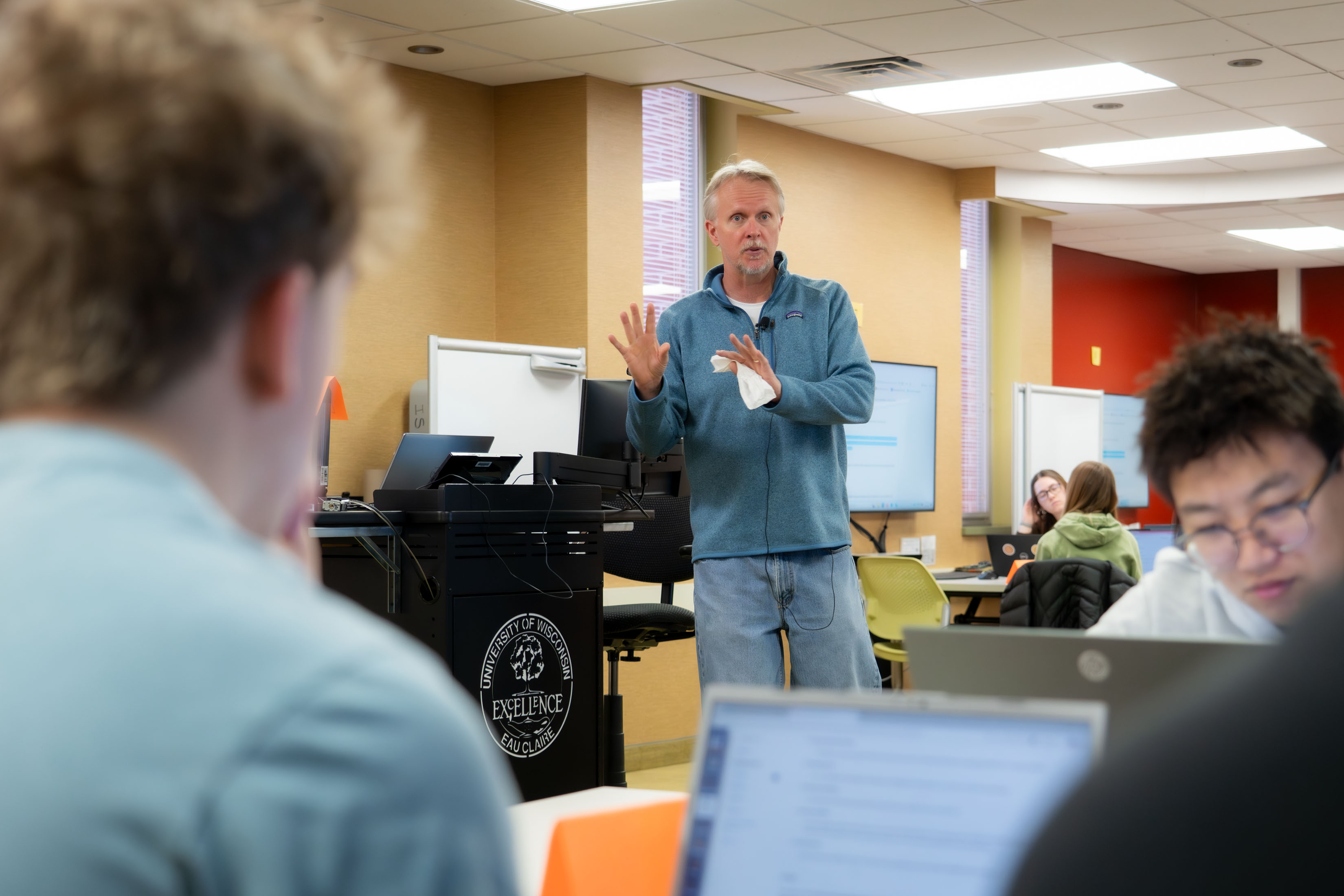
“ISABEL is actually an acronym, which I did not make up — I asked AI for suggestions of a good name for the model,” Sveum says. “It stands for Information Systems and Business-Enabled Learning.”
Sveum says he also wanted ISABEL to have some human-like empathy and an engaging way of not just answering student questions but sparking a progression of thought driven by the students.
“My IS 240 students ‘ask ISABEL’ when they are in doubt, as at least as a first attempt to find the information they need,” Sveum says.
“Of course, I’m still available to my students the same as always, but ISABEL can usually help guide them to an answer through prompts they come up with on their own, and there’s an advantage in that.” Sveum says.
An added benefit to students is that the AI teaching aid is available to students around the clock, any day of the year. Sveum notes that the way ISABEL is built, the logic requires students to carefully craft their questions, consider the reliability of sources they use and become “skilled discerners of information.”
“ISABEL is not built to be an answer machine — it was designed to expand critical thinking,” Sveum says.
AI as a learning tool for coursework and modern life
While ISABEL may be a novel specific use of AI on campus, students and faculty at UW-Eau Claire have been using generative AI and predictive modeling for a while now. According to Dr. Lisa Jepsen, dean of the College of Business, ISABEL is just the latest of many useful applications of this technology.
“Our students use AI in classes throughout our business curriculum, including editing professional communications, analyzing data and forecasting trends, receiving coaching feedback on sales pitches and presentations and many more industry-driven applications,” Jepsen says.
She adds that with ISABEL, Sveum has now given an inspiring example of AI use in business realms like customer service.
“Developing a support system for students with questions when faculty are unavailable demonstrates creative problem-solving,” she says. “In today’s world, customers have come to expect immediate answers to their questions, and ISABEL shows them what’s possible through this technology.”
Takeaways for students and faculty
As Jepsen points out, through tools like ISABEL, Blugolds are seeing practical applications of AI in ways that far exceed the technology’s ability to find a quick factual nugget. It can even help with basic study approaches like time management.
Sophomore accounting major Mason Hughes finds that ISABEL provides time-saving suggestions for his workflow which he says have enhanced his overall learning in IS 240.
“I found ISABEL most useful in helping me think through the approach to complex assignments,” says the Mahtomedi, Minnesota, native.
“I would give ISABEL the instruction document and she then suggested a step-by-step process to best complete it. This allowed me to more deeply focus on the content of my responses rather than spending my efforts deciding how to even start the project. ISABEL’s help in breaking things down logically made the assignments more approachable.”
Hughes has been grateful for the opportunity to become more adept in the use and understanding of AI in this classroom setting.
“AI use in the classroom is one of the greatest ways to get students to adapt to this technology early and in the proper way,” Hughes says.
“Rather than avoiding the use of AI, I believe embracing it through uses like ISABEL will help students employ it to further their learning — not as an alternative to their learning.”