ID
Story Categories
Authored on
Blugold researchers at forefront of community PFAS testing
Published on:
Intro text

Researchers at the University of Wisconsin-Eau Claire and the Eau Claire City-County Health Department are currently collaborating on a research project aimed at increasing local identification of one of the biggest public health concerns in the nation — drinking water contamination from per- and polyfluoroalkyl substances, or PFAS.

Sections

These human-made chemicals, upwards of 4,000 distinct compounds, according to state experts, resist heat, grease and water. They have been prevalent in cleaning products, cookware, water-and flame-resistant fabrics and personal care products for decades. The widespread use of these chemicals over the past 50 years has left traces of them throughout the environment, particularly in critical resources such as drinking water.

For third-year geology major Avery McKeown-Robbie, this collaborative water research opportunity has aligned perfectly with her academic interests and her passion to create a healthy environment and remediate hazards.

“Through our well sampling, we have been able to connect with homeowners, hearing stories about their homes and land, glimpsing each of their unique lives and building a connection with the community,” says the Naperville, Illinois, native.

“This was one of my favorite parts about the fieldwork and collaboration with health department colleagues — being able to connect face-to-face with the community members directly impacted by PFAS contamination and the subsequent guidance toward a safe solution.”

A joint effort built on a history of shared resources

The academic health department partnership, established in late summer 2025 between UW-Eau Claire and the ECCCHD, provided the framework to expand on an already vital relationship between the university and local public health professionals.

Dr. Sarah Vitale, associate professor of geology and environmental science, says she has long collaborated and data-shared with the ECCCHD and other area agencies on water quality testing and studies, and is grateful for the bigger impact those connections can now facilitate.

Sarah Vitale geology faculty
Dr. Sarah Vitale, associate professor of geology and environmental science

“When the health department testing began to see positive PFAS results in the southwest part of the county, we were able to get additional grant funding to greatly expand our own PFAS testing,” she says.

At that time, Vitale and student researchers had been conducting other types of standard water quality tests on wells in the county along with “a handful” of PFAS tests, student work funded by Freshwater Collaborative of Wisconsin.

"Then, the health department put out a press release asking for property owners in Eau Claire County to reach out if they were interested in having their well water tested for PFAS chemicals,” Vitale says.

“Our efforts ran parallel, and the university priority was not only to ensure people were not drinking from contaminated wells, but also that our data would be useful for the health department.”

Audrey Boerner, a project manager with the ECCCHD, says the partnership with UW-Eau Claire on these efforts has been invaluable.

“The task is huge — there are over 10,000 private wells in Eau Claire County,” Boerner says. “About one in four people are on a private well for drinking water, wells that are not regulated or tested unless a homeowner seeks a test. Once we started seeing county exceedances in PFAS, it became more urgent to contact owners with recommendations to test, and Sarah's group had the capacity and the interest to take that on.”

Boerner says that in all instances of a PFAS exceedance, residents are advised of the options to address the problem, which range from a new well, a treatment system, bottled drinking water or some combination of those.

According to the Wisconsin Department of Health Services, potential health impacts of PFAS exposure may include:

  • Rising cholesterol levels
  • Decreased vaccine response
  • Increased risk of thyroid dysfunction and disease
  • Increased risk of certain cancers
  • Complications of pregnancy such as high blood pressure or low birth weight
Meg Walker collecting well sample from outdoor spigget
Meg Walker collecting a water sample at an Eau Claire County residence.

“We work with them on remediation and inform them of the possible risks,” Boerner says. “We then contact neighboring well owners to encourage that they test for PFAS, similar to the process we use for some other drinking water concerns."

Vitale points out that asking for percentages of positive PFAS tests in their data isn’t exactly predictive because they are intentionally testing in areas near existing PFAS exceedances.

“In that respect, our methodology is somewhat skewed toward positive results,” Vitale says about public health risks connected to their data. “But it’s important to test those wells most likely to have PFAS.”

Both Vitale and Boerner emphasize the miniscule level of PFAS that constitutes an exceedance, an amount deemed capable of creating health problems.

“With anything above 4 parts per trillion in a sample, research shows there is an increased risk for long-term use of that water leading to health impacts,” Boerner says, adding that more common water contaminants like nitrates, lead or copper have health-related limits for drinking water set at much higher levels.

Vitale explains it to students this way:

“I've described the 4 parts per trillion as the same as four backpacks in the state of Wisconsin, four average-sized backpacks in the entire square mileage of the state. It’s wild,” Vitale says.

Both Vitale and Boerner say that communication with property owners is key, as requesting these tests can be a difficult choice when the financial and other resulting outcomes can be daunting.

“It’s a vulnerable position for people to put themselves in, to say, ‘Yes, test my water,’" Vitale says. “Communicating in a way that helps residents feel supported and well-informed has been important to us.”

Blugolds gain expertise, a community gains knowledge and better health

We know that the variety of out-of-classroom learning at UW-Eau Claire is often the difference maker in a Blugold degree. And research opportunities like this PFAS study, research with serious implications for public health, provides that invaluable learning experience for the students involved.

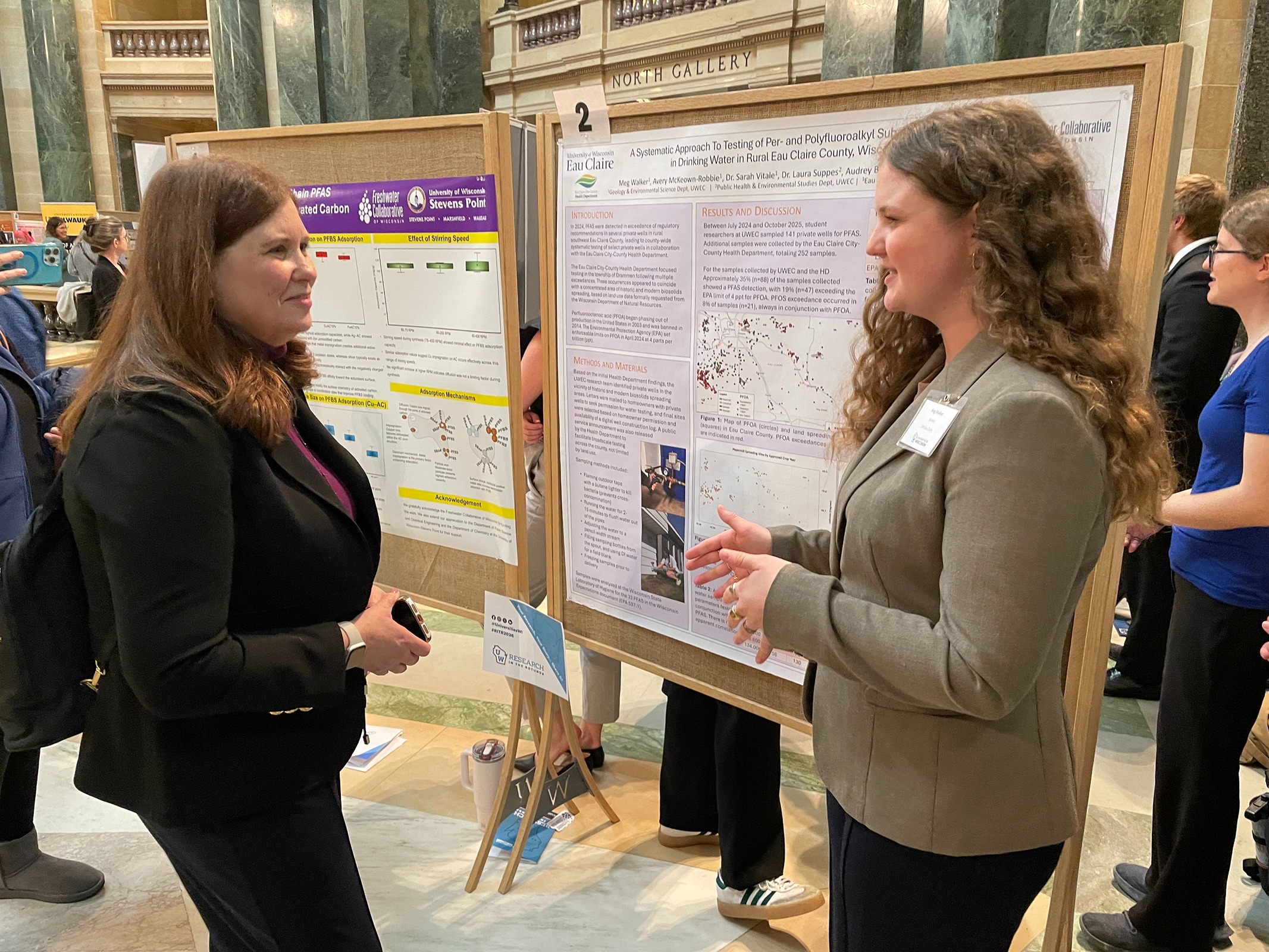
Meg Walker is a senior from Lancaster, majoring in geology with environmental science emphasis. On March 11, Walker presented her PFAS research study at the annual Research in the Rotunda event in Madison, a Universities of Wisconsin-sponsored celebration of undergraduate research.

“As one of six projects across the state to represent the Freshwater Collaborative of Wisconsin, I feel very grateful,” Walker says. “This organization is dedicated to increasing opportunities for student research on issues dealing with the freshwater resources in our state. Everyone and everything requires clean water; I am very fortunate to help aid in preserving our surface and groundwater systems.”

Meg Walker discusses her research with Gov. Tony Evers and Universities of Wisconsin President Jay Rothman at the Research in the Rotunda event March 11 in Madison.
Meg Walker had the special opportunity to share her PFAS research with Gov. Tony Evers, foreground, and Jay Rothman, president of the Universities of Wisconsin System.

As Walker’s poster abstract explains, her field study alongside research partner McKeown-Robbie is in data analysis phases but clearly will have significant impact on the ways in which the ECCCHD advises residents moving forward. The abstract reads, in part:

“Between July 2024 and April 2025, student researchers at UWEC sampled 141 private wells for PFAS and the Eau Claire City-County Health Department sampled 111. Samples were analyzed at the Wisconsin State Laboratory of Hygiene. The total of samples collected detected PFAS in approximately 35% of the samples, with 19% exceeding the EPA limit of 4 ppt (parts per trillion) for PFOA.”

Walker says the study will continue next fall with McKeown-Robbie as the lead student researcher, with assistance on data analysis from UW-Eau Claire public health master’s student Alexis Boehm.

“A major benefit of the project for me is the collaboration with the Eau Claire City-County Health Department,” Boehm says.

“Working alongside local health professionals provides valuable hands-on experience and shows me how environmental health research can directly inform community health decisions. Opportunities like this are a big reason I chose to continue my graduate studies at UW-Eau Claire.”

McKeown-Robbie echoes the sentiments of both Walker and Boehm, sharing that what she has learned outside of her classes may have as great an impact on her career as classroom learning.

“I never expected to be a part of such an impactful project within my undergraduate career,” McKeown-Robbie says.

“Before I even committed to a university, I already had a dream in mind — to attend and present my research at the Geologic Society of America Conference as an undergraduate.

“Then, in the fall of my junior year, the dream I set at age 17 came true. I presented my research on PFAS contamination in Eau Claire County at the 2025 Geologic Society of America Conference in San Antonio, Texas. It is truly hard to put into words how important this event was to me,” McKeown-Robbie says.

A mutually informative and beneficial partnership

While the university may often focus on the student and faculty benefits of community collaborations, Boerner emphasizes the importance of student contributions to organizations that exist in an ever-changing landscape of science, technology and innovation.

“Public health is changing and our understanding of our environment is changing all the time,” Boerner says.

“Working with students and faculty who are at the front edge of interpreting those changes is really helpful for us to better serve the public and give them the most updated and useful information that we can. That’s a win-win for everyone.” 

Top image caption: At the Research in the Rotunda event in Madison, Meg Walker, right, presents her PFAS research to Kathy Blumenfeld, secretary of the Wisconsin Department of Administration.

Meg Walker and Avery McKeown-Robbie
Meg Walker, left, and Avery McKeown-Robbie spent hundreds of hours driving to residences in Eau Claire County in 2024-25.
For the media
For the media
Image download