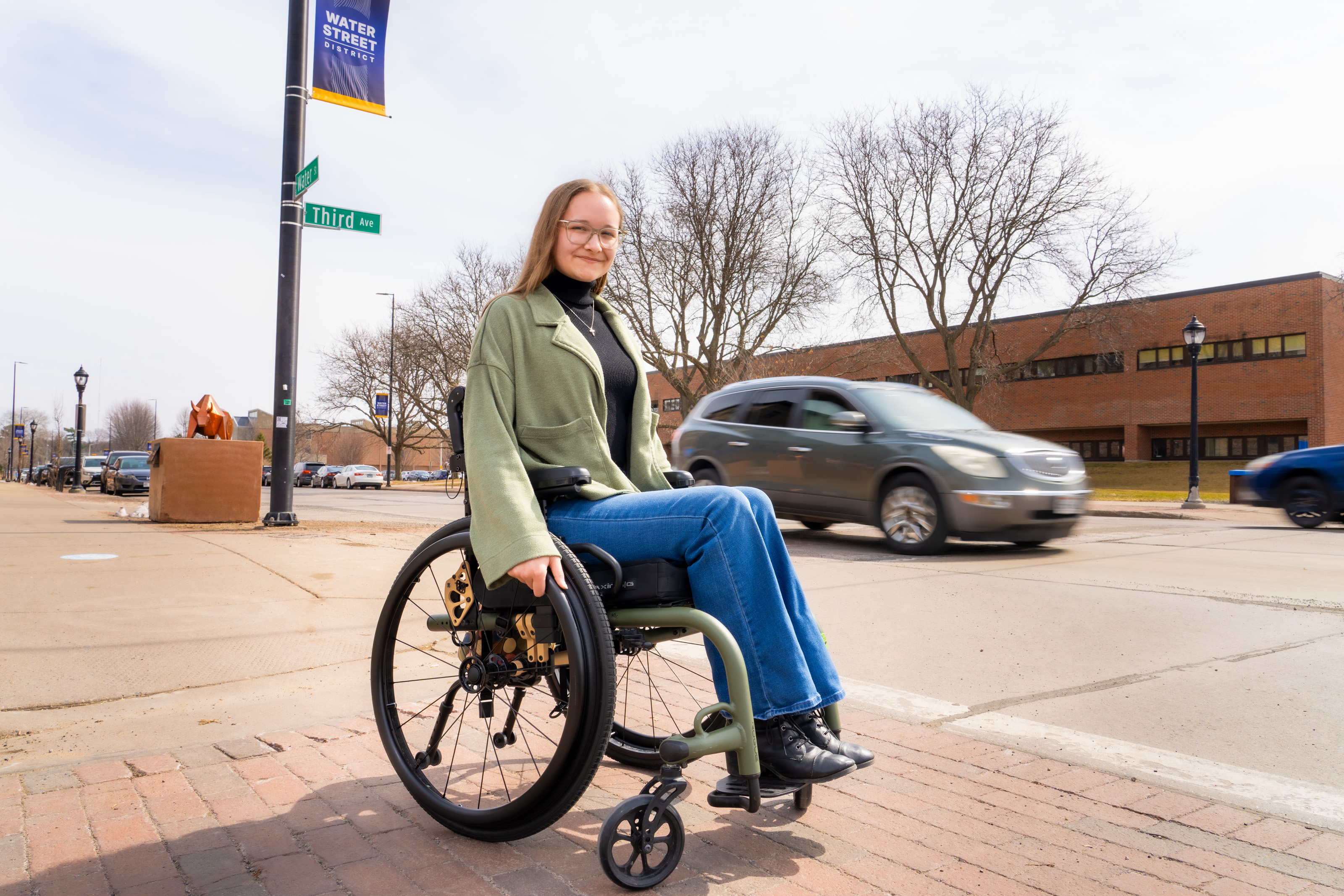
“I live in Aspenson Mogensen Hall on Water Street,” says the social work major from Altoona. “It’s the most accessible option in university housing for my specific needs as a wheelchair user. It was quickly apparent to me that crossing Water Street to go to campus from my building was not easy. Car and bus traffic is steady, parked cars block the view, and I often need to roll my chair well into the street before I can even see if it’s safe to cross.”
Roth says she took her parents’ advice. When something is bothering her, she knows the best next step is to track down the person or people who could fix the problem.
After a series of inquiries and emails, Roth’s letter of concern made it to the proper city official. Now, thanks to one assertive Blugold student, a rapid-flashing LED beacon signal for pedestrians is scheduled to be installed at the corner of Water Street and Third Avenue this spring.
“Of course, I was concerned for myself and the other two wheelchair users in my building, but this safety feature will make a difference for a lot of people who live or work in this area,” Roth says.
A student turned advocate
Roth says she became a regular wheelchair user as a senior in high school, and while she is still ambulatory to some extent, the chair is her main access to mobility.
“I’m still adapting to my mobility limits,” Roth says. “I can’t say that it hasn’t made the transition to college harder for me in some ways, but I’m finding my way through the obstacles and learning how to advocate for my needs.”
When it came to improving safety at the intersection near her residence hall, Roth narrowed her search for a solution to the Office of Engineering for the city of Eau Claire.
Al Rinka, deputy city engineer, was the main person to address the issue and find out what the best solution would be.
“Becca reached out to me late last summer with her concerns about her daily Water Street commute,” Rinka says.
“Becca suggested flashing pedestrian crosswalk signs because in her chair she is only 4 feet tall, less noticeable to drivers and unable to see past parked cars.”
Rinka says that the city must carefully analyze each location where such a crossing light is requested, relying on collected data to determine if the cost is warranted.
“Fortunately, after collecting and analyzing the data for this Third and Water Street intersection, we did find that all thresholds were met, and a $10,000 system could be installed. All parts are being shipped, and we expect installation this spring.
“We really appreciate when members of the community bring these types of safety concerns to our attention,” Rinka says. “It’s a win for everyone when we can actually do something to improve safety for our citizens.”
Spreading disability awareness among peers and neighbors
For Roth, changes in her own mobility over time have led to more conscious awareness of physical and emotional barriers that she herself didn’t even recognize until they impacted her.
“Until you find yourself with this kind of mobility limitation, it’s easy to take many things for granted,” Roth says. “For most people, seeing handicapped parking spaces and an elevator in a building means it’s accessible. But can I reach the sink in the kitchen or the bathroom? Does the bathroom have bars? Are the counters and cabinets within my reach? Those are the factors that allow me to use a space, and they just don’t exist everywhere.”
Katie Bublitz, director of Services for Students with Disabilities at UW-Eau Claire, emphasizes that the barriers Roth faces and the ways institutions and municipalities handle them can truly make or break individuals’ success in daily life.
“Students with mobility disabilities face things that able-bodied students don’t have to think about,” she says. “These can include safely crossing streets, taking different, often longer routes to get somewhere because it’s more accessible, being negatively impacted by inclines of sidewalks or cracks in the pavement or accessible door openers not working.”
Bublitz says she is inspired by the students she advises, students who often see unique opportunities for things to be done in totally new ways that nobody has thought of before. She says these creative thinkers come up with ways to make their world better, and not just for themselves.
“I am so proud of Becca and her success in making a physical change to the landscape of her city, making it a more inclusive and accessible space. I’m also grateful to live and work in a city that takes the needs and concerns of its residents to heart and is willing to make changes.”
A new student organization to bring more change for the better
Since meeting other students on campus who use a wheelchair or have other types of disabilities, Roth has been motivated to push the envelope even further in creating a more accessible and welcoming campus community. One way she and her friends are doing that is the establishment of a new student organization.
“We have applied as a new official student organization, a local chapter of a national organization called DREAM, which stands for disability rights, education, activism and mentoring,” Roth says.
DREAM was created as an online disability cultural center specifically for college students, as part of the federally funded National Center for College Students with Disabilities based at the University of Minnesota’s Institute of Community Integration. The group is open to students with any type of disability.
“It’s very new, but our goal is to look for projects around campus to improve all kinds of accessibility,” Roth says.
“One of our first projects is coming up, a meeting with city officials to take them on a tour of Water Street from the perspective of students with disabilities, pointing out the challenges that just this one portion of our environment can pose.
“We are also hosting an adaptive recreation day called 'Try it Out Day' on April 16. It will be a chance to try different sports or activities adapted to wheelchair use,” Roth says.
One aspect of campus life that Roth says DREAM can help offset is the isolation of being a student with disabilities, students who often miss out on simple daily social interaction in places like the cafeteria.
“The Hilltop cafeteria is not really an option for me; riding the conveyance van turns it into a very long ordeal,” Roth says. “And getting over to Davies Center Marketplace isn’t much easier. Those are the spaces where so much social interaction takes place. Having the DREAM group and regular activities like games and meals together will be nice.”
One other way Roth has chosen to shape her own destiny is by joining hall council and applying to be hall president in Aspenson Mogensen.
“I figured one way to make sure there were hall events planned that would be accessible to me was to become the person creating events, so I went for it and I’m now president. It has been fun so far to think about ways to boost participation and come up with some interesting and inclusive events,” she says.
In continuing to follow her parents’ mantra, Roth has discovered that sometimes when you “see something,” the person you most need to influence for change is yourself — something she says she is ready and willing to do.