ID
Authored on
UW-Eau Claire meets area teaching needs with new certificate program
Published on:
Intro text

Part of the mission of the University of Wisconsin-Eau Claire is to shape curriculum to meet workforce needs. A new certificate offered in the College of Health and Human Sciences is doing just that, with the first students completing certificates this past August.

Sections
The Bilingual-Bicultural Education Certificate is a 12- to 14-credit hybrid-delivery program that equips both current undergraduates and in-service teachers with a license endorsement to teach in bilingual-bicultural, also called dual immersion, classrooms in the state. These are classrooms that have a 50-50 mix of heritage language-speaking and English-speaking students.

The goal of these classrooms is to have all students learn both languages. Curriculum is delivered in both languages, usually by alternating which language is used for different subjects, though there are many models for bilingual education. Currently, UW-Eau Claire can endorse for licensure bilingual-bicultural teachers who want to teach in Spanish-English or Hmong-English schools.

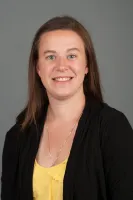
Dr. Abby Hemmerich, professor and interim chair of the education studies department, emphasizes the strong collaborative atmosphere between the university and the local schools that makes innovative solutions like this certificate a reality.

Abby Hemmerich department photo
Dr. Abby Hemmerich, professor and interim chair of the education studies department
"The collaboration between faculty at UW-Eau Claire and its partners in the Eau Claire Area School District, where students complete the field experience component, has been essential for getting this program off the ground," Hemmerich says.

“We are excited to see the collaboration grow to include other districts, giving students valuable teaching experience and filling a staffing gap in those schools. There is a significant need for teachers who are qualified to teach in bilingual-bicultural programs, so this program is an exciting step in supporting our regional schools.”

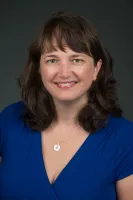
Dr. Anne Hlas, professor of Spanish in the languages department at UW-Eau Claire, was an initial program coordinator for the certificate. She says the Eau Claire Area School District was looking to grow its K-5 bilingual Spanish program at Longfellow Elementary School but needed to find more qualified teachers.


Anne Hlas 2016
Dr. Anne Hlas, professor of Spanish

“The university wanted to support not just Longfellow, but other areas with changing populations, like nearby Abbotsford. We knew that a certificate program with some online flexibility would be a great answer,” Hlas says.

“This certificate is really a high value add-on to a teaching license. It will expand learning opportunities for children and families, and it will open doors for Blugold graduates to teach in these specialized classrooms. In addition to the language acquisition, there is a real added benefit on a bigger scale — it also raises levels of cross-cultural attitudes and globally minded students and teachers,” Hlas says.

First certificates completed in summer 2026

Dr. Cristina Betancourt, assistant professor of education studies and advisor for the teaching English as a second language minor and the bilingual-bicultural certificate, says that the undergraduates electing to complete the certificate are a mix of Spanish teaching majors, elementary education majors and secondary education majors.

“We have our first in-service teacher enrolled in the program this fall, one of our grads who was offered a job in a Wisconsin bilingual school and was able to accept and teach while completing the certificate credits,” Betancourt says.

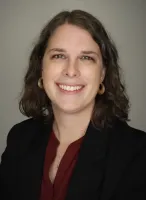
Headshot of Professor
Dr. Cristina Betancourt, assistant professor of education studies

Prior to the UW-Eau Claire certificate, licensed practicing teachers in this part of the state only had an online, fully asynchronous program option through CESA, the state’s cooperative education service agency.

“It’s nice that we can now offer valuable in-person evening courses for practicing teachers in this area,” says Betancourt, adding that most practicing teachers complete the program in two years with one course per term. Depending on qualifying previous coursework, that timeline may be shorter for some.

Ava Hoffmann is a summer 2026 UW-Eau Claire education graduate. She was one of the first two graduates to complete the bilingual-bicultural certificate, along with her majors in Spanish and teaching English to speakers of other languages (TESOL), K-12 teaching and Latin American studies. Hoffmann accepted her first job in Arvada, Colorado, where she is teaching Spanish to middle and high school students.

“The bilingual-bicultural certificate courses and my time in the BLBC classroom at Longfellow added significantly to my level of preparation for teaching,” Hoffmann says. “I’m not currently teaching in a bilingual classroom, but my Blugold education in bilingual teaching pedagogy has strengthened my passion for language and has diversified my strategies for teaching it.”

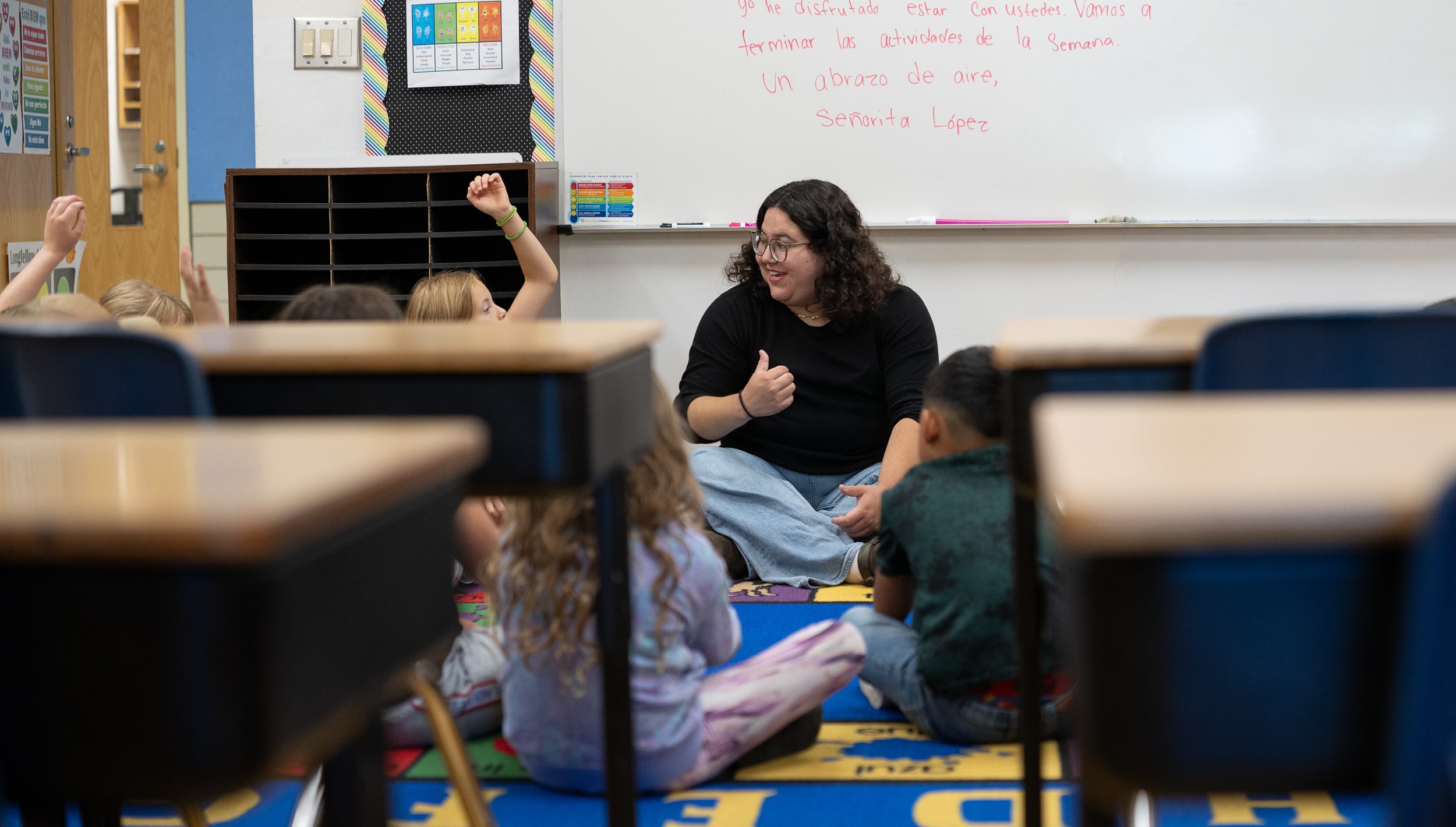
Ava Hoffman teaching in dual immersion classroom at Longfellow
Ava Hoffmann completed her Longfellow summer practicum as her final requirement to complete her degrees and bilingual-bicultural certificate. She says her three weeks in the dual language classroom offered the chance to teach more Spanish than all her previous teaching opportunities.

Longfellow began its English/Spanish dual language immersion program in 2019 with a kindergarten class and the program now spans all grades in the building. When families commit to the program through a lottery system, they agree to enrollment of their student through fifth grade.

Reanna Goodman is the kindergarten dual language immersion teacher at Longfellow, and she mentored the three Blugold certificate practicum students for the three-week summer school session. The Blugolds had an initial week of lesson planning before students arrived. Goodman says this certificate and the opportunities it brings students and instructors are exciting.

“Our dual classroom is a setting where Spanish language is seen as an asset and students who speak Spanish exclusively and occasionally will shine in this program,” Goodman says. “Plus, university students can see how language can be taught in a setting that is likely different from their own Spanish language acquisition experience; one that is immersive and structured to teach content along with language.”

Sophomore Zoe Rubenzer in Longfellow classroom
Sophomore Zoe Rubenzer says the Longfellow practicum helped solidify her hopes to teach in a similar dual immersion classroom after graduation. "I love the translanguaging setting, where the back and forth between English and Spanish is fluid and sometimes spontaneous — it's all completely intertwined."

UW-Eau Claire sophomore Zoe Rubenzer says that the summer practicum at Longfellow really ignited her drive to be the best K-12 language instructor she can become. For completion of Betancourt’s summer certificate course, ES 411/471: Methods of Bilingual/Bicultural Content-Based Instruction and Curriculum Design, Rubenzer submitted a paper discussing the dual immersion pedagogy and how she intends to apply it in her own teaching. Her paper read, in part:

“As a future educator, it is critical to dream. The truth is that there will always be challenges and barriers when creating and implementing a dual immersion program,” wrote the Spanish and TESOL teaching major who hopes to teach dual immersion in the future.

“My dream is that my vision can come to life with the help of family and community members so that we can transform education together. It is important to remember that these programs are designed for the students and their families, intended to create a safe space with open communication and culturally competent mindsets.”


For more information about the bilingual-bicultural certificate and the pathway to licensure to teach in dual immersion programs, please email the Teacher Education Program at tep@uwec.edu.

For the media
For the media
Image download