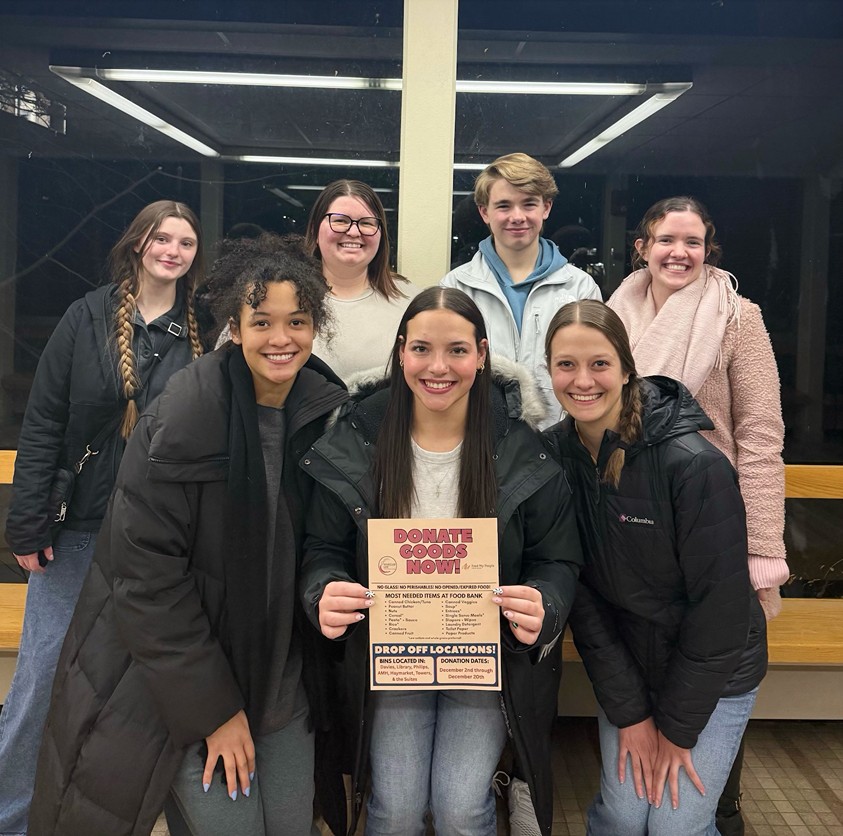
“One of our lab students, Rachel Horejsi, received an email from a STEM organization that was calling on scientists to support their local food banks during the lapse in SNAP benefits,” says Wheeler, assistant professor of biology. “Although benefits were restored during their planning phase, recognizing the ongoing needs, the planning forged ahead. None of our lab team members felt they were too busy to contribute to this effort. In addition to their organizing work, the students donated money the team has received in research awards.”
Nonperishable food and personal care items can be dropped off in bins located in the Student Senate office on the second floor of Davies Center, in McIntyre Library near the doors facing the river and in the first-floor hallway of Phillips Hall. Donations will be directed to the Feed My People Food Bank in Eau Claire. Find a list of most-needed items, as well as a QR code for donating digitally.
Horejsi, a senior microbiology major from Ellendale, Minnesota, says that Feed My People offered great support in the logistics of the drive, including setting up of a fundraising page which was crucial for success in reaching the $500 fundraising goal. She says the team will opt to leave distribution of the proceeds to Feed My People, which supports many area pantries.
“UW-Eau Claire is within the greater community, and we see ourselves as part of a greater cooperative effort to fight food insecurity everywhere in our region,” Horejsi says. “Therefore, we plan to let Feed My People determine designation based on community needs.”
Learning together beyond lab work
For lab team member Declan Algrem, the option to create and execute this food drive gets to the heart of being an active part of the campus community.
“Something we have learned through this process and want to make more widely known is that food insecurity is a bigger problem than most students understand,” says the junior biology major from Green Bay.
“The notion that some of my fellow students could be dealing with food insecurity has motivated me to contribute. Nobody should have to go without sufficient food.”
For Wheeler, seeing students apply their impressive work ethic in his lab to the community around them is rewarding.
“One fun result is that while we were planning, we were also recruiting three new students to start doing research with us,” Wheeler says. “Although these new students haven’t begun lab experiments yet, they’ve already made meaningful contributions to the food drive. Seeing our senior students mentor newer members is a great example of inclusion.”
Wheeler says this experience has him rethinking the onboarding process for the lab — potentially making a service project part of the winter routine to build meaningful camaraderie and welcome new students.
Horejsi, a recent Goldwater Scholarship recipient, has taken this project as another opportunity to apply her skills in scientific experimentation.
“Like so much of science, hunger is a multifactorial problem,” Horejsi says.
“When there are multiple factors involved, it creates complex interactions that can be hard to tease apart. Hunger is a systematic problem, but systems take time to change or evolve. You can’t fix it overnight, but a food drive effort like this one allows us to make progress in the meantime,” she says.
And to fellow busy students who wonder how they can make a dent in community issues, from food insecurity to a host of others, Horejsi has a tip.
“Ask yourself, ‘If not me, who?’”
And she reminds others that the vision is as important as the outcome.
“It’s about trying to make a tangible impact in your community. Find a way to focus on that.”
Visit the Feed My People Food Bank website for more information about creating a food drive of your own in the future.