ID
Authored on
Blugold eager to enhance patient care and save lives through humanities-infused healthcare
Published on:
Intro text

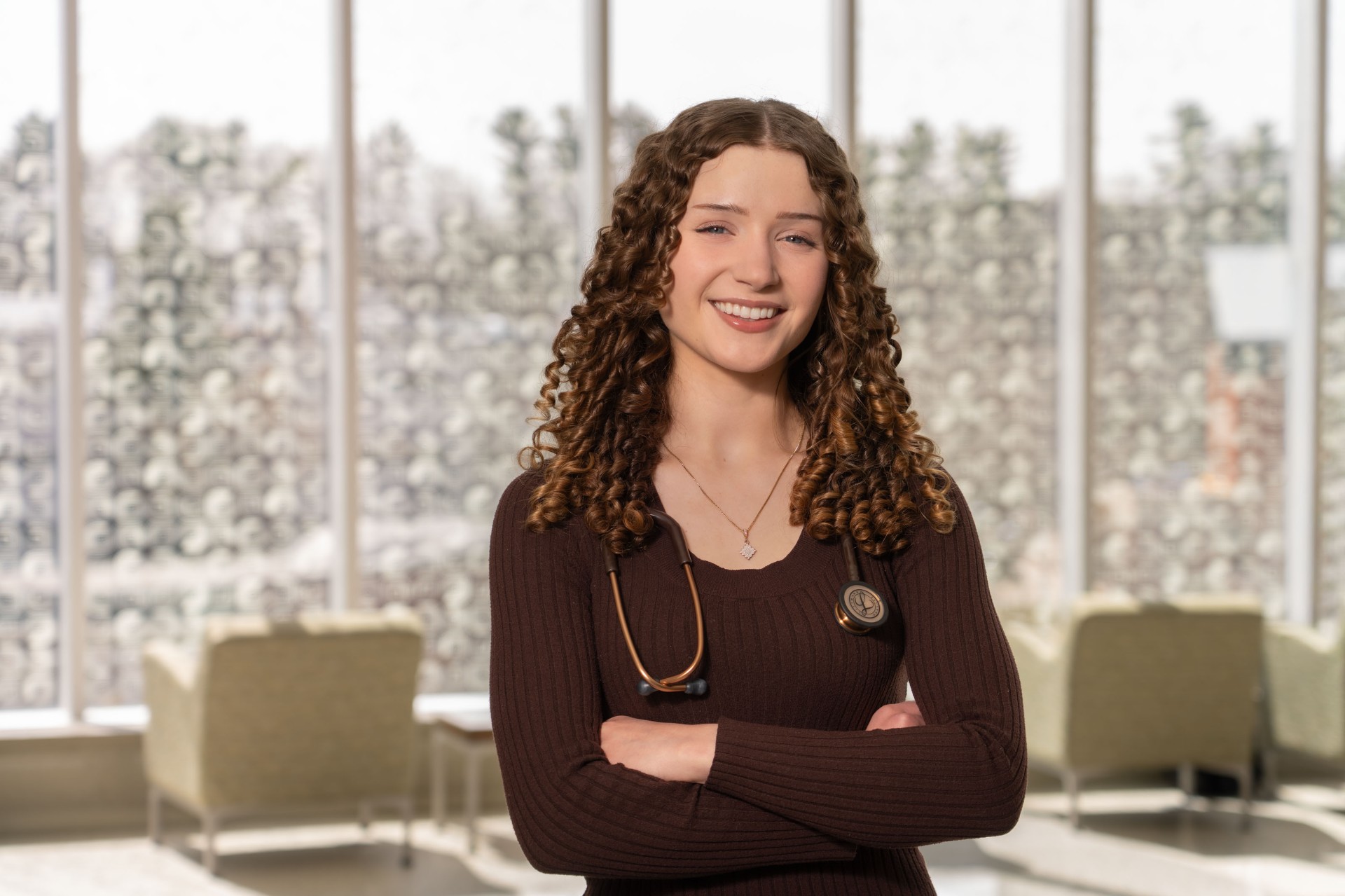
When Faith Oldenburg is not honing her nursing skills in the simulation lab or conducting nursing education research to help her peers recognize and treat critical conditions like postpartum hemorrhage, she is immersing herself in language and cultural studies.

Sections

After four years of hard work and unwavering determination, Oldenburg will graduate from the University of Wisconsin-Eau Claire this month with bachelor’s degrees in nursing and Spanish. In addition to her degrees, she will also take with her meaningful experiences and knowledge in critical Hmong studies that will prepare her to administer culturally responsive, lifesaving care.

To say Oldenburg has worked hard to ensure she will leave campus with a holistic education is a dramatic understatement. She has been a busy Blugold.

A mission to heal and save lives

Oldenburg’s mission to heal and save lives became clear after she suffered a concussion in high school.

“I’ve always been very passionate about science since I was a young girl, and the health professionals who cared for me inspired me to pursue a healthcare career because of the impact they had on my life,” Oldenburg says. “I decided to choose nursing because I really wanted to pursue a health career in which I could be with my patients as much as possible. That human-to-human interaction is so beautiful and so impactful.”

Faith Oldenburg

Her passion for patient care and concern about the lack of Spanish interpreters in hospitals led the Madison native to initially pursue a nursing major and a Spanish for health professions minor at UW-Eau Claire. During her freshman year, Oldenburg realized she would finish her minor early, and because she was determined to retain and expand her Spanish skills, she met with Dr. Elena Casey, associate professor of Spanish.

Casey knew a double major in nursing — a comprehensive degree — and Spanish would be a challenge, but one Oldenburg would be able to meet.

“Faith has this clear direction for what she wants to be able to do and what she needs to be able to do it,” Casey says. “To be able to provide the culturally responsive care, the level of attention to the health needs of patients she may be working with, she knew she needed to maintain her language development. I think because she was so regularly meeting both with her nursing advisors and with me as her Spanish advisor, she was able to make it work, and because she's tenacious.”

Prioritizing critical Hmong studies and intercultural care

Oldenburg’s tenacity also shows in the coursework she completed in critical Hmong studies.

“I was inspired to pursue Hmong studies for both professional and personal reasons,” Oldenburg says. “My partner is Hmong, and many members of my friendship group and personal community are Hmong as well. Educating myself became a priority, both for my relationships, and also for my practice as a nurse, because cultural competency is so necessary in order to provide excellent healthcare. Too often, Hmong communities are overlooked and not served adequately.”

Dr. Mai Neng Vang, adjunct professor of critical Hmong studies, taught Oldenburg in her Hmong American Experiences in the U.S. course.

“After class, she would wait to ask me questions related to that day’s topic or lesson,” Vang says. “We'd spend anywhere from 15 to 30 minutes just talking. I always really appreciated those conversations because a lot of them were clarification questions, but much of it was just her thinking much deeper about the content.”

Oldenburg’s quest for knowledge led her on a global journey. In Puebla, Mexico, she completed a pre-medicine internship that expanded her medical, Spanish and intercultural care skills.

On a Hmong studies immersion experience in Laos, Vietnam, Thailand and China, Oldenburg learned from Hmong communities and formed lasting relationships. She also analyzed how colonialism, displacement, genocide and cultural erasure continue to impact the global Hmong community.

Faith Oldenburg in Ban Long Lan, Laos
Oldenburg stops to admire the view while picking vegetables in Ban Long Lan, Laos, during her Hmong studies immersion trip.

“It deepened my awareness of Hmong culture, history, epistemologies, art and language in ways that have helped me to connect better with the Hmong community here and will aid me in serving future patients and providing care that is culturally competent. It also really stoked a fire in me to continue learning, engaging and relating with Hmong studies here at UW-Eau Claire and to advocate for the continuation of critical Hmong studies on campus and for the community here, which I care about so much,” Oldenburg says.

Civil Rights Pilgrimage and research experiences

Oldenburg also traveled with other Blugolds to several southern states on the Civil Rights Pilgrimage, an immersion experience that explores the history of the Civil Rights Movement. The experience challenged Oldenburg’s perspective of systemic oppression, including within healthcare.

“My experience on the trip led me to go on a deep dive trying to research and educate myself on the connection between racial injustice and health disparities. That was part of why I wanted to become a Civil Rights Pilgrimage coordinator, to continue passing on the knowledge that I had learned on the trip itself and then also to incorporate more discussion regarding the intersection between race, bias and healthcare,” Oldenburg says.

Faith Oldenburg, right, educating Civil Rights Pilgrimage participants
Oldenburg, right, educates Civil Rights Pilgrimage participants about the racist, unethical history of experimentation in modern gynecology at the statue of Dr. James Marion Sims, located at the Alabama State Capitol.

Oldenburg inspired others to go on the pilgrimage, including her professor, Dr. Gail Hanson Brenner, assistant professor of nursing and president of the Wisconsin Nurses Association.

During the trip, Hanson Brenner was impressed with Oldenburg’s presentation on racial bias in healthcare. For the last three semesters, Hanson Brenner has invited Oldenburg to share the presentation with first-semester nursing students in the Foundations of Professional Nursing Practice course.

Oldenburg also finds joy in sharing knowledge through research and recently reached a milestone beyond her wildest dreams: becoming a published researcher. Oldenburg worked with Dr. Sanchita Hati and Dr. Sudeep Bhattacharyay, professors of chemistry and biochemistry. Their project, “Understanding the Molecular Mechanisms that Govern Opioid Potency Through a Course-embedded Computational Research Project,” was published in the American Journal of Undergraduate Research.

Even in the busy days leading up to her graduation, Oldenburg continues to excel in her scholarship work. She recently presented “Forced Sterilization in Puerto Rico: From Past to Present" at this year's Provost’s Honors Symposium on campus. Originally developed in Casey's Spanish for Health Professions course in the Spanish language, the project examines how forced sterilization in Puerto Rico occurred and aims to promote awareness to prevent similar atrocities from happening in the future.

Post-graduation plans

As Oldenburg’s college journey comes to an end, she now prepares for her next milestone: starting her first job as a registered nurse at UW Health in Madison, where she will join the medical-surgical team.

Oldenburg’s ultimate goals are to earn a doctoral degree in nurse-midwifery and to serve patients in a community health setting.

“I'm very passionate about maternal health and maternal health justice,” Oldenburg says. “We have a maternal mortality crisis here in the United States, and that is especially true for underserved communities. Anything that I can do to be a part of providing better care and bridging the care gaps that exist is what I want to do.”

Hanson Brenner looks forward to what Oldenburg will accomplish in her career.

“I really think that she will bring so much more to the profession of nursing than what most people realize, just with her passion. I think that Faith has insight into larger problems than just what's right in front of her, meaning that she will be able to take care of patients and understand their needs more like an expert nurse rather than a novice nurse,” Hanson Brenner says.

Oldenburg also plans to become a certified healthcare Spanish interpreter and to continue learning Hmong.

Casey and Vang believe that multilingual and culturally competent providers help build trust and connection with patients. Casey also says that establishing trust early can be lifesaving in healthcare situations where every second counts.

Vang says Oldenburg brings another special quality to the healthcare system, where disparities related to race and class persist.

“It’s important that we train future healthcare workers to be culturally sensitive,” Vang says. “But I think beyond that, what Faith is doing is more than just culturally sensitive. She infuses her practice with love and care for people from all backgrounds.”


Written by Kelly Austin, a writing intern in University Communications. She is a junior at UW-Eau Claire majoring in English with an emphasis in creative writing and minoring in interdisciplinary linguistics. She is from Eau Claire.

For the media
For the media
Image download