Art exhibit, programming on Japanese American experiences in WWII engage UW-Eau Claire and Chippewa Valley
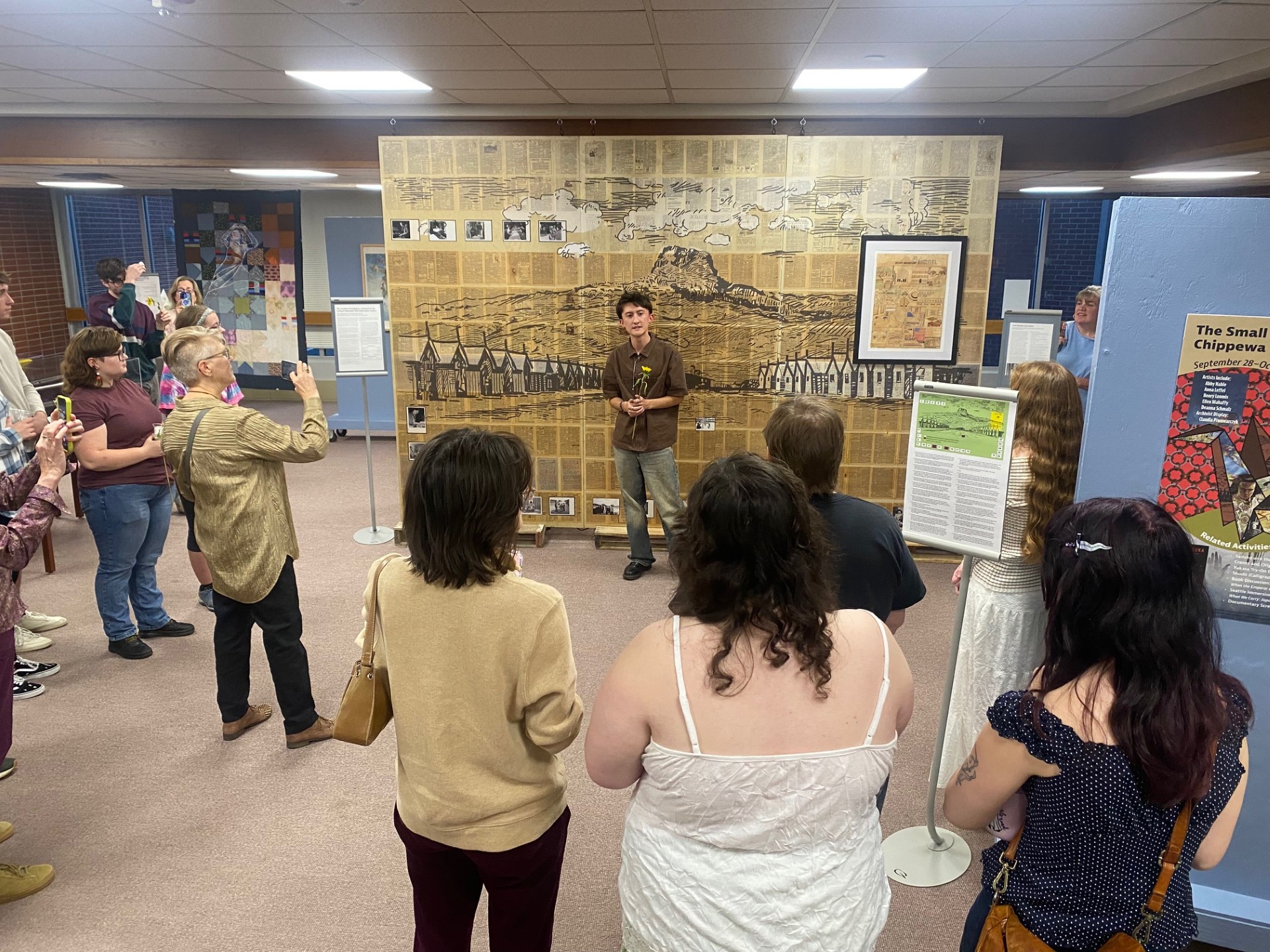
The McIntyre Library breezeway at the University of Wisconsin-Eau Claire is not designed to be an art gallery.
This month, however, a collection of impactful pieces and programming is filling the second-floor space with engaged Blugolds and community members.
“The Small and the Mighty: Chippewa Valley” exhibit, which opened Sept. 28, is on display through Oct. 30 and ties together local and U.S. history through archival research of four area women associated with UW-Eau Claire: Clarice Chase Dunn, Sarah Harder, Eleanor Jones and Pearl Robinson.
Dunn, a 1937 alumna of what was then called Eau Claire State Teachers College, is notably featured for her experience teaching adult classes at the Heart Mountain Relocation Center, a Japanese American incarceration center in Wyoming during World War II. Artwork by UW-Eau Claire students and faculty detail Dunn’s eight months at the camp from 1942-43 and her greater life story.
Abby Hable, a fourth-year student from Bloomer pursuing a major in studio art and a minor in Japanese, created several pieces about Dunn for the exhibit. Her manga, or Japanese comic book, which resembles The Heart Mountain Sentinel, the camp’s newspaper, and postcards connect Hable’s study abroad travels to Yokohama, Japan, last spring to Dunn’s during the Korean War.
“It was very pretty. It smelled of the sea,” says Hable, who created 20 watercolor paintings from the photos she took throughout her journey. “A lot of reflective surfaces.”
Included on each postcard are writings in English and Japanese to depict Hable’s efforts to learn and navigate a language different from her native one. She hopes viewers take in the postcards through the eyes of a Wisconsinite experiencing a new country.
Deanna Schmalz, a fifth-year studio art major from Minnetonka, Minnesota, focused on Dunn’s experience specifically at the camp. Her sculptural piece of clay and wire, titled “Never Again is Now,” reflects the ingenuity, creativity and determination demonstrated by the residents of Heart Mountain.
Ellen Mahaffy, professor of communication and journalism, created the exhibit’s largest item, a digital print on varnished birch plywood displaying issues of The Sentinel, War Relocation Authority photographs and Hable’s artwork about Dunn’ s life. Pieces featuring Harder, Jones and Robinson from UW-Eau Claire alumni balances out the exhibit.
“I think it turned out beautifully,” Schmalz says of the room. “It gives a really full picture of the people we've been researching that have their things in the Eau Claire archives and about Heart Mountain.”
In conjunction with the exhibit, Kai Hirata, a fourth-year senior majoring in sociology, has organized a series of related programming activities for anyone to attend. He is hosting a free student book club to read “When the Emperor Was Divine” by Julie Otsuka, and facilitating three cultural workshops through the Japanese Outreach Initiative at UW-Stout Polytechnic. The last one, a calligraphy workshop, will take place on Oct. 13. Previous experiences invited guests to try on yukatas, traditional robes worn at summer festivals in Japan, and to create paper cranes.
Register for the calligraphy workshop by visiting the library’s website.
Crane making stations are still available in the McIntyre Library breezeway and the L.E. Phillips Memorial Library in downtown Eau Claire. The goal is to send 1,000 paper cranes made through the exhibit to the Children’s Peace Monument in Hiroshima, Japan.
“I studied abroad in Japan the spring of my sophomore year and was able to visit Hiroshima. Just seeing the impact there and having that emotional impact present within myself,” says Hirata, a Japanese American, “it's a really, really important thing we're doing here and I'm really happy to be a part of it.”
Anna Zook, arts librarian and assistant professor in McIntyre Library, is fascinated by how many students have engaged in folding the cranes and is impressed by several exhibit pieces, including 13 artist books created by students who participated in the 2026 Domestic Intercultural Immersion Program’s trip to the Pacific Northwest over the summer. Zook’s biggest joy, though, has been seeing the impact of the workshops.
“People from the community, people from Stout, people from our campus are all coming together and having this shared experience and engaging in something,” Zook says.
Hirata hopes the art and programming continue to diffuse through the community and prompt important discussions about American history.
“The more time we spend intentionally discussing these things through creative spaces like this or even in conversation around our book, can really mean a lot to a lot of people,” he says. “The more we put into that, the more positive energy we’ll get out of it.”
You may also like