ID
Authored on
UW-Eau Claire educator camp brings materials science to secondary classrooms
Published on:
Intro text

There are a few extra teachers on campus at the University of Wisconsin-Eau Claire this week. They are not university faculty, however. A cohort of nine middle and high school teachers are attending a camp designed to incorporate materials science lessons and labs into their secondary classrooms.

Sections

And on just day three, the participants are already excited about the ways they plan to bring their new knowledge and understanding of materials to young students.

“I teach high school math,” says Marcia Weishaar of Arkansas City, Kansas. “I wanted to attend this camp so I can better demonstrate to my students how math applies directly to so many other subjects and career paths — dynamic fields like materials science. The examples I’ve already learned are so valuable.”

UW-Eau Claire’s turn to host national educator series

Co-hosted by UW-Eau Claire’s materials science and biomedical engineering department and the ASM Materials Education Foundation, the UW-Eau Claire camp is one of 37 ASM Materials Camps for Teachers hosted across the country in 2026. Wisconsin’s camp sites have rotated, with Madison hosting last year, and UW-Eau Claire is pleased to have this current opportunity to host.

“We are here to help secondary teachers better understand that materials-related programming can easily fit into their existing science curriculum,” says camp coordinator Dr. Matthew Jewell, professor and chair of the materials science and biomedical engineering department.

“Materials are all around us every day,” Jewell says. “This kind of teachers’ camp is to help them show their students the basic science at the molecular level and get them excited about what can happen next.”

Jewell says that materials science, at its core, is a bridge between learning how a material works and finding out what it can be made into.

“Every manufacturer in Wisconsin needs people with materials experience,” Jewell says. “It’s the connection between the chemistry and physics of the materials and the engineering of how we turn materials into usable products.”

For Robin Bolyard of La Crescent, Minnesota, returning to UW-Eau Claire for this educator camp was an exciting chance to visit her alma mater and take new skills back to her West Salem middle and high school STEAM classrooms.

“I’m a Blugold, so this opportunity was special,” says the 1991 education graduate.

“As a general physical science teacher, it is important for me to gain a depth of knowledge in specialty areas when possible. This camp is giving me the right language and methods to use in leading student understanding of these concepts. Materials science is such a perfect marriage of hands-on learning and application of scientific concepts. I can’t wait to bring these lessons to my classes.”

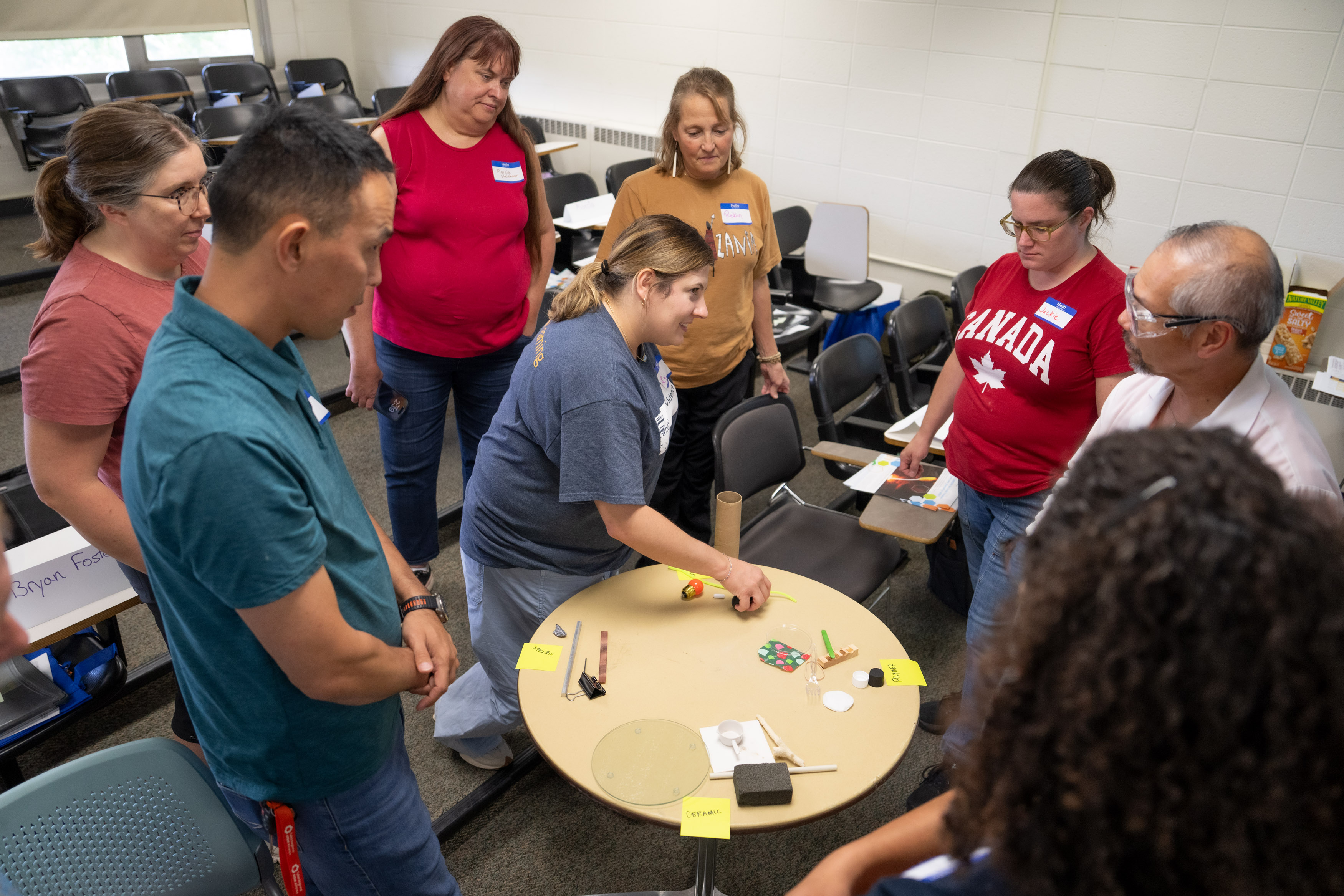
Science teacher camp scene in lab
Camp facilitator Dr. Bernoli Baello, center, is a chemist who transitioned to teaching science at the high school level and now teaches a materials engineering course in a Milwaukee area high school. This and the top image show the first-day lab session in which attendees identified classes of materials (metals, polymers, ceramics, composites, etc.) by the physical properties of the objects.

Camp attendees turned facilitators

As part of the co-sponsorship of the teacher camps, the ASM Materials Foundation provides facilitators for each of the nationwide camps. The UW-Eau Claire session this week is being facilitated by Anne Kavicky, a middle and high school science teacher in Algoma, and Dr. Bernoli Baello, a high school engineering teacher at St. Augustine Preparatory Academy in Milwaukee.

“I attended the ASM camps one and two in 2018 and 2019, and became a camp facilitator in 2021,” says Kavicky, who created a materials course for her high school in 2019.

Kavicky says the main goal of the educator camps is to give teachers the tools to help students grasp the basics of solid materials — metals, polymers, ceramics and composites.

“Most of what students learn at the high school level in chemistry relates to gasses and liquids, but solids are exciting for students to work with. They can see it, touch it and hold it in their hands, which seems to make the core concepts easier to understand,” Kavicky says.

Baello, who has a Ph.D. in chemistry, says he got involved with the ASM camps in 2013 as a means of professional development to widen his teaching expertise, and now facilitates camps like this session to “give back to the teaching community.”

“As a trained chemist and a high school materials engineering instructor, I have greatly benefitted from materials science and now get to show others what they can do in this exciting field,” Baello says about teaching both young students and high school teachers about the applications of materials science.

“My niece is now a materials engineer, and I have had several former students go on to study materials science and work in the field,” Baello says. “The thing about materials science is that everyone can relate, and kids can relate — materials surround us every day. It’s a complicated yet tangible and accessible science.”

The materials science and engineering program at UW-Eau Claire is available to help secondary STEM teachers develop materials-related content for their classrooms or to bring materials-related demonstrations to STEM classrooms. For further information, contact the department at matsci@uwec.edu.

For the media
For the media
Image download