Voicing their expression
Clemen’s interest in sociology began long before they stepped onto campus.
“I think it was part of discovering who I was as a queer and trans person,” she explains. “I got really into political and social issues through online spaces and through teachers who were formative for me. Sociology felt like a way to understand all of that.”
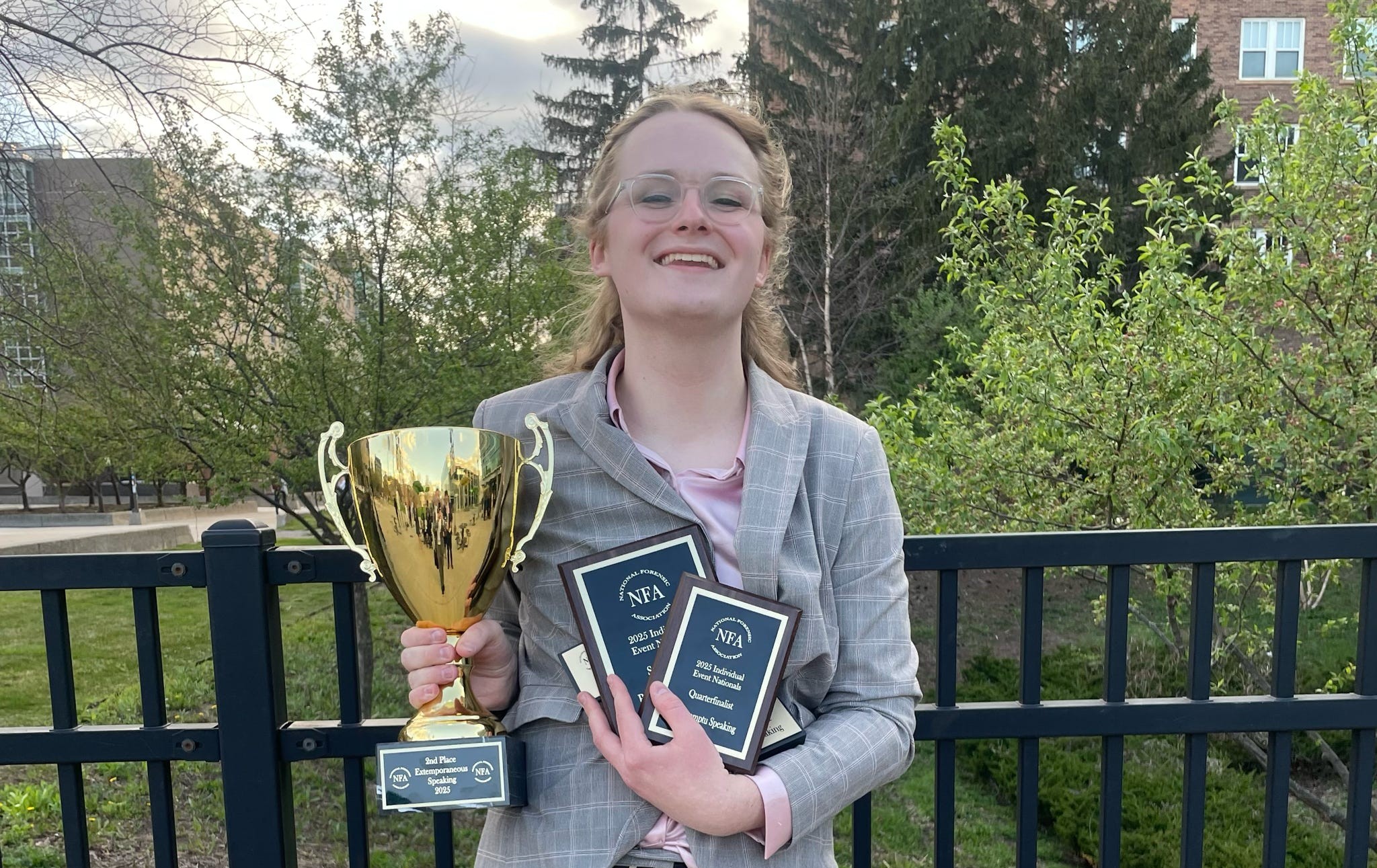
Theatre had been her first love, but as Clemen immersed herself in collegiate forensics, something shifted. Speech transformed from just performance into a way of thinking and being, an intellectual home that blended communication, identity and advocacy. By the spring of their sophomore year, Clemen officially added a second major in communication studies.
“I realized I wanted to focus more on speech and forensics, and that blossomed into a love of communication studies.”
For Clemen, the power of voice was not only a tool for the podium or stage but a lens for understanding the world.
An honors microphone
The resonance of voice is at the heart of Clemen’s UW-Eau Claire story — but, in her account, the Mark Stephen Cosby Honors College was a vocal amplifier.
Clemen recalls how their honors journey felt personal, molded to their own experiences and interests, which was not always the case in other areas of her academic life.
“I feel like honors adapted to me. As a double major, it was hard to take colloquia all the time, but honors gave me the experiences that were personal to my path.”
One of those experiences was tutoring in HNRS 420. Clemen received the opportunity to tutor for forensics events alongside Chris Outzen, teaching professor and director of forensics. It marked a turning point: her first taste of coaching, mentoring and guiding others through the craft she loved.
“That experience was super tailored to me. Now, I’m writing my thesis about it, about peer mentoring, about forensics, about how those experiences shaped the way I think about communication.”
When asked to offer a piece of advice to future honors students, Clemen spoke thoughtfully about the “personalization” the honors college offers at UW-Eau Claire.
“Honors has so much to offer everyone. There are so many branches, so many ways to make the honors experience here tailored to you and unique to you, so many ways to make the experience your own.”
Turning up the volume
Clemen insists, however, that their honors experience is not marked by courses or requirements but by the people who shaped their experience.
“It’s the little interactions,” they say. “Meeting with Sean while preparing for grad school applications, or talking with students I tutored in HNRS 156 (Story-Telling: Communicating Literature through Performance). Those small moments of connection are what I remember the most.”
That sense of community expanded well beyond honors for Clemen. Since her sophomore year, Clemen has been a member of Women Uniting and Fighting, an organizing space for marginalized students and a hub of activism for issues like freedom of choice and reproductive rights on campus. Clemen also immersed herself in other communities: singing in UW-Eau Claire’s Concert Choir, serving as an orientation assistant and performing in Cabaret Productions, the campus’ student-led show choir and theatrical performance group.
But Clemen is no stranger to academic extracurriculars, either. Their current research project is a two-year collaboration between sociology and race, ethnicity, gender and sexuality studies, examining the fallout of the 2024 hospital closures in the Eau Claire and Chippewa Falls communities.
“We’re interviewing healthcare leaders about what the community has done well, where we’ve faltered and what needs to be done moving forward. It’s about healthcare access and equity: ensuring people still have care after something so devastating.”
She presented that work at UW-Madison’s Women’s Gender Studies Consortium Conference and will again at the Provost’s Honors Symposium during this year's Celebration of Excellence in Research and Creative Activity or CERCA.