ID
Authored on
New artificial intelligence majors bring excitement, innovation to UW-Eau Claire
Published on:
Intro text

Following a successful first semester of classes, new artificial intelligence majors at the University of Wisconsin-Eau Claire continue to take shape and position students for promising futures. As the only Universities of Wisconsin school currently offering bachelor of arts and bachelor of science programs in AI, Blugolds are enjoying unmatched classroom and research experiences.

Sections

There are currently 13 students pursuing the majors within the computer science department, says Dr. Mary Hoffman, interim provost and vice chancellor for academic affairs. Nine of those students are pursuing a comprehensive major, which requires 60 credits compared to the standard 36.

“That’s a pretty solid enrollment for a new program,” Hoffman says. “It will be even more exciting as the students get further along and we see what kind of research they’re going to work on and what internship opportunities they might have.”

Mary Hoffman
Dr. Mary Hoffman, interim provost and vice chancellor for academic affairs

Fourteen more students are pursuing either a minor or certificate in AI. UW-Eau Claire, which announced the majors in February 2025, estimates that 165 students will be working toward degrees by the end of the fifth year, with 70 students graduating from the program.

13 students with 13 stories

Landon Dierkes checked his mailbox every day for a month waiting for a response.

The Lake Mills native had applied for a summer research opportunity through UW-Eau Claire’s Research Experiences for Undergraduates program and was anxiously awaiting a decision from its director, Dr. Rahul Gomes.

Dierkes was beginning to think his summer would be spent working at his local McDonald’s when he received an email response from Gomes, who also serves as associate professor and chair of the computer science department, asking to set up an interview.

“I don't know what else I would be doing right now if I didn't do that,” Dierkes says.

A day later, his plans for the summer, and for the next three years, changed with an official invitation to join the 10-student research group.

Landon Dierkes Artificial Intelligence major
Landon Dierkes, artificial intelligence major

Dierkes’ original plan after high school was two years of community college, then to follow in his father’s footsteps and attend UW-Whitewater to study computer science. But the research experience inspired him to walk a different direction, back to Eau Claire, to pursue a major in AI and research pancreatic cancer detection using AI algorithms.

“REU, that kind of changed my path. Artificial intelligence is really cool,” says Dierkes, a junior. “There’s a lot of things we don’t know about it yet, a lot of things that can be improved upon.”

In early 2025, Aiden Wisch was grinding his way through community college near his hometown of Roscoe, Illinois, when his mother sent him a Facebook message.

It contained a link to UW-Eau Claire’s announcement of the AI majors, which aligned with Wisch’s computer science interests.

“Why don’t I go for this? I don’t think it’s going to leave anytime soon,” he remembers thinking. “I thought it was a great idea. I jumped on board.”

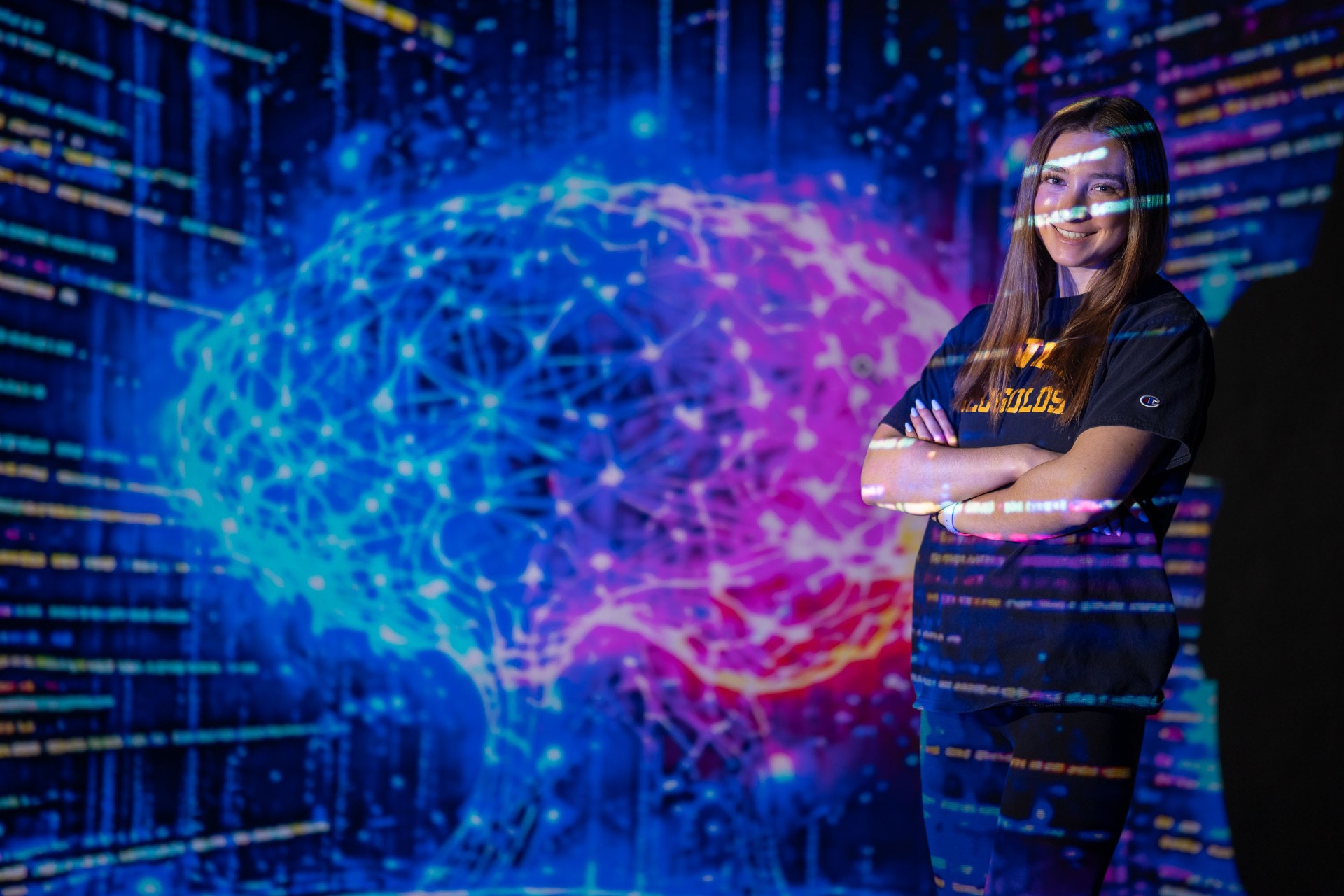
Aiden Wisch picture
Aiden Wisch, artificial intelligence major

The timing was ideal for the sophomore, who moved straight into his comprehensive major studies last fall. In his AI foundations course with Dr. Benjamin Fine, associate professor of computer science, Wisch gained hands-on ethics experience through a case study and conducted a data science course using Python to predict who would win the Formula 1 championship.

Another sophomore, Mykle Buhrow, chose UW-Eau Claire for the immediate opportunity to conduct research within the Biomedical Innovator Scholars program. She learned about the AI major through Dr. Alex Smith, professor emeritus of mathematics and the lead designer of the new program, prompting Buhrow to pursue double majors in AI and computer science.

Buhrow is now a research assistant with Gomes, working to improve AI detection of inferior vena cava filters in CT scans. She will accompany Gomes to the February Universities of Wisconsin Board of Regents meeting to discuss AI research at UW-Eau Claire.

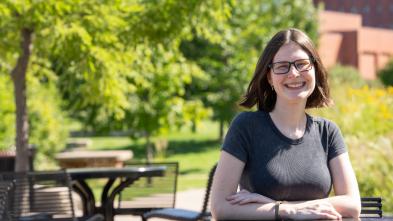
Mykle Buhrow
Mykle Buhrow, pursuing double major in artificial intelligence and computer science

“It would be really cool to use AI to help in the healthcare field somehow,” Buhrow says. “With how much AI has changed in the past four years, I cannot even imagine when it’s time for me to look for a job what could be out there.”

Buhrow and her classmates share a desire to be on the “front end” of AI and are showing it to Gomes by seeking out advanced experiences outside the classroom.

“They are not waiting for content to come to them,” Gomes says, “but instead stepping into open-ended, research-driven challenges that mirror current industry and research practice.”

Rahul Gomes
Dr. Rahul Gomes, associate professor and chair of the computer science department

Excited to be part of the process

The new programs are being taught by existing faculty in computer science, but they’re working directly with students to fine-tune the curriculum. Dr. Emily Hastings, assistant professor of computer science, says daily reflection assignments in her courses allow students to share what they found interesting and raise questions. The responses have helped shape some of the topics she covers in the course AI 350: Human-Computer Interaction.

Professional portrait of Emily Hastings
Dr. Emily Hastings, assistant professor of computer science
Benjamin Fine
Dr. Benjamin Fine, associate professor of computer science

Fine adds that students have helped identify where expectations were unclear or where prerequisites needed better reinforcement. Their feedback has also resulted in more emphasis on applied work using real tools and real constraints in coursework.

Gomes says conversations with students have made it clear that generative AI, natural language processing and hands-on interaction with large language models are now essential skills instead of optional add-ons. A new course called AI 427: Natural Language Processing and Generative AI will be available for the 2026-27 academic year.

“Student feedback and research collaboration has helped shift the AI major from a traditional model-centric curriculum toward one that better reflects how AI is actually being built and used today,” Gomes says.

“It’s cool that I’m helping to shape the major as it continues in the future,” Buhrow adds.

Wisch has been inspired to pursue his own AI interests through coursework and research opportunities. He’s also helped professors in outside departments address AI-related questions and issues, such as AI-generated essays.

“Building a connection with the professors is great,” Wisch says. “I think that’s what a lot of students need to focus on.”

Doing so helped shape Dierkes’ path, one that he hopes will lead to a fulfilling career in the medical field.

“I’m really excited and looking forward to the next three semesters,” he says. “We’re on the cutting edge of AI and the future. I’m really glad to be a part of that.”

Visit the AI majors program page.

For the media
For the media
Image download