ID
Story Categories
Authored on
Megan Eilers: Growing into green
Published on:
Intro text

Megan Eilers found her academic home at the University of Wisconsin-Eau Claire, where honors courses and a research community helped her grow from a reserved student into a confident leader. Inspired by her camp experiences and her therapy dog, Koda, she’s now off to study law, but she's still focused on justice, empathy and pro bono service.

Sections

In March of her high school senior year, when Eilers first toured UW-Eau Claire, she knew she had found the right place. The Bettendorf, Iowa, native was drawn to the university's strong undergraduate research opportunities, its unique partnership with Mayo Clinic and the welcoming community of the Mark Stephen Cosby Honors College.

“I loved learning about undergraduate research,” Eilers recalls. “Originally, I wanted to be pre-med, and Eau Claire was one of only two schools in the country working with Mayo at the time. That really stood out.”

Her decision was reinforced during Admitted Students Day when she connected with faculty members like Dr. Julie Anderson, professor of biology and director of the Health Careers Center, and Dr. Heather Fielding, professor of English and director of the Mark Stephen Cosby Honors College. The latter, Eilers remembers, sparked a conversation about a favorite book, "The Great Gatsby." More than a visit day, and not so unlike Gatsby’s iconic green light, Eilers found her place and her people upon joining blue and gold.

True colors

Though she initially considered education as a profession, Eilers discovered her passion for biochemistry during her junior year of high school. At UW-Eau Claire, she paired her biochemistry/molecular biology major with a minor in criminal justice equity and inclusivity.

“I’ve always been super into criminal justice. It probably started when I was four or five, watching 'Sunday Night Mysteries' on TV.”

Those childhood interests deepened in high school anatomy and physiology class, where exposure to autopsy images sparked a fascination with forensic science. Now, that passion has evolved into environmental toxic tort law, a field that bridges her scientific training with her commitment to justice.

For Eilers, the honors college has been similarly transformative, a space where seemingly disparate interests combine. The college’s discussion-based courses, she says, helped her reimagine a lifelong speech disorder and find her voice.

“In high school, I wouldn’t talk for hours at a time,” she admits. “Honors gave me a safe environment to speak up. It’s definitely improved my confidence.”

Living in the Honors Living Learning Community (LLC) her first year provided a groundwork for friendship and memorable experiences. From late-night camaraderie to end-of-year picnics to a sushi card game extravaganza, time among other intellectually curious honors students sparked lasting connections.

But one of her most impactful academic experiences came in Dr. Mel Kantor’s epidemiology course, where she can still pinpoint her exact seat.

“That was the first class were I really started talking. The environment made me feel comfortable.”

Curiosity for justice

Since the fall of her junior year, Eilers has worked with Dr. Amber Wilson and Dr. Mia Kelly, assistant professors in the political science and criminal justice department. Together, they’ve embarked on a project examining sexual victimization in prisons, comparing media portrayals, such as in the hit show "Orange is the New Black," with data collected under the Prison Rape Elimination Act of 2003.

So far, Eilers has contributed to their literature review and coding work and hopes to see the team’s findings published in the near future. With Eilers as one of the student leaders, that work is about uncovering how stigma and silence shape reports of violence, especially in men’s prisons.

Eilers’ leadership extends to extracurriculars, too, and it might be felt most keenly in the Cosby Honors College. Eilers has served as a mentor in a program called Honors Helping Honors for two years, guiding peers through their honors journeys; and she has held both director and co-director positions of community building in Honors Student Council. With a couple of other honors students, Eilers also participates in the Lutheran Student Association, adding another layer of community involvement to her college experience.

“Working with people from different backgrounds is something I already valued, but honors really reinforced it.”

Lessons in color

Eilers’ growth at UW-Eau Claire isn’t entirely owed to honors, she says; it started much earlier, built on lessons learned long before college. She spent 13 summers at the YMCA's Camp Abe Lincoln in Iowa, first as a camper, then as a volunteer and eventually as a counselor. She details how her camp friends would do personality tests and joke about “bright yellow” and “baby blue” personalities. The first is outgoing and bubbly, the second calm and soft.

“At camp, I never had a shell,” Eilers explains. “It was the one place I could be bright yellow. Everywhere else I was baby blue, quiet and reserved.”

Working with children from diverse backgrounds, including those with disabilities and those facing food insecurity, taught Eilers resilience, empathy and the importance of inclusive spaces. One camper left a lasting impression: After a summer at camp, he went from failing every class to earning straight As. She still remembers how his dad beamed.

“It was a camp for all,” she says. “That’s something I carry with me.”

Guiding light from Koda

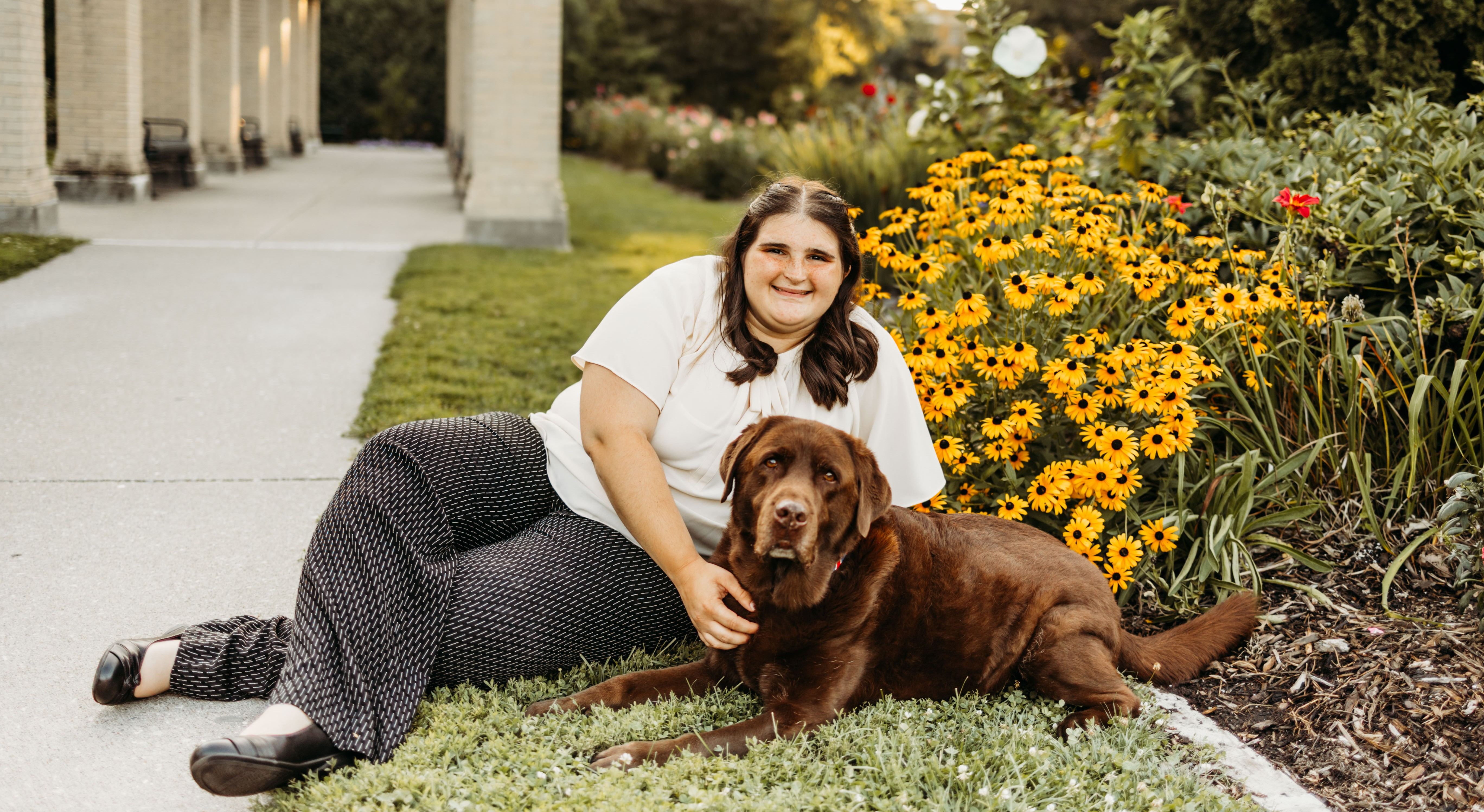
For Eilers, inspiration and courage often come from her loyal companion, Koda. Trained as a therapy dog when Eilers was just 10, Koda accompanied her on visits with college students, quietly sitting by their side as they studied or unwound, bringing comfort just with his presence.

For Eilers, Koda embodies the courageous, empathetic support she hopes to provide to others.

“He’s always ready to greet people and make new friends,” she says. “Even now, at 12 years old, he still loves meeting new people. He’s kind of my role model.”

Yellow into green

Eilers has big plans after her December graduation: she’ll be attending the University of Iowa College of Law, following in the footsteps of her aunt, a program alumna.

Eilers’ interests span environmental law, toxic tort law and civil rights law, but she’s particularly drawn to toxic tort cases, which involve harmful chemicals or medicines that negatively impact people’s health.

“But I’m interested in the pro bono side, taking cases for people who might not otherwise have access to the legal system,” she explains.

Pro bono work is central to Eilers’ vision for her career. She hopes to join one of the clinics in Iowa where law students act as teams of attorneys under faculty supervision, providing free legal services to community members. She draws inspiration from a historic Davenport, Iowa, law firm, founded in the 1880s, that emphasizes pro bono work and community involvement.

“Almost all of their lawyers serve on school boards or community organizations,” Eilers says. “That’s the kind of environment I want to be a part of.”

Three years of law school, internships and the bar exam all await Eilers in the near future, but she’s excited for the journey. After all of her shell-shedding experiences at UW-Eau Claire, she’s looking to even greener pastures — part bright yellow, part baby blue.


Written by Zoe Eineichner, a third-year junior at UW-Eau Claire double majoring in psychology and organizational communication and pursuing a graduate degree in industrial-organizational psychology. Her hometown is Mukwonago.

For the media
For the media
Image download