Always stretching her skills to get more opportunities
The path to “hired before graduation” for Meudt required more than being a standout student in a tough program — it required that she look for opportunities to grow her skills and prove her abilities.
And she did that in spades, seeking work with the DOT not once, not twice, but three times in her final year of school.
After learning about a spring 2024 internship opening with the department, she just kept opening more doors to learn and eventually find her career path.
“One of my professors, Dr. Matt Jewell, told me about the first internship,” Meudt says. “From there I continued with the DOT in a summer internship testing construction aggregate, and I’ve worked there this fall as well. I’ve also been given access to their lab for my capstone course experiments, which has been amazing.”
Capping off her comprehensive degree
Capstone courses at UW-Eau Claire are a way for seniors to actively apply all they have learned in a project of their choosing, which can be individual or with a partner. Given all the unique experiences Meudt gained doing materials inspection and testing with the DOT, she elected to create a project that fine-tuned those skills and offered useful information to the agency.
Jewell, professor and chair of the materials science and biomedical engineering department, was impressed with the initiative Meudt took in designing her capstone, one he believes will deliver novel analysis tools for future use in the DOT.
“What is unique about Lauren's project is that she came up with this idea on her own while working at the DOT's materials lab,” Jewell says. “Lauren not only had to design and carry out the project but also present it to her managers and explain the value to their operation.”
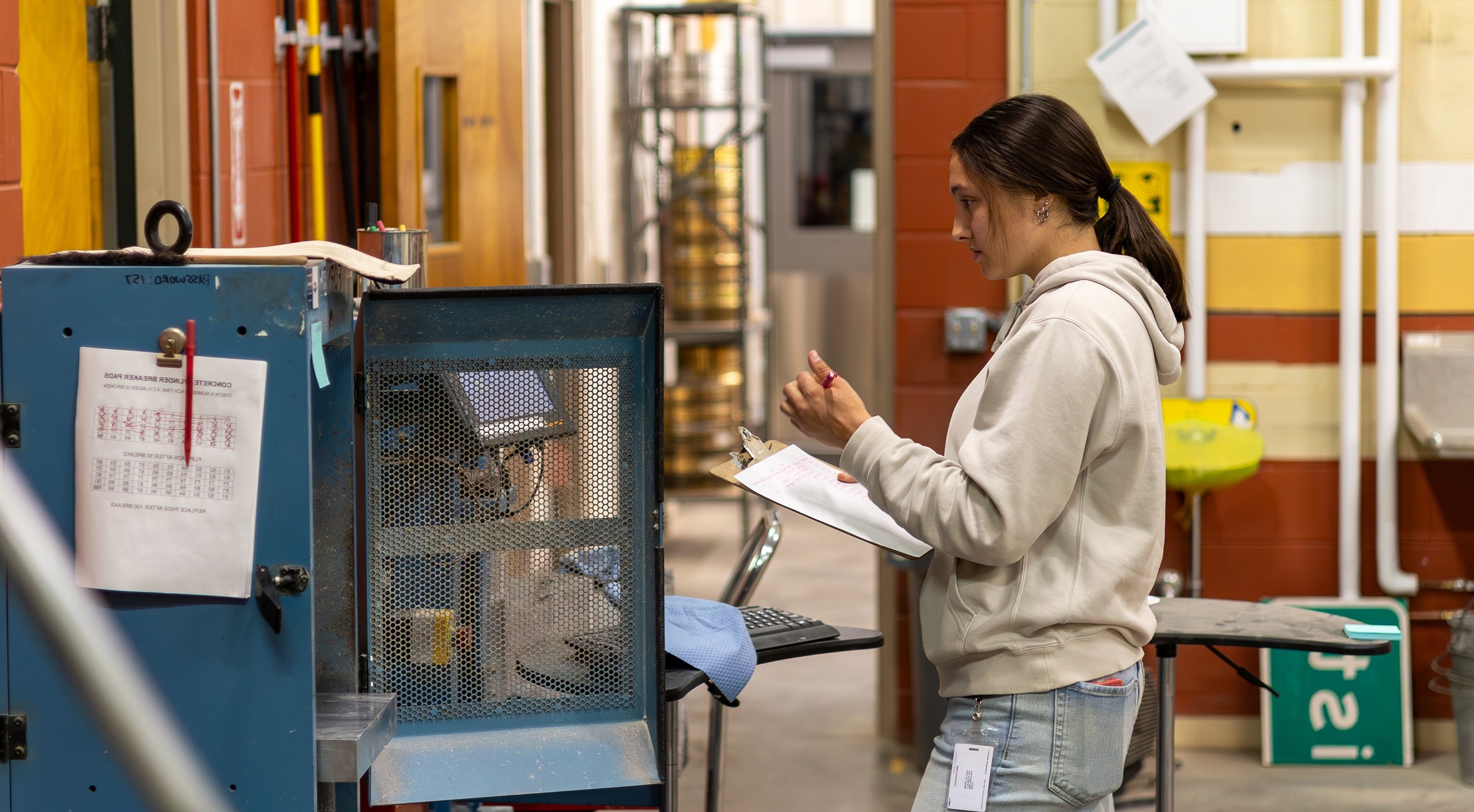
The project does extensive stress analysis on test cylinders the department uses in road construction, 6-by-12-inch samples of actual concrete mixes in use or in planned use. Meudt’s idea was to use extreme high- and low-temperature conditions to see how the material’s strength changes when subjected to large temperature swings.
“The ovens and cold tanks are some of the equipment I’d been trained to use, and this seemed like an excellent way to simulate the extremes of weather in our region and see how our road mixes hold up during the 28-day curing process,” Meudt says.
Jewell adds that Meudt’s materials knowledge will prove a useful addition to the state unit that consists largely of civil engineering experts.
“Lauren’s capstone experiments complemented the expertise already in the lab and allowed them to develop this new testing capability at minimal cost,” Jewell says. “Her approach will allow the DOT to better understand how concrete pouring operations impact the lifetime of the concrete, through Wisconsin's hot summers and cold winters.”
According to Meudt’s DOT supervisor, Wendy Maves, in the Eau Claire location, Jewell’s prediction is already proving correct.
“I had an idea for a capstone for Lauren, but the project she came up with was better, not only because it was of particular interest to her — I was impressed with the thought that went into her proposal,” Maves says.
“Lauren has already been an asset to the northwest region materials team and is a pleasure to work with.”
Advice to future MSE students
Lauren came into the materials science and engineering program as a transfer with a big change of major from accounting, yet she is graduating early, so she seems an obvious choice to tap for advice to students interested in this major.
Her answer was a simple one, rooted in the overall program design and small class sizes.
“The great thing about our department and this major is that you move through with a small cohort of students on the same path together,” Meudt says. “These groups of students become very close, socially as well as academically.”
Meudt points to the strength of these relationships as key to everyone getting the most out of the program.
“I truly learned the most when our group was working together, hashing things out and building our understanding off each other. Materials studies are complex; it often takes a variety of approaches to get at all the nuances. In our cohort, we each had different strengths and that allowed us to grow to better overall understanding, together.”
Top image photo credit: Lauren Meudt, volunteer student photo staff, Blugold athletics